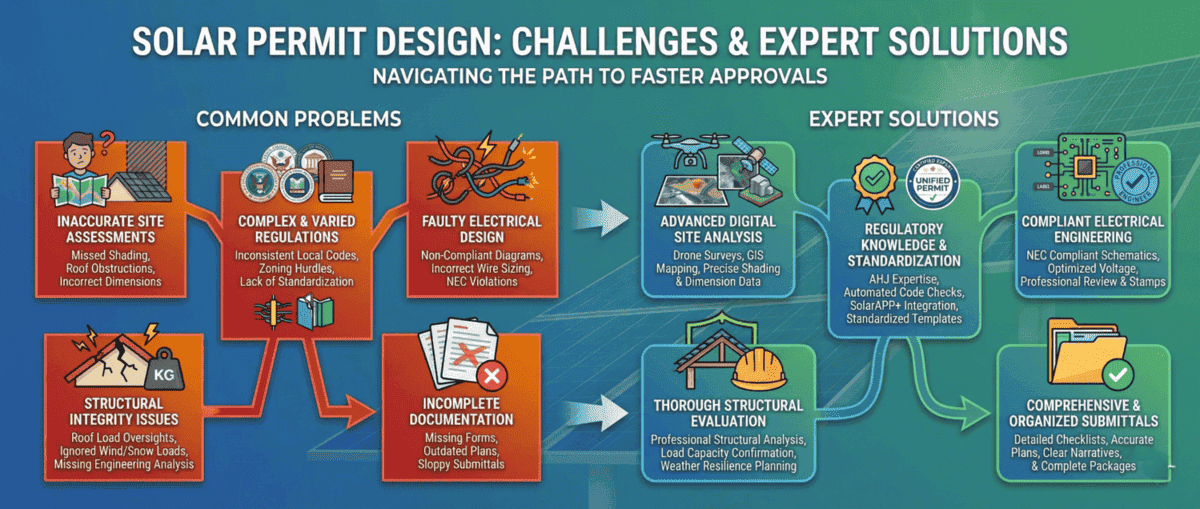
Solar permit design challenges are the leading cause of project delays in solar installations, with common issues including jurisdiction-specific regulations, structural calculation errors, incomplete documentation, electrical configuration complexities, fire safety non-compliance, revision management, and stakeholder coordination problems.
Quick Answer: Top 7 Solar Permit Design Challenges
Solar professionals face these critical permit design obstacles:
- Local regulation variations – Each AHJ maintains unique requirements
- Structural calculation accuracy – Load-bearing assessments must be precise
- Electrical system complexity – Integration with existing infrastructure is intricate
- Documentation gaps – Missing paperwork causes approval delays
- Fire safety compliance – Emergency access and code adherence are mandatory
- Revision cycles – Resubmissions consume time and resources
- Multi-party coordination – Managing stakeholders creates logistical challenges
Why solar permits get rejected: The most frequent rejection reasons include inaccurate structural calculations (45% of cases), incomplete documentation (30%), fire code violations (15%), and electrical design errors (10%).
Average approval timeline: Solar permit processing ranges from 2-3 days with automated systems to 3-8 weeks in high-volume jurisdictions, depending on submission quality and local workload.
Solution: Implementing thorough pre-submission review processes, utilizing advanced design software for calculations, maintaining comprehensive documentation checklists, and establishing direct communication with AHJ officials reduces rejection rates by up to 85% and accelerates approval timelines by 40-60%.
These are the primary permit design hurdles and effective approaches to address them.
1. Understanding Jurisdiction-Specific Requirements
The Problem: Each authority having jurisdiction maintains unique regulatory standards and specifications for solar system installations. Tracking these diverse requirements across different locations presents significant difficulties.
The Action Plan: Maintain current knowledge of municipal codes and establish direct communication with AHJ representatives to clarify their particular specifications. Professional permit design services ensure all documentation aligns with jurisdiction-specific regulations, achieving exceptional approval success rates. According to SolSmart’s permitting guidelines, streamlined processes and clear communication with local authorities are essential for successful project completion.
2. Precise Load-Bearing Assessments
The Problem: Verifying that rooftop or ground-mounted structures possess adequate capacity to handle solar panel weight is essential. Flawed assessments result in structural integrity concerns and application denials.
The Action Plan: Employ sophisticated engineering software to conduct accurate load-bearing evaluations. Professional teams deliver comprehensive structural analysis with Professional Engineer certification to validate design safety compliance. The National Renewable Energy Laboratory provides resources on proper structural assessment methodologies for solar installations.
3. Intricate Electrical System Design
The Problem: Creating an optimized and compliant electrical layout that properly integrates with current electrical infrastructure requires technical expertise.
The Action Plan: Develop comprehensive electrical schematics showing wire routing, inverter positioning, and protective equipment. Experienced designers produce thoroughly documented electrical plans that eliminate approval complications and accelerate processing. Understanding electrical fundamentals from IEEE is crucial for creating code-compliant designs.
Solar Permit Solutions
Skip the Permit Headaches
We design plan sets that pass inspection the first time. Code-compliant, PE-stamped, accepted by AHJs nationwide.
4. Incomplete Application Materials
The Problem: Absent or contradictory paperwork creates processing bottlenecks and generates unnecessary delays.
The Action Plan: Develop a verification checklist covering all mandatory submissions and verify each document’s completeness and accuracy. Complete permit packages incorporate every required element, eliminating documentation gaps. Professional permit expediting services can help ensure all materials are properly prepared and submitted.
5. Fire Code Compliance Requirements
The Problem: Meeting fire protection standards is mandatory, and insufficient compliance leads to application rejection.
The Action Plan: Engineer systems incorporating adequate emergency access routes and implement all mandated safety protocols. Detailed fire safety documentation that satisfies local fire marshal requirements prevents approval setbacks. Green Building Advisor offers guidance on integrating fire safety requirements into solar designs.
6. Managing Application Updates and Refilings
The Problem: Revision cycles and resubmission requirements consume valuable time and resources without proper management.
The Action Plan: Establish thorough quality control procedures to identify potential concerns before initial filing. Skilled teams respond efficiently to inspector feedback and execute required modifications for prompt resubmission and clearance. Whether you’re working on residential solar design or commercial solar projects, proper quality control minimizes revision cycles. Large-scale projects like California’s massive solar farms demonstrate the importance of thorough planning.
7. Multi-Party Project Coordination
The Problem: Managing interactions among property owners, installation crews, engineering consultants, and municipal officials creates logistical complexity.
The Action Plan: Create defined communication protocols and project oversight systems that maintain stakeholder awareness and agreement. Solar Permit Solutions provides professional coordination services to ensure all participants remain synchronized throughout project development. The International Energy Agency highlights the importance of effective stakeholder coordination in successful renewable energy deployments.
Conclusion
Successfully navigating solar permit design challenges requires a combination of technical expertise, regulatory knowledge, and strategic planning. While obstacles such as jurisdiction-specific requirements, structural calculations, electrical configurations, and fire safety compliance can seem daunting, understanding how to address each challenge systematically makes the approval process significantly more manageable. By staying informed about local codes, utilizing advanced design tools, maintaining thorough documentation, and establishing clear communication with all stakeholders, solar professionals can dramatically reduce permit delays and rejection rates.
The key to overcoming these common permit design challenges lies in preparation and attention to detail. Whether you’re dealing with complex electrical layouts or coordinating multiple parties, implementing proven solutions and best practices ensures your projects move forward efficiently. From off-grid solar system design to large-scale installations, remember that each successfully approved permit not only accelerates your current installation timeline but also builds valuable experience and relationships with local authorities that benefit future projects. Organizations like Vote Solar advocate for policies that streamline permitting processes nationwide. Investing time and resources into getting permit designs right the first time ultimately saves money, strengthens client relationships, and contributes to the continued growth of the solar industry. The World Bank’s energy initiatives demonstrate the global commitment to expanding renewable energy access through improved regulatory frameworks.
FAQs
Skip the Permit Headaches
We design plan sets that pass inspection the first time. Code-compliant, PE-stamped, accepted by AHJs nationwide.
Frequently Asked Questions
The primary reasons for solar permit rejections include inaccurate structural calculations that fail to demonstrate adequate load-bearing capacity, incomplete or missing documentation, non-compliance with local fire safety codes, electrical design errors that don't meet National Electrical Code (NEC) standards, and failure to adhere to jurisdiction-specific zoning requirements. Additionally, inconsistent information across different submission documents or outdated permit forms can trigger rejections. Ensuring comprehensive documentation review and verification before submission significantly reduces rejection risks. Whether you're working in Houston or Los Angeles, understanding local requirements is essential.
Solar permit approval timelines vary considerably depending on the jurisdiction and project complexity. The process can range from as quick as a few days in areas with streamlined automated systems like SolarAPP+ to several weeks or even months in jurisdictions with high application volumes or manual review processes. Factors affecting the timeline include the completeness of your initial submission, the AHJ's current workload, whether revisions are required, and the complexity of your installation. Working with experienced permit designers and submitting thorough, accurate applications the first time helps expedite approval.
PE stamp requirements depend on your specific jurisdiction and project characteristics. Many AHJs require Professional Engineer certification for structural calculations, particularly for ground-mounted systems, commercial installations, or residential projects involving older buildings or complex roof structures. Some jurisdictions also mandate PE stamps for electrical designs exceeding certain system sizes. Additionally, projects in high-wind or high-snow load areas typically require stamped structural engineering documents. Check with your local AHJ early in the design process to determine if PE certification is necessary for your specific project.
Staying current with evolving permit requirements involves several strategies. Regularly visit your local AHJ's website and subscribe to any available updates or newsletters. Establish direct relationships with building department officials and attend pre-application meetings when possible. Join local solar industry associations and participate in contractor workshops where regulatory changes are discussed. Utilize professional permit design services that maintain updated databases of jurisdiction-specific requirements across multiple areas. Additionally, review the Solar Energy Industries Association (SEIA) resources and state-specific solar databases for broader regulatory changes that may impact local requirements.
A complete solar permit application generally includes several essential documents. These typically consist of a detailed site plan showing the solar array location, property boundaries, and setbacks; electrical single-line and three-line diagrams illustrating system configuration and connections; structural calculations demonstrating roof load capacity; equipment specification sheets for all major components (panels, inverters, racking); fire safety plans showing emergency access pathways and setback compliance; interconnection agreement or utility approval documentation; and completed jurisdiction-specific application forms. Some AHJs may also require additional items such as homeowner association approval letters, environmental impact assessments, or photographic documentation of existing conditions. Always verify specific requirements with your local permitting authority before submission.

SPS Editorial Team
Solar Permit Solutions
Solar Permit Solutions provides professional solar permit design services for residential, commercial, and off-grid installations across all 50 states. Our team ensures permit-ready plan sets delivered fast.
Related Articles
Off-Grid Solar System Requirements: Sizing, Permits & NEC Code Guide
Off-grid solar permit requirements by state: building codes, NEC compliance, bat...
Solar Battery Permit: What Most Installers Get Wrong
Quick Answer: Adding battery storage to a solar system almost always requires ne...
Solar Battery Tax Credit 2026: What Homeowners and Contractors Need to Know
There is no federal solar battery tax credit available to homeowners in 2026. Th...