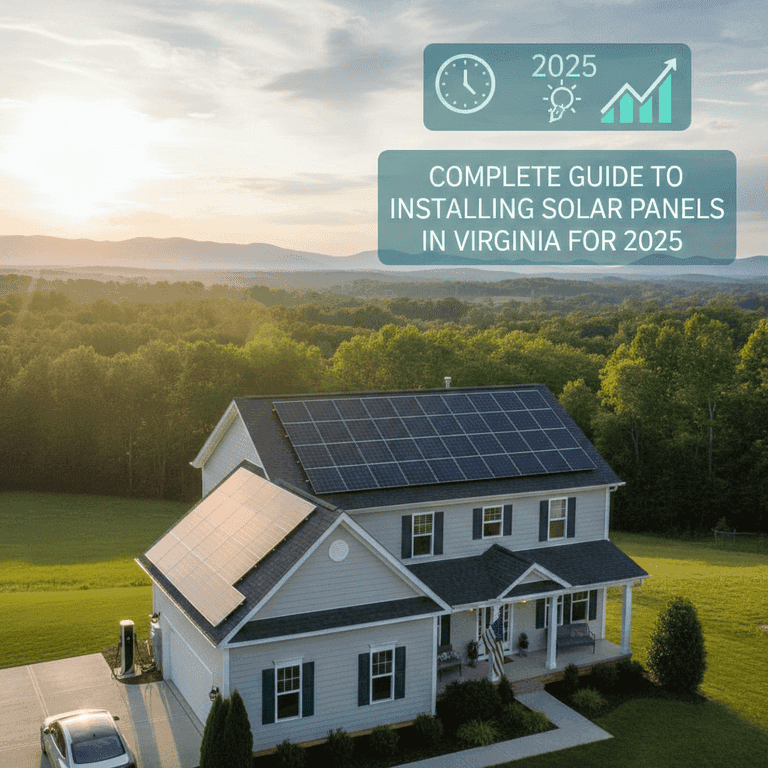
Virginia solar panel installation costs $3-$5 per watt for residential systems and $2-$3 per watt for commercial properties. The average Virginia homeowner investing in a 10 kW system pays $40,080 upfront ($28,056 after the 30% federal tax credit), with a 16-year payback period and 9.55% ROI. Virginia ranks 9th nationally for solar potential with 4.2-4.5 peak sun hours daily.
What You Need to Know About Virginia Solar in 2025
Installing solar panels in Virginia offers significant financial advantages in 2025. Virginia’s commitment to 100% renewable energy by 2050, combined with the 32nd highest electricity rates in the U.S., creates strong conditions for solar investment returns. Learn more about federal solar initiatives from the Department of Energy.
Key Virginia Solar Statistics:
- State Ranking: 9th best solar state (SEIA)
- Installed Capacity: 4,286 MW powering 476,108 homes
- Daily Sun Exposure: 4.2-4.5 peak sun hours
- Residential ROI: 9.55% (16-year payback)
- Commercial ROI: 11.98% (12.63-year payback)
- Federal Tax Credit: 30% of total system cost
- System Lifespan: 25-30 years with warranty
Available 2025 Incentives:
- 30% Federal Solar Tax Credit (up to 70% for qualifying commercial projects)
- Solar Renewable Energy Credits (SRECs) at $35 per 1,000 kWh generated
- USDA REAP Grants covering up to 50% of project costs for farms and rural businesses
- Accelerated depreciation (60% in year one for businesses)
- Net metering credits (changing in 2025-2026, act now to grandfather current rates)
Installation Timeline: Residential solar installations take 3-7 days to complete. Commercial and agricultural systems require several weeks to months for design, permitting, and installation.
This comprehensive guide covers everything Virginia homeowners, businesses, and farmers need to know about solar panel installation, including step-by-step procedures, detailed cost breakdowns, financing options, incentive programs, installer selection criteria, and answers to common solar questions. Whether you’re looking to reduce electricity bills, lower tax obligations, or invest in renewable energy, this guide provides actionable information for making informed solar decisions in Virginia.

Should You Install Solar in Virginia?
Virginia offers substantial solar potential thanks to abundant sunshine and attractive financial incentives.
SEIA’s U.S. Solar Market Insight Report positions Virginia as the ninth-strongest solar market nationwide. The state currently hosts 4,286 MW of installed solar capacity, enough to power 476,108 residential properties.
Rising electricity costs, decreasing installation expenses, and robust incentive programs make solar a sound financial decision for Virginia’s commercial operators, agricultural businesses, and homeowners.
Virginia receives 4.2 – 4.5 peak sun hours daily on average. Florida, known for sunshine, receives 4.5 hours for context. Combined with the 32nd highest electricity rates nationally, Virginia properties can realize significant benefits from solar investments. Understanding how much a home solar system costs helps you budget effectively.
Starting Your Solar Energy Journey in Virginia
Beginning your solar transition may feel complex initially. Follow these guidelines to move forward confidently. Arlington County residents can access additional local solar resources.
Virginia Solar Installation Process
Complete these essential steps for your Virginia solar installation:
Step one: Schedule an on-site evaluation with a qualified solar installer. This assessment determines solar viability for your property. Installers examine roof suitability based on direction, shade exposure, and structural integrity. For properties unsuitable for rooftop systems or those preferring ground installations, professionals identify optimal ground-mount locations. Site evaluations address your questions and identify the most cost-effective panel placement.
Pro tip: Companies unwilling to conduct property visits may not meet quality standards, consider alternative providers.
Step two: Choose your installation partner after deciding to proceed. Select a reputable company to handle system design, permitting, grant applications, installation work, and ongoing maintenance. Learn more about what happens if you install solar panels without a permit before starting your project.
Step three: Your installer initiates design work and schedules installation once selected. Typical residential projects require several days to one week. Falls Church residents should review local guidelines before installation begins. Understanding solar PV construction codes and permitting requirements ensures compliance. Larger commercial and agricultural systems need several weeks to months for design, permitting, and installation completion.
Step four: Activation day arrives. Your system goes live and begins generating savings immediately.

Virginia Solar Panel Installation Costs
Installation costs vary based on multiple factors: system capacity, installation type, location, equipment selection, and utility connection requirements.
Virginia homeowners partnering with reputable installers should budget $3 to $5 per watt. Properties with average monthly bills of $120 typically invest approximately $40,080 initially, reducing to $28,056 net cost after applying the 30% federal tax credit.
Virginia commercial properties and farms should plan for $2 to $3 per watt. Businesses with $1,200 monthly electricity expenses face initial costs around $273,300. Tax benefits reduce net investment to $126,845. Commercial solar design services can optimize your system layout and maximize returns.
Solar Permit Solutions
Need Solar Permit Plans?
Professional, permit-ready solar plan sets delivered fast. Residential and commercial projects across all 50 states.
Financing Your Virginia Solar Installation
Virginia offers multiple payment options for solar systems.
Direct purchase through cash or financing delivers optimal returns in most scenarios. You capture all incentives (tax credits, SRECs, and utility savings) while owning a value-generating asset. Understanding Virginia building permit requirements helps streamline your project timeline.
Third-party arrangements like solar leases and power purchase agreements (PPAs) eliminate or minimize upfront expenses in exchange for monthly payments. Third parties maintain system ownership and collect available incentives with these options.
2025 Virginia Solar Incentives
Virginia property owners and businesses access numerous incentives making solar investments more accessible and financially beneficial. Tax credits, depreciation advantages, SREC earnings, and substantial USDA REAP grants collectively reduce solar transition costs. Review these key programs and their advantages.
Federal Solar Tax Credit
The 30% federal tax credit provides significant tax reduction opportunities for Virginia homeowners and commercial entities.
Homeowners receive a straightforward 30% credit. Business applications involve additional complexity.
Commercial tax credits begin at 30% for systems under 1 MW AC, potentially reaching 60% when meeting three separate 10% adder requirements. Systems exceeding 1 MW AC start at 6% and may increase to 70% when satisfying conditions regarding prevailing wages, domestic content, and location specifications.
Business Depreciation Benefits
Business solar investments qualify for depreciation benefits that substantially enhance financial returns. Accelerate 60% of federal depreciation into year one for major upfront tax advantages. Spread the remaining 40% and state-level depreciation across five years following the Modified Accelerated Cost Recovery System (MACRS) schedule.
Solar Renewable Energy Credits (SRECs)
SRECs deliver ongoing financial returns for residential and commercial solar projects. Earn one SREC for every 1,000 kilowatt-hours (kWh) your system generates. As of May 2024, Virginia SRECs traded at $35 each, though rates fluctuate with market conditions and demand. This continuous revenue stream adds considerable long-term value.
USDA REAP Grant
Virginia agricultural operations and eligible businesses can leverage USDA REAP Grants to dramatically reduce installation costs. This grant program, available through 2027, covers up to 50% of total project costs. The application process requires significant time and faces intense competition, often extending over one year from submission to funding.
USDA REAP accepts applications three times annually: March 31, September 30, and December 31. In 2025, 25% grants remain available during all three cycles. For 50% grant funding, applications open July 1, 2025, for the September cycle, no submissions accepted before this date.
Applications require extensive documentation: 12 months of utility statements, financial records for all affiliated entities, and project completion funding verification. Active applicant participation throughout the documentation and submission process proves essential for success. Avoid common mistakes when applying for solar permits to expedite approval.
Net Metering
Virginia’s net metering landscape continues evolving for solar owners. Current systems allow monthly rollover of excess energy credits, though credits expire annually without payout.
Proposed utility changes from Appalachian Power and Dominion may reduce net metering benefits, with implementations potentially occurring between 2025 and 2026. Recent legislative proposals may impact commercial-scale solar permitting across Virginia. Act quickly to secure grandfathered status under current regulations before modifications take effect.
Meter aggregation, or virtual net metering, matters for Virginians managing multiple electric meters. This option enables solar owners to offset consumption across multiple meters when serviced by investor-owned utilities like Dominion or Appalachian Power. Meeting specific requirements proves necessary: identical account holders and contiguous properties. Rate class modifications and aggregation fees may impact overall savings, early planning and utility coordination remain crucial. Learn how to streamline solar permit processing for faster project completion.
Solar Panel Payback Timeline in Virginia
Solar installations recoup costs through immediate tax benefits and long-term utility savings. First-year tax credits reduce federal tax liability while accelerated business depreciation frontloads substantial investment returns.
Virginia homeowners typically experience 16-year average payback periods with 9.55% ROI.
Virginia businesses investing in solar systems generally recover initial investments within 12.63 years, achieving solid 11.98% returns. Virginia’s solar permitting process varies by system size and jurisdiction.
Solar panels operate 25 to 30 years, protected by equivalent warranty coverage. Homeowners enjoy over ten years of zero-cost electricity. Businesses benefit for more than two decades.
Evaluate expected lifespan against tax savings, projected utility savings, and environmental impact to determine if solar suits your situation. While solar represents excellent value for many Virginia residents, it doesn’t fit every scenario.
*Sources: Average Annual Stock Market Return and Average Annual Roth IRA Return

Why Virginia Residents Choose Solar
Hundreds of Virginia businesses, farms, and homeowners across the Commonwealth have invested in solar. For Virginia residents, solar delivers excellent investment opportunities with long-term cost control and immediate tax advantages.
The decision to go solar in Virginia stems from multiple compelling factors that extend beyond simple financial calculations. Homeowners consistently cite the desire for energy independence as a primary motivator. With Virginia’s electricity rates ranking 32nd highest nationally and continuing to rise, locking in predictable energy costs for 25-30 years provides invaluable budget stability. Solar panels essentially function as a hedge against future utility rate increases, protecting households from unpredictable energy market fluctuations.
Commercial property owners and agricultural operations find solar particularly attractive due to the substantial first-year tax benefits. The combination of the federal Investment Tax Credit and accelerated depreciation can offset 60-70% of installation costs within the first year alone. For businesses managing significant tax liabilities, solar represents a strategic financial move that improves cash flow while reducing operational expenses. Many Virginia farms have leveraged USDA REAP grants to cover up to half their project costs, transforming solar from an expense into a revenue-generating asset through SREC income.
Environmental stewardship plays an increasingly important role in solar adoption decisions. Virginia residents take pride in contributing to the state’s renewable energy goals while reducing their carbon footprint. A typical 10 kW residential system offsets approximately 4-5 tons of carbon dioxide annually, equivalent to planting 100 trees each year. For businesses, demonstrating environmental responsibility through solar adoption enhances brand reputation and appeals to environmentally conscious customers and stakeholders.
Property value considerations also influence investment decisions. Multiple studies indicate that homes with solar installations sell for premium prices compared to comparable properties without solar. Buyers recognize the value of reduced utility bills and appreciate the modern, forward-thinking appeal of solar-equipped properties. This value addition, combined with decades of energy savings, makes solar an investment that pays returns whether you stay in your property long-term or sell in the future.
The Virginia solar community continues growing as early adopters share their positive experiences. Neighbors seeing tangible benefits, lower electricity bills, minimal maintenance requirements, and smooth installation processes, gain confidence to pursue their own solar projects. This grassroots momentum, supported by improving technology, declining costs, and strong policy support, positions Virginia as an increasingly solar-friendly state where residents actively choose clean energy solutions.
Is Solar Right for Your Virginia Property?
Virginia’s strong solar conditions, lucrative incentive programs, supportive policies, and long-term savings combine compellingly. Solar represents wise investments for many Commonwealth homeowners, farmers, and businesses.
Learn how solar could benefit your property by consulting with solar professionals. Request comprehensive quotes containing all information needed for informed investment decisions. Understanding how long until you get the green light for solar permits helps with project planning.
Utilize solar calculators or explore educational resources including blogs, videos, and guides to advance your solar knowledge.
Conclusion
Virginia stands at a pivotal moment for solar energy adoption. With the state’s commitment to 100% renewable energy by 2050, favorable solar conditions averaging 4.2-4.5 peak sun hours daily, and comprehensive incentive packages, the opportunity to transition to solar has never been stronger.
The financial case for solar in Virginia proves compelling across all property types. Homeowners can achieve 9.55% ROI with 16-year payback periods, while businesses realize even better returns at 11.98% ROI with 12.63-year payback timelines. These figures surpass many traditional investment vehicles, particularly when considering the 25-30 year lifespan of solar systems that continues generating value long after the initial investment recovers.
Time-sensitive factors demand immediate attention. Net metering changes proposed by Appalachian Power and Dominion threaten to reduce benefits for new solar adopters between 2025 and 2026. Property owners who act now can lock in current favorable policies through grandfathered status. The 30% federal tax credit, accelerated depreciation benefits for businesses, and USDA REAP grants offering up to 50% cost coverage create a powerful incentive stack, but these programs come with deadlines and competitive application processes.
Beyond financial returns, solar installations provide energy independence, protection against rising utility rates, and meaningful environmental impact. Each solar system installed contributes to Virginia’s renewable energy goals while reducing carbon footprints and supporting local clean energy jobs.
Your next steps are straightforward: research qualified local installers with proven track records, schedule property evaluations to assess solar viability, compare detailed quotes including all available incentives, and secure financing that aligns with your investment strategy. Contact solar permitting experts to ensure your project meets all regulatory requirements. The sooner you begin this process, the sooner you start capturing tax benefits, generating SREC income, and reducing monthly electricity expenses.
Virginia’s solar future is bright, position yourself to benefit from it. Start your solar journey today with professional solar design and permitting services and join the thousands of Commonwealth residents already enjoying the financial and environmental rewards of clean, renewable energy.
FAQs
Beyond immediate tax benefits, Virginia homeowners typically save thousands of dollars over panel lifespans. Most commercial properties save hundreds of thousands over system lifetimes. Understanding how HOA regulations impact solar permit approvals can prevent installation delays.
Research installation companies thoroughly online. Review their websites to understand team composition, company values, and industry expertise. Examine Google and SolarReview.com ratings. Request past customer references. Roanoke’s solar energy initiatives demonstrate successful municipal solar implementation. For faster approval timelines, consider solar permit expediting services.
Pro Tip: Ask potential installers these 10 critical questions for successful solar investments. Local permitting costs can impact your total investment, so factor these fees into your budget.
More cost-effective solutions involve grid-tied solar with small battery systems or generators supporting essential loads during brief outages. Many jurisdictions now offer automated solar panel permit submission to accelerate approval processes.
Need Solar Permit Plans?
Professional, permit-ready solar plan sets delivered fast. Residential and commercial projects across all 50 states.
Frequently Asked Questions
Solar savings vary significantly based on electricity consumption and system capacity. Beyond immediate tax benefits, Virginia homeowners typically save thousands of dollars over panel lifespans. Most commercial properties save hundreds of thousands over system lifetimes.
Virginia utilities must compensate solar owners for surplus electricity production. Net metering, this compensation mechanism, enables solar owners to exchange electricity with the grid on equal terms. Solar owners receive fair compensation for grid contributions and draw power during low solar production periods.
Solar represents a long-term commitment. Ensure system longevity post-installation by selecting trustworthy local installers with proven experience, financial stability, and dedicated service teams. Research installation companies thoroughly online. Review their websites to understand team composition, company values, and industry expertise. Examine Google and SolarReview.com ratings. Request past customer references.
Properly installed solar systems require minimal maintenance. Warranty coverage typically addresses any arising issues through manufacturers or installers.
Most solar panels include 25- or 30-year production warranties, guaranteeing maintained efficiency levels throughout warranty periods or replacement.
Complete off-grid capability remains possible but expensive. Whole-home battery systems cost upwards of $100,000. Off-grid solar system design requires careful planning for energy storage and backup power. More cost-effective solutions involve grid-tied solar with small battery systems or generators supporting essential loads during brief outages.

SPS Editorial Team
Solar Permit Solutions
Solar Permit Solutions provides professional solar permit design services for residential, commercial, and off-grid installations across all 50 states. Our team ensures permit-ready plan sets delivered fast.
Related Articles
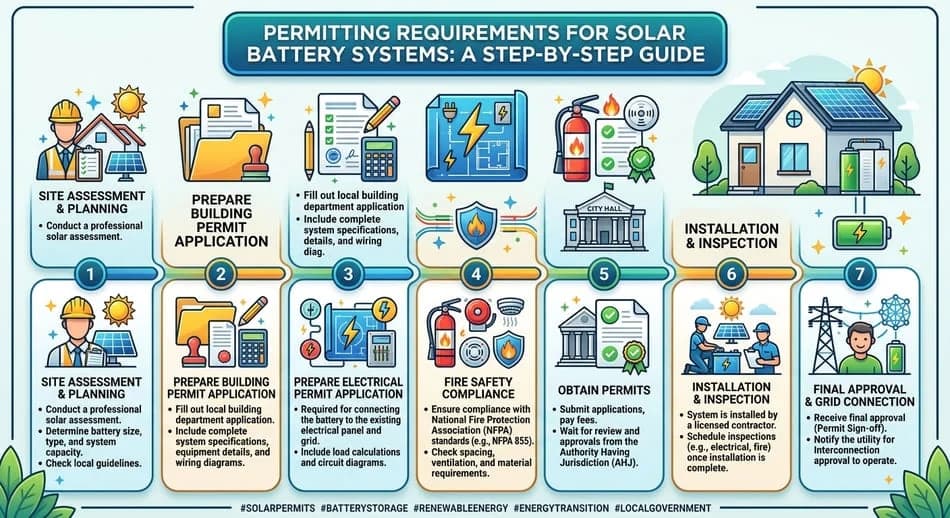
Solar Battery Permit Requirements: What You Need to Know
A solar battery usually needs local approval and a utility review before it can ...
How To Add A Battery To Your Existing Solar System
Adding a battery to your solar system costs $10,000-$20,000. Save with 30% feder...
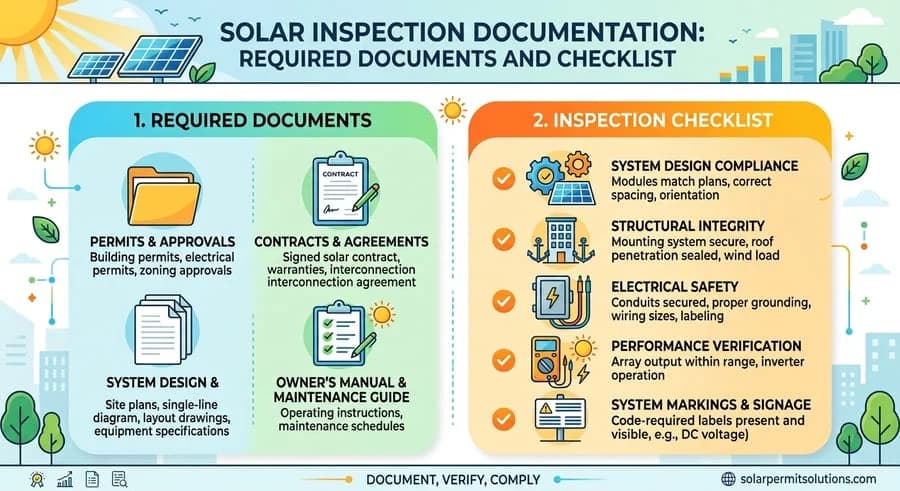
Solar Inspection Documentation: Required Documents and Checklist
Learn about solar inspection documentation, including permit requirements, NEC c...