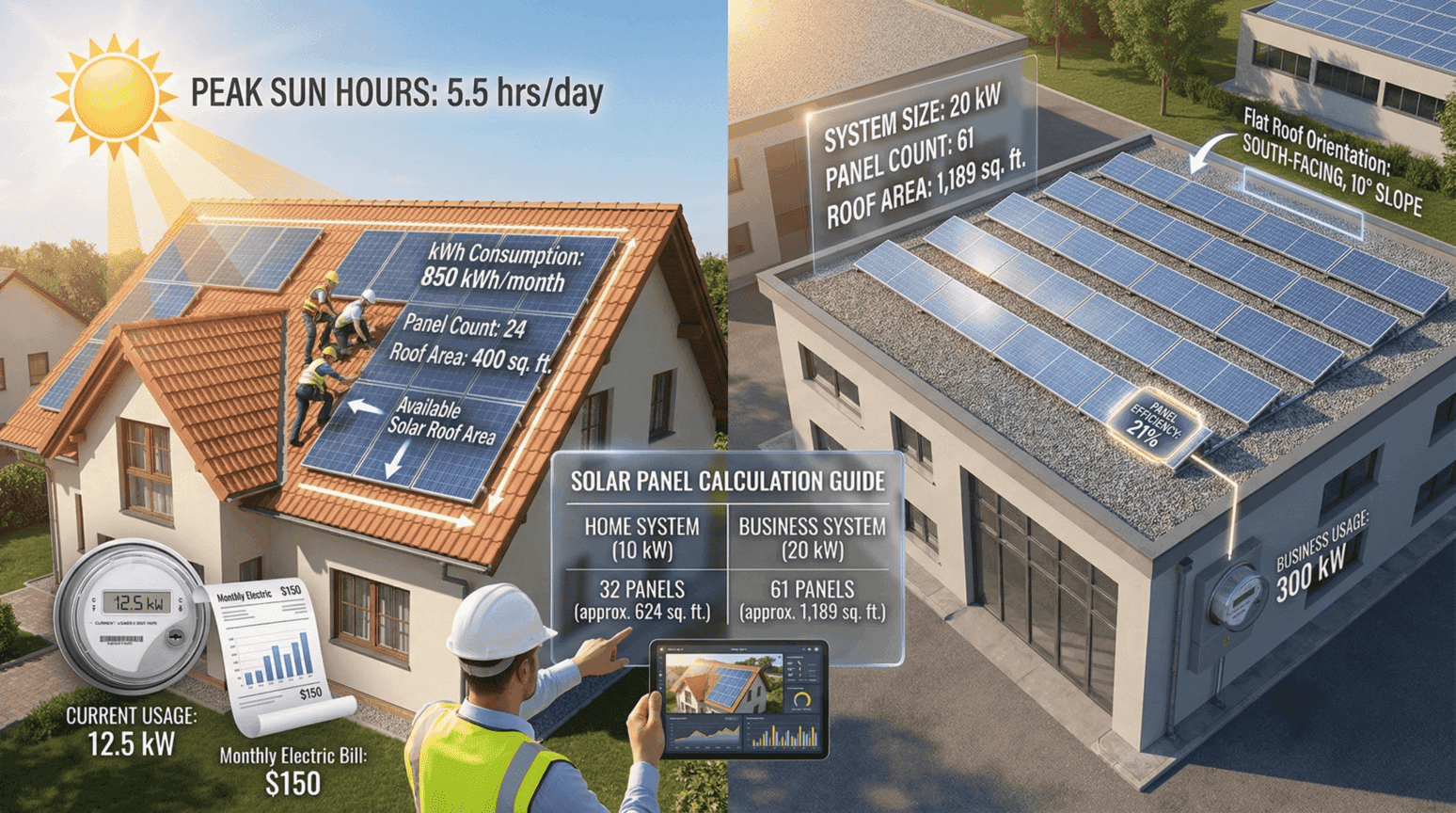
The number of solar panels required depends on your annual electricity consumption, not your home’s square footage. Calculate your needs using this formula: annual kWh usage ÷ 1,200 = system size in kW. A home with a $120 monthly electric bill typically needs a 10 kW system with 32 panels (330W each) covering 624 sq. ft.
Four key factors determine your exact requirements:
- total electricity consumption based on 6-12 months of utility bills
- daily peak sun hours in your location (averaging 4.7 hours in mid-Atlantic states)
- available roof space and orientation (ideal: 30° pitch, south-facing)
- solar panel efficiency (16.6%-21%).
Residential systems range from 5-20 kW, while commercial installations need 50-200 kW. Higher-efficiency panels work best for limited roof space, while standard panels suffice when ample area is available.
Discover the key factors for calculating the right number of solar panels for your property. Your electricity consumption, available roof area, and panel performance are critical considerations.
When homeowners first explore solar energy, they frequently wonder how many panels are required for a 1,200 sq. ft. home. The answer isn’t as straightforward as it might seem, property size alone doesn’t tell the complete story.
Consider this: a 1,200 sq. ft. residence occupied by two people will typically consume far less power than an identical home housing two adults and two teenagers. Despite having the same square footage, the household with four occupants demands a larger solar installation. This illustrates why square footage by itself can’t reliably predict panel requirements.
Think of solar system design as assembling a complex puzzle. Without gathering all the necessary pieces, creating the complete picture becomes impossible. Here are the essential components you’ll need to begin.

Key Factors Influencing Your Solar Panel Count
While your building’s square footage contributes to the final calculation, four primary factors ultimately determine your panel requirements:
- Your total electricity consumption
- Daily direct sunlight exposure in your location
- Available roof area suitable for installation
- Solar panel model and specifications
Analyzing Your Energy Consumption: Reviewing 6 to 12 months of utility data provides the most accurate picture of your energy needs. With Net Metering programs, this historical information enables proper system sizing to offset 100% of annual electricity usage in many situations.
Sunlight Availability Matters: The direct sunlight your roof captures varies significantly by geographic location and season (making Net Metering benefits even more valuable). Resources like NREL’s U.S. State Solar Resource Map, combined with local weather station records and specialized software, help quantify peak sun hours for any region. Mid-Atlantic states typically receive an average of 4.7 peak sun hours daily.
Roof Characteristics Count: Ideally, roofs should have a 30° slope and face directly south. When actual conditions differ from this ideal, additional panels may be necessary to generate the required energy output. Understanding whether your roof can support solar panels is essential before moving forward. Fortunately, advancing solar panel technology has improved efficiency dramatically, making installations on east/west-facing roofs and non-optimal pitches increasingly viable and cost-effective.
Panel Efficiency Varies: Solar panel efficiency, the percentage of sunlight converted into usable electricity, differs across products. Efficiency ratings have improved substantially over the past ten years. Current panels feature efficiency levels ranging from 16.6% to 21%.
Calculating Your Solar Panel Requirements
Considering the factors outlined above, here’s a basic calculation for estimating your system capacity: Annual kWh consumption / 1200 = Required system size (kW). While professional solar design services incorporate additional variables, this formula provides a useful starting point. After determining the kW requirement, panel selection depends on available installation space (rooftop or ground-mounted) and budget parameters. When space is limited, higher-efficiency panels maintain strong energy production within a smaller footprint. Conversely, more affordable panels work well when ample installation area is available.
You can perform these calculations independently using a solar system sizing guide or reference the examples provided below for a general estimate of your panel needs. However, consulting with solar installation experts ensures accurate system sizing tailored to your specific requirements. Use this reference chart as a baseline:
Note: Each 330W solar panel occupies approximately 19.5 sq. ft.

Residential Properties
Typical residential installations range from 5 kW to 20 kW systems. This range fluctuates based on specific factors like heated swimming pools or electric heating systems.
Properties with $120 average monthly electricity bills generally require a 10 kW solar installation to meet annual energy demands. A 10 kW system comprises 32 330W solar panels occupying roughly 624 sq. ft. For those interested in building a DIY solar system, understanding these requirements helps determine project scope.
Properties with $240 average monthly electricity bills typically need a 20 kW solar installation. A 20 kW system incorporates 61 330W panels covering approximately 1,189 sq. ft. Proper solar panel layout optimization ensures maximum energy production within your available space.

Solar Permit Solutions
Need Solar Permit Plans?
Professional, permit-ready solar plan sets delivered fast. Residential and commercial projects across all 50 states.
Commercial Properties
Small to medium-sized commercial facilities typically require 50 kW to 200 kW systems. Requirements vary considerably based on business type, but here are representative examples:
Businesses with $600 average monthly electricity bills generally need a 50 kW solar installation. This configuration requires approximately 157 330W solar panels across 3,061 sq. ft. of space. Commercial solar design must account for unique building characteristics and energy demands.
Businesses with $2,400 average monthly electricity bills typically need a 200 kW solar installation. A 200 kW system incorporates 556 330W solar panels covering approximately 10,842 sq. ft. For larger projects, understanding utility-scale solar power considerations becomes essential.
Now you have all the essential information needed to determine your solar panel requirements and system size. The next consideration is understanding installation costs through professional sizing services and financing options with qualified installers for your solar project.
Conclusion
Determining the right number of solar panels for your property requires careful consideration of multiple factors rather than relying on simple square footage calculations. Your annual electricity consumption, local sunlight conditions, available roof space, and panel efficiency ratings all play crucial roles in sizing your solar installation correctly. By analyzing your utility bills from the past 6 to 12 months and understanding your roof’s characteristics, you can estimate whether you need a residential system ranging from 5 kW to 20 kW or a larger commercial installation. Remember that a typical 10 kW system uses approximately 32 panels and covers around 624 sq. ft., while larger properties or businesses may require systems up to 200 kW or more. With solar panel technology continuously improving and how net metering works to offset costs available in many areas, transitioning to solar energy has become an increasingly accessible and cost-effective solution for offsetting electricity costs. Taking the time to properly calculate your solar panel requirements ensures you’ll install a system that meets your energy needs efficiently and maximizes your long-term savings. For expert assistance with system design, permitting, and installation planning, visit Solar Permit Solutions.
FAQs
What happens if my roof doesn’t face south or has a less-than-ideal pitch?
Roofs that don’t face due south or lack the optimal 30° pitch can still effectively support solar panels, though you may need additional panels to compensate for reduced efficiency. Modern high-efficiency solar panels have made east-west facing installations and various roof angles increasingly viable. Your solar installer can calculate the specific impact of your roof’s orientation and pitch, then adjust the system design accordingly to ensure you generate sufficient energy to meet your needs. For off-grid applications, explore off-grid solar system design options.