Illinois Solar: Unlock $15,000+ In Incentives Before December 31, 2025
|
16 min read
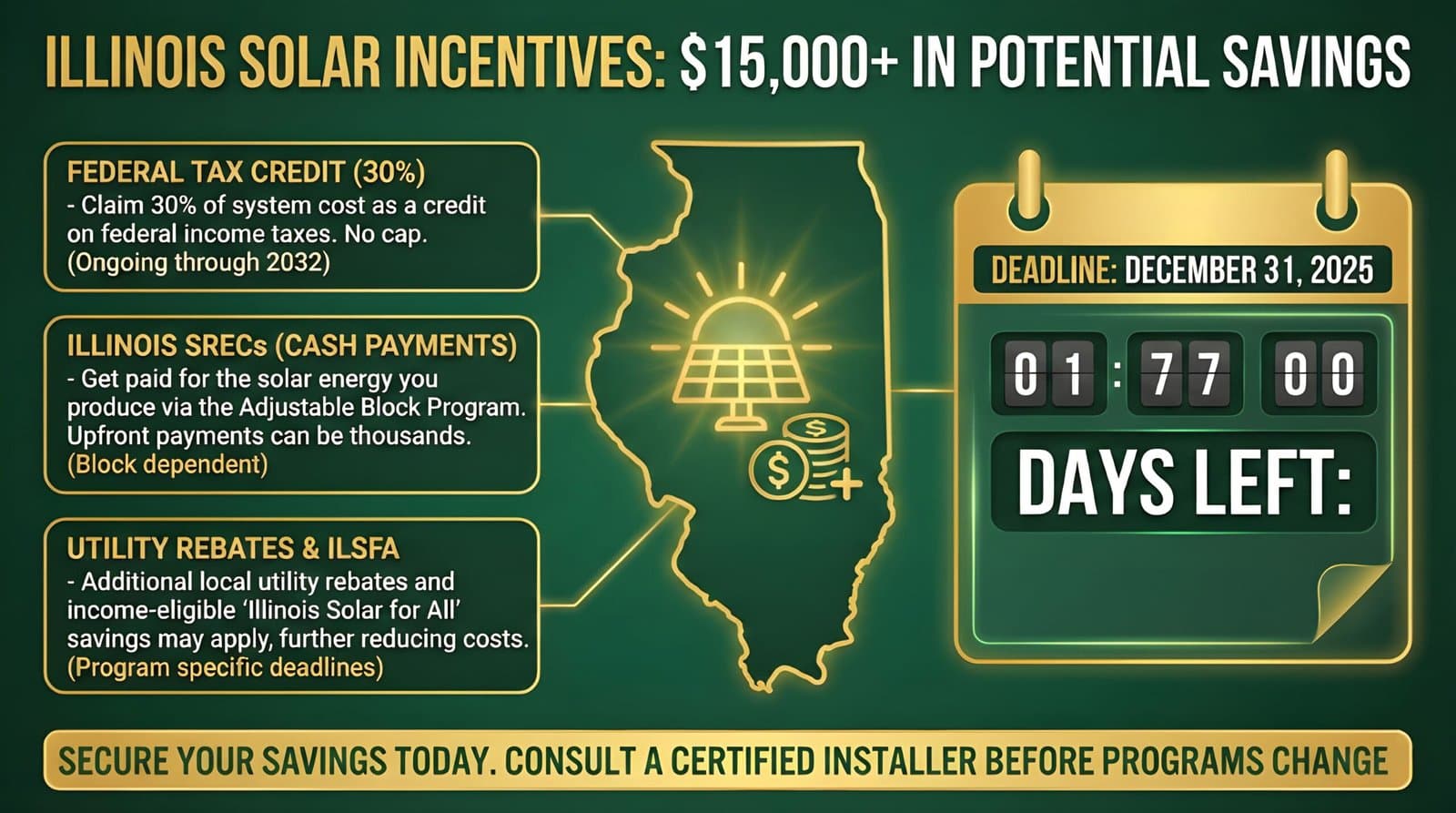
Illinois homeowners can access over $15,000 in combined solar incentives in 2025, reducing installation costs by more than 80%. The state offers four major financial incentives: a 30% federal tax credit (approximately $6,300 for average systems), Illinois Shines program payments ($8,700-$9,900 in upfront SREC credits), utility smart inverter rebates ($2,100 for solar, $4,050 with battery storage), and property tax exemptions. These incentives reduce the average 7 kW solar system cost from $21,000 to as low as $3,800, creating a 2.5-year payback period.
Critical deadline: The federal solar tax credit expires December 31, 2025. Systems must be fully installed by this date to qualify for the 30% credit. Illinois Shines and Solar For All programs remain available beyond 2025 as state-funded initiatives. Income-qualified households earning 80% or less of Area Median Income qualify for enhanced Solar For All benefits with guaranteed savings and no upfront costs.
Net metering changed January 1, 2025. Systems installed after December 31, 2024 receive supply-only credits worth 35-49% of retail rates, compared to full retail credits for earlier installations. Ameren, ComEd, and MidAmerican customers all qualify for available incentives.
Critical Update: Federal Tax Credit Deadline
IMPORTANT: The federal solar tax credit will expire on December 31, 2025. Legislation signed on July 4, 2025, eliminates the residential solar tax credit starting January 1, 2026. Homeowners must complete installations by December 31, 2025, to claim the 30% federal tax credit.
Time-Sensitive Changes To Illinois Solar Programs
Illinois maintains several long-term solar incentive programs, though important changes have occurred. The state’s net metering program changed for installations completed in 2025, reducing energy credits to approximately half or less of previous values. Additionally, the federal solar tax credit will no longer be available after December 31, 2025.
Complete Breakdown Of Available Solar Financial Benefits
Solar Permit Solutions
Affordable Solar Permit Plans
Don't let permit costs slow your project. Professional plan sets at competitive prices — all 50 states, fast turnaround.
30% Federal Clean Energy Credit (Expires December 31, 2025)
Value: 30% of solar installation costs Frequency: One-time tax credit, can roll over to future tax years Deadline: Must complete installation by December 31, 2025 How to apply: File IRS Form 5695 with annual tax return
No specific Illinois solar tax credit exists, but the federal solar tax credit (formerly the Federal Solar Investment Tax Credit or ITC) provides substantial savings. The Clean Energy credit applies to all U.S. residents who own homes and install solar panels.
CRITICAL DEADLINE: Systems must be installed by December 31, 2025. The credit will not be available for systems installed after this date.
The credit equals 30% of solar installation costs and requires sufficient tax liability to claim it.
The average solar panel system in Illinois earns a tax credit of approximately $6,300. Tax credit values depend on system size:
Taxpayers claim the credit in the year after solar installation completes. The credit applies to all solar panel or home battery storage installation costs but excludes structural improvements not directly associated with solar energy generation.
Note: Lending companies often require applying the solar tax credit value toward solar loans within 18 months to maintain low monthly payments.
Value: $66.34-$75.48 per SREC for systems under 10 kW (paid to Approved Vendor) Frequency: Upon installation completion and incentive approval How to apply: Select an Illinois solar installer listed as an Approved Vendor
The Illinois Shines adjustable block solar grant program provides significant savings for solar installations. The program offers upfront payments in exchange for solar renewable energy credits (SRECs) solar systems generate during their first 15 years of operation.
Systems earn one SREC for each megawatt-hour of electricity generated. Illinois’s average rooftop solar installation generates approximately 19 SRECs per kW of solar panels installed over the 15-year program period.
For example, the average 7-kW system generates 9,093 kWh in the first year (earning 9 SRECs) and produces an estimated 131,600 kWh by year 15 (131 SRECs), totaling 18.7 SRECs per kW of solar.
Solar system owners must sign contracts with Approved Vendors (typically solar installers) who either reduce system upfront costs based on SREC values or pay system owners after the program compensates the Approved Vendor.
How the payment works: In most cases, the Approved Vendor applies the Illinois Shines payment directly as an upfront discount on installation costs, so homeowners see immediate savings. Some vendors may structure payments differently, so confirm the payment terms with your chosen installer before signing.
SREC values vary by geographic location and utility group:
Program Payment Examples
The average-sized solar system in Illinois (7 kW) generates around 131 SRECs over 15 years. With an average payment of $75.48 per SREC in ComEd territory, the program payment equals approximately $9,888. This represents nearly half of the estimated $21,000 installation cost.
The same 7-kW solar system in Ameren territory earns $66.34 per SREC, with program payments totaling approximately $8,691.
These payments go to Approved Vendors through the Illinois Shines program. The percentage passed to homeowners varies by Vendor.
Income-Qualified Solar For All: Guaranteed Savings Program
Value: $180.28-$180.68 per SREC (paid to Approved Vendor) Frequency: Upon installation completion and incentive approval How to apply: Select a Solar For All Approved Vendor
Who Qualifies?
The Illinois Solar For All (ILSFA) program ranks among the nation’s best low-income solar incentives. The program specifically serves lower-income households earning 80% or less of Area Median Income.
Single-family homeowners and multi-family residential property owners or managers qualify for reduced solar energy system installation costs. Landlords qualify when specific percentages of tenants meet eligibility requirements. Program consumer education resources provide additional information.
How It Works
The program resembles Illinois Shines by providing SREC payments to Approved Vendors for installed projects. ILSFA differs by requiring vendors to design systems guaranteeing energy bill savings to homeowners.
Signing up for the ILSFA incentive program through Approved Vendors offers payment options including cash purchases, loans, leases, or power purchase agreements (PPAs).
Loan payments must remain affordable with no prepayment penalties and no home liens. Leases or PPAs must save at least half the retail value of system-produced energy. The program’s residential solar brochure indicates most participants have no monthly payments to solar companies.
Community Solar Access For Renters And Unsuitable Roofs
Renters and homeowners without suitable roofs for solar installations participate in the ILSFA program through Community Solar. Community Solar allows people to subscribe for portions of energy from large-scale solar installations. System-generated energy earns subscribers credits on utility bills.
Under the ILSFA program, subscription fees cannot exceed half the energy credit value, guaranteeing participants save at least that amount.
Critical Service Provider Incentives For Organizations
The ILSFA program includes incentives for nonprofit organizations and public facilities serving low-income communities. Properties must be occupied by Critical Service Providers (including hospitals, houses of worship, senior centers, food pantries, and libraries).
Similar to the residential incentive program, the nonprofit program guarantees participants receive at least half the retail value of solar energy their systems produce. The ILSFA nonprofit brochure provides additional information.
Utility Smart Inverter Rebates: $300 Per kW Plus Battery Storage
Value: $300 per kW for solar and $300 per kWh of solar-attached storage Frequency: One-time upfront rebate How to apply: Apply online through Ameren or ComEd websites
Ameren and ComEd customers receive cash rebates paid directly to them. Signing up for utility Distributed Generation programs allows utilities to temporarily control solar inverters or batteries.
Program enrollment earns rebates of $300 per kW of solar and $300 per kWh of energy storage. Systems must include smart inverters for incentive eligibility. Ameren provides specification documents determining smart inverter qualifications (most popular solar inverters qualify).
Property Tax Exemption For Solar Installations
Value: Varies with property Frequency: Annual How to apply: File form PTAX-330 with county assessor
Illinois law (35 ILCS 200/10) requires county assessors to assess solar energy system values the same way they assess conventional heating and cooling system values.
This means properties with existing central heating and cooling should not experience property value increases for tax assessment purposes when installing solar.
Net Metering Policy Changes And Billing Credits
Average electric rate in Illinois: $0.158 per kWh Net metering availability: Available for Ameren, ComEd, and MidAmerican customers Solar buyback rate: Full retail for systems completed by December 31, 2024. Supply-only after.
Net metering is a utility billing practice where solar owners earn credits for excess electricity solar panels generate and send to the grid. Each kWh of energy counts as a bill credit, with utilities applying credits toward energy customers pull from the grid when the sun is not shining.
Illinois’s previous net metering program required major investor-owned utilities (Ameren, ComEd, and MidAmerican) to offer full retail credits for excess energy. Installations completed by December 31, 2024, qualify for the life of their systems.
Installations completed on January 1, 2025, and after receive only partial credit for excess solar energy. Maximum credit amounts are based on utility wholesale electricity supply costs, known as the supply rate.
Supply rate breakdown from three major Illinois utilities:
Detailed supply charge information appears on the Illinois.gov website and MidAmerican’s tariff book.
Total System Costs With All Incentives Applied
Average solar panel costs in Illinois equal $21,000 before incentives for 7-kilowatt installations. After factoring all Illinois solar incentives, costs can drop to approximately $3,800, over 80% lower than pre-incentive costs.
Average pre-incentive cost: $21,000 Federal tax credit: $21,000 x 30% = $6,300 Illinois Shines incentive: $8,800 ComEd Distributed Generation solar rebate: $2,100 Effective system cost: $21,000 – $6,300 – $8,800 – $2,100 = $3,800
Battery storage systems cost approximately $15,600 on average, bringing total solar plus storage system costs to about $36,600 before incentives. These systems qualify for all above incentives plus additional distributed generation rebates for batteries. This represents 71% lower than pre-incentive costs.
Stacking Multiple Incentives: Tax Treatment Guide
Good news: Most Illinois solar incentives are designed to work together seamlessly. The federal tax credit, Illinois Shines payments, and utility rebates can all be claimed on the same system.
The Distributed Generation rebates from Ameren and ComEd are treated as payments for future services rather than cost reductions, which means they generally do not affect your federal tax credit calculation. However, tax rules can be complex and may vary based on individual circumstances.
Bottom line: Your solar installer and our team at Solar Permit Solutions are familiar with how these incentives stack. We always recommend consulting with a qualified tax professional to ensure you maximize your savings while staying compliant with IRS rules for your specific situation.
Financial Returns And Payback Timeline Analysis
Cost of grid power: $0.158/kWh (19th highest nationally) Rate of increase in grid power cost: 1.91% per year (4th lowest nationally) Median IL solar payback time: 2.5 years without battery, 7 years with battery
Incentives available to Illinois homeowners rank among the nation’s best, reducing average solar installation payback times to just 2.5 years.
Low-income incentives like the Solar For All program, community solar projects, and additional programs make Illinois exceptional for clean energy. These results reflect the intentions of the General Assembly when passing the Climate and Equitable Jobs Act (CEJA) in 2021.
Time-Sensitive Opportunity: With the federal tax credit expiring December 31, 2025, homeowners should act quickly to secure maximum savings. Solar projects typically take several months from consultation to installation, making immediate action critical.
Conclusion
Illinois ranks among the top states for residential solar adoption, offering homeowners exceptional financial incentives that can reduce installation costs by over 80%. The combination of the 30% federal tax credit, Illinois Shines upfront SREC payments, utility smart inverter rebates, and property tax exemptions creates an impressive 2.5-year average payback period.
However, immediate action is critical. The federal solar tax credit expires December 31, 2025, eliminating the single largest available incentive. Solar system installations typically require several months from consultation to completion, making prompt planning essential. While state programs like Illinois Shines and Solar For All continue beyond 2025, the loss of the federal credit will significantly impact total savings.
For homeowners ready to proceed, working with experienced professionals ensures smooth navigation of permits, utility interconnection requirements, and incentive applications. Solar Permit Solutions provides expert assistance with solar permits, engineering stamps, and interconnection support to help Illinois residents maximize savings before the critical December 31, 2025 deadline.
FAQs
Ready to maximize solar savings in Illinois? Contact Solar Permit Solutions for expert assistance with solar permits, engineering stamps, and utility interconnection support across all 50 states. Our team ensures installations meet all Illinois requirements and help homeowners access available incentives before the December 31, 2025, federal tax credit deadline.
All 50 StatesFast TurnaroundPE Stamped Plans
Affordable Solar Permit Plans
Don't let permit costs slow your project. Professional plan sets at competitive prices — all 50 states, fast turnaround.
Currently accepting new projects — 2–5 day turnaround
The USDA offers grants to agricultural producers and rural small businesses in Illinois under its Rural Energy Program (REAP). Other solar incentive programs like Illinois Solar For All help homeowners, landlords, and nonprofits transition to solar at lower costs.
Average-sized residential systems in Illinois can recover costs in 2.5 years when owners claim all available solar incentives, including the federal clean energy tax credit (must install by December 31, 2025), Illinois Shines payments for RECs, and distributed generation rebates from Ameren and ComEd.
Illinois law previously required the state's largest utility companies to offer full credit for excess energy solar customers send to the grid. This net energy metering arrangement changed for installations completed after January 1, 2025. Systems installed by December 31, 2024, maintain full retail rate net metering for the system's lifetime.
Illinois does not offer state tax credits for photovoltaic solar panel installations, but Illinois homeowners qualify for the federal clean energy tax credit offering 30% of costs as credits to eligible taxpayers. This credit expires December 31, 2025.
Illinois offers the Solar For All program, providing several ways to install solar panels with no upfront costs and guaranteed savings. Income-eligible homeowners can access financing options including loans with no prepayment penalties and no home liens, or leases and PPAs that guarantee savings of at least half the retail value of produced energy.
The federal solar tax credit will no longer be available for residential installations after December 31, 2025. However, Illinois Shines and Illinois Solar For All programs are state-funded and independent of federal programs. These programs continue making clean energy accessible and affordable for Illinois households, businesses, and communities.
Share:
SPS Editorial Team
Solar Permit Solutions
Solar Permit Solutions provides professional solar permit design services for residential, commercial, and off-grid installations across all 50 states. Our team ensures permit-ready plan sets delivered fast.