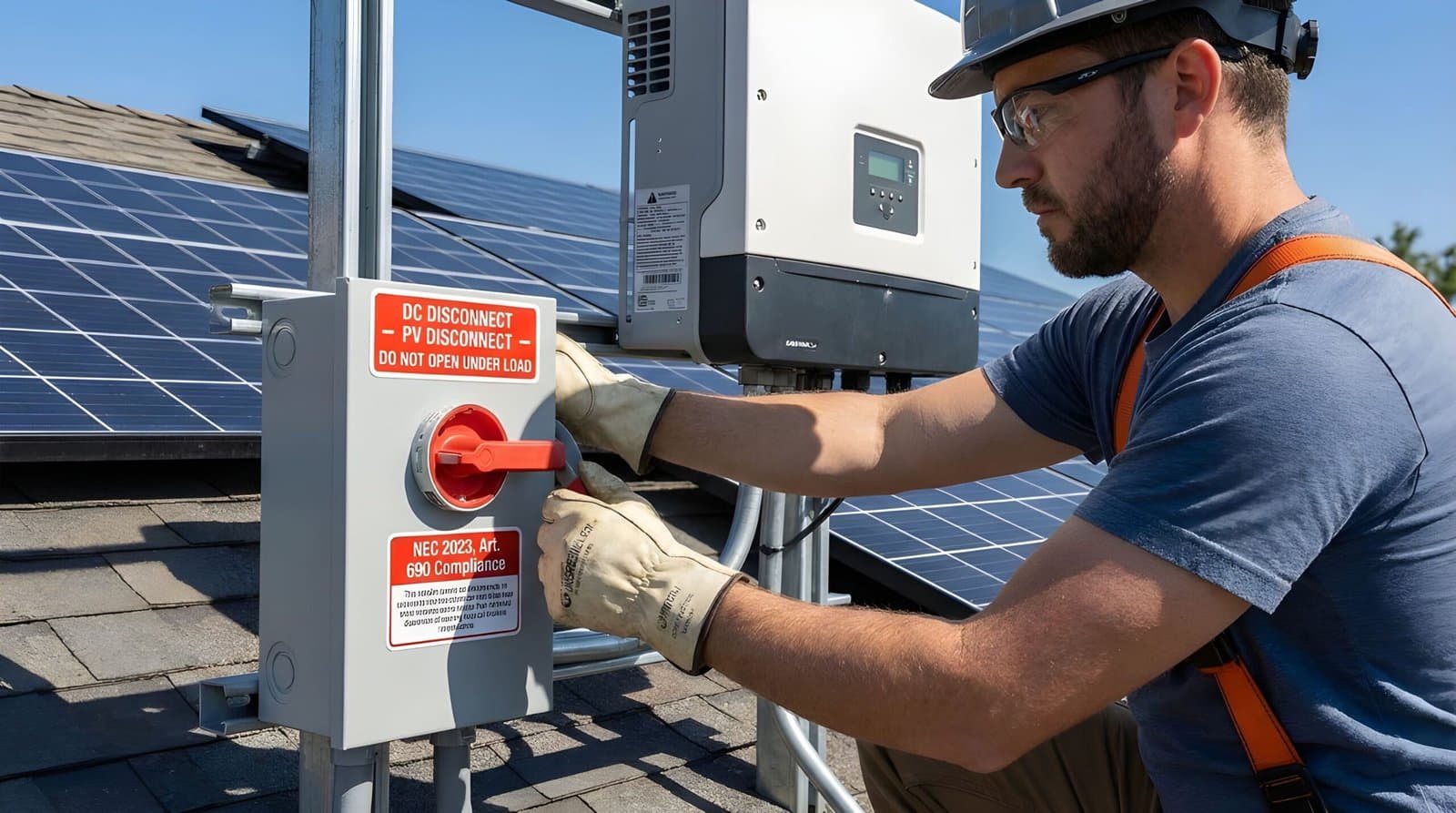
Technician safety during PV maintenance starts with proper equipment isolation, and that is exactly what NEC 690.15 governs.
NEC 690.15 is the section of the National Electrical Code that requires disconnecting means for isolating photovoltaic equipment, including inverters, charge controllers, DC-to-DC converters, fuses, and AC PV modules. Under the 2023 NEC (the current edition as of this writing), these disconnecting means must be located within the equipment, within sight and readily accessible from the equipment, lockable per Section 110.25, or provided with compliant remote controls.
The purpose of NEC 690.15 is to protect technicians and maintenance personnel by ensuring they can safely de-energize specific PV components before servicing. This requirement applies to both residential solar and commercial solar installations and is enforced by authorities having jurisdiction (AHJs) during electrical inspections. Solar installers, electricians, and permit designers must understand these disconnecting means requirements to achieve code compliance and pass inspections.
What Equipment Requires Disconnecting Means Under NEC 690.15
The NEC mandates that disconnecting means be provided for specific photovoltaic equipment to disconnect them from all conductors that are not solidly grounded. Equipment covered under this requirement includes:
- AC PV modules
- Fuses
- DC-to-DC converters
- Inverters
- Charge controllers
The purpose of these isolating devices is to enable safe and convenient replacement or servicing of specific PV system equipment without exposing personnel to energized conductors.
Depending on the application, some PV system equipment requires a disconnecting means while other types may be isolated without requiring all conductors to be simultaneously disconnected. An equipment disconnecting means or a PV system disconnecting means can serve in place of an isolating device when appropriate.
When the maximum circuit current exceeds 30 amperes for the output circuit of a DC combiner or the input circuit of a charge controller or inverter, an equipment disconnecting means must be provided for isolation. For charge controllers or inverters with multiple input circuits, a single equipment disconnecting means is permitted to isolate the equipment from all input circuits.

Location And Control Requirements For Disconnecting Means
The 2023 NEC restructured Section 690.15, moving location rules that were previously in 690.15(A) to 690.15(D), while the type of disconnect requirements moved from 690.15(D) to 690.15(A). This reorganization provides clearer guidance on where disconnecting means must be installed and how they can be controlled. Reviewing the official code text helps clarify these structural changes.
Under the current code, isolating devices or equipment disconnecting means must comply with one or more of the following options:
Located Within The Equipment: The disconnecting means can be installed as an integral part of the PV equipment itself, providing convenient access during maintenance operations.
Located In Sight From And Readily Accessible From The Equipment: The disconnect must be visible and not more than 50 feet distant from the equipment, while also being capable of being reached quickly for operation without requiring the use of tools, climbing over or under obstacles, or using portable ladders.
Lockable In Accordance With 110.25: If a disconnecting means cannot meet the visibility and accessibility requirements, it must be capable of being locked in the open position with provisions that remain in place with or without the lock installed.
Provided With Remote Controls: Remote control activation of the disconnecting means is permitted when either the disconnecting means and controls are located within the same equipment, or the disconnecting means is lockable in accordance with 110.25 with the control location marked on the disconnecting means.
Key Changes In The 2023 NEC For Section 690.15
The 2023 NEC introduced significant clarifications to Section 690.15 that affect how installers approach equipment disconnection. The previous rule specifying a 10-foot maximum distance between the equipment and the disconnect has been revised to require the disconnect to be “in sight from” and “readily accessible” from the equipment for those to whom access is required. These updates align with broader code change guidance affecting solar installations.
According to Article 100 definitions, equipment that is visible and not more than 50 feet distant from other equipment meets the “in sight from” requirement. Equipment that is “readily accessible” must be capable of being reached quickly for operation, renewal, or inspections without requiring personnel to use tools (other than keys), climb over or under obstacles, remove barriers, or resort to portable ladders.
Without incorporating both defined terms into the code, a PV equipment disconnect could have been readily accessible without being within sight, or vice versa. The 2023 code ensures that service technicians can both see and easily access the disconnect while working on equipment, enhancing safety during maintenance operations.

Solar Permit Solutions
Skip the Permit Headaches
We design plan sets that pass inspection the first time. Code-compliant, PE-stamped, accepted by AHJs nationwide.
Types Of Isolating Devices And Disconnecting Means
NEC 690.15 distinguishes between isolating devices and equipment disconnecting means.
Isolating Devices: These do not require an interrupting rating, meaning they may not be designed to interrupt current flow during operation. However, they must be clearly marked if they cannot interrupt current, typically with labels stating “DO NOT DISCONNECT UNDER LOAD” or “NOT FOR CURRENT INTERRUPTING.” Proper PV labeling ensures compliance with these marking requirements.
Equipment Disconnecting Means: These must be rated for the maximum circuit current and available fault current of the circuits they serve. They must also be rated for the circuit voltage and should be capable of disconnecting all ungrounded conductors simultaneously. The disconnecting means must be operable without exposing the operator to energized parts.
Acceptable types of isolating devices include:
- Connectors that comply with 690.33 requirements
- Switches rated for the application
- Devices supplied as part of listed equipment when used according to manufacturer instructions
Some listed equipment, such as microinverters, have been evaluated to use mating connectors as disconnect devices even when marked with load interruption warnings. Understanding DC connector risks helps installers select appropriate components.
Safety Requirements For Systems Above 30 Volts
When disconnecting means of PV equipment operating above 30 volts are readily accessible to unqualified persons, additional safety measures apply. Any enclosure door or hinged cover that exposes live parts when open must be locked or require a tool to open. This requirement appears in both Section 690.13(A) for PV system disconnects and Section 690.15 for equipment disconnects. State-level guidance provides additional clarification on these requirements.
The intent of this requirement is to protect unqualified individuals from accidental contact with energized components. PV systems present unique hazards because arrays remain energized whenever exposed to light, making proper disconnect implementation critical for personnel safety throughout the system’s 25 to 30 year lifespan.
Equipment disconnecting means must clearly indicate whether they are in the open (OFF) or closed (ON) position. For DC disconnecting means, visible break technology allows service technicians to physically see the air gap between open contacts, providing definitive verification of electrical isolation rather than relying solely on handle position indicators.

Relationship Between NEC 690.13 And NEC 690.15
Understanding the distinction between NEC 690.13 and NEC 690.15 helps clarify the multiple disconnect requirements in PV installations. Section 690.13 addresses the PV system disconnecting means, which separates PV system conductors from all other conductors associated with other electrical systems. Section 690.15 addresses equipment disconnecting means for isolating specific PV components during maintenance. The Article 690 scope provides foundational context for these requirements.
In practice, typical solar installations may require two to four disconnects serving different functions. These include the building disconnect for emergency shutdown at the service entrance, the equipment disconnect within sight of the inverter for maintenance purposes, array disconnects at combiner boxes for string-level work, and battery disconnects when energy storage systems are present. Industry resources offer practical guidance on disconnect placement.
Each disconnect enables isolation of specific equipment while other parts of the system remain operational. Although multiple disconnects may seem redundant, they serve distinct purposes and meet different code requirements for system safety and maintainability. Systems must also comply with rapid shutdown requirements that work alongside equipment disconnects.
Compliance Considerations For Installers And AHJs
Proper implementation of NEC 690.15 requirements helps installers pass inspections and ensures systems meet safety standards. Understanding AHJ requirements in your jurisdiction helps navigate local interpretations.
When designing PV installations, consider the following factors to achieve compliance:
- Verify equipment coverage. AC PV modules, fuses, DC-to-DC converters, inverters, and charge controllers must each be capable of being isolated from ungrounded conductors.
- Confirm location requirements. The disconnect should be within sight from and readily accessible from the equipment, or meet alternative requirements for lockable or remotely controlled disconnects. Proper wire routing ensures conductors reach disconnects without code violations.
- Ensure proper ratings. Devices must be rated for maximum circuit current, available fault current, and system voltage. Technical training resources help installers understand proper sizing.
- Secure enclosures above 30 volts. Systems accessible to unqualified persons must have enclosures that require tools or keys to open.
Working with Solar Permit Solutions ensures that permit packages include properly specified disconnecting means that meet current NEC requirements. Professional permit design services help streamline the approval process by addressing these technical requirements upfront.
Large-Scale PV Systems And Article 691
For large-scale photovoltaic electric supply stations with inverter generating capacity of 5,000 kilowatts or larger, Article 691 provides modified requirements. Section 691.9 addresses disconnecting means for isolating photovoltaic equipment in these utility-scale installations. NFPA code materials document the rationale behind these provisions.
Under Article 691, isolating devices are not required within sight of equipment and may be located remotely from equipment when the engineered design documents disconnection procedures and means of isolating equipment. This flexibility accommodates the unique operational requirements of large-scale PV facilities while maintaining appropriate safety measures through documented procedures.
The distinction between Article 690 and Article 691 requirements highlights the importance of understanding which code sections apply to specific installation types and sizes. Off-grid systems have their own unique disconnecting means considerations.
Ensuring Safe Maintenance Through Proper Disconnection
The primary purpose of NEC 690.15 is personnel safety during maintenance and service operations. A solar disconnect’s fundamental function is not overcurrent protection but electrical isolation. When properly opened and locked out, the disconnect creates a verified air gap that guarantees zero energy to downstream equipment, protecting technicians from shock hazards. PV research supports these safety principles.
PV systems present continuous energization risks during daylight hours, making reliable disconnection means essential for safe servicing. By requiring disconnecting means to be within sight and readily accessible, or alternatively lockable when remotely located, the code ensures that maintenance personnel can confidently isolate equipment before beginning work.
Proper lockout/tagout procedures combined with compliant disconnecting means provide the safety foundation for the thousands of service operations that occur over a PV system’s operational lifetime. Installations that meet NEC 690.15 requirements protect both the technicians who maintain them and the property owners who depend on safe, reliable solar power generation. Understanding solar system cost factors helps owners budget for compliant installations.
Conclusion
NEC 690.15 serves as a critical safety provision within Article 690, establishing clear requirements for disconnecting means that protect service technicians and maintenance personnel throughout a PV system’s operational lifetime. The 2023 code cycle brought important clarifications by restructuring the section and replacing the previous 10-foot distance requirement with defined terms that ensure disconnects are both visible and accessible during equipment servicing. Contractor training materials provide additional technical depth on these requirements.
Proper implementation of these requirements involves selecting appropriate disconnecting means for each piece of covered equipment, positioning them according to code-compliant location options, and ensuring ratings match circuit current, fault current, and voltage specifications. Whether using isolating devices for lower-current applications or equipment disconnecting means for circuits exceeding 30 amperes, installations must provide reliable isolation capabilities that support safe lockout/tagout procedures. Educational resources offer comprehensive guidance on PV system design.
For installers, understanding the distinction between PV system disconnects under 690.13 and equipment disconnects under 690.15 helps avoid confusion during design and inspection phases. Visit our blog for more solar code guidance, or check typical permit timelines to plan your next project.
Ready to ensure your next installation is 100% compliant with NEC 690.15? Contact Solar Permit Solutions today for a free consultation on your permit design package.
FAQs
Skip the Permit Headaches
We design plan sets that pass inspection the first time. Code-compliant, PE-stamped, accepted by AHJs nationwide.
Frequently Asked Questions
The 2023 NEC replaced the previous 10-foot maximum distance with the requirement that disconnects be 'in sight from' (visible and not more than 50 feet distant) and 'readily accessible' from the equipment. Alternatively, disconnects can be lockable or remotely controlled when they cannot meet these requirements.
No, isolating devices under NEC 690.15 do not require an interrupting rating. However, they must be clearly marked if they cannot interrupt current, typically with 'DO NOT DISCONNECT UNDER LOAD' labeling.
Disconnecting means must be provided for AC PV modules, fuses, DC-to-DC converters, inverters, and charge controllers to disconnect them from all ungrounded conductors.
An equipment disconnecting means is required when the maximum circuit current exceeds 30 amperes for DC combiner output circuits or charge controller and inverter input circuits.
Disconnecting means for equipment operating above 30 volts that are readily accessible to unqualified persons must have enclosure doors or hinged covers that are locked or require a tool to open.
NEC 690.13 addresses the PV system disconnecting means, which separates PV system conductors from all other electrical systems. NEC 690.15 addresses equipment disconnecting means for isolating specific PV components such as inverters, charge controllers, and fuses during maintenance operations.
Yes, for charge controllers or inverters with multiple input circuits, a single equipment disconnecting means is permitted to isolate the equipment from all input circuits, simplifying the installation while maintaining compliance.

SPS Editorial Team
Solar Permit Solutions
Solar Permit Solutions provides professional solar permit design services for residential, commercial, and off-grid installations across all 50 states. Our team ensures permit-ready plan sets delivered fast.
Related Articles
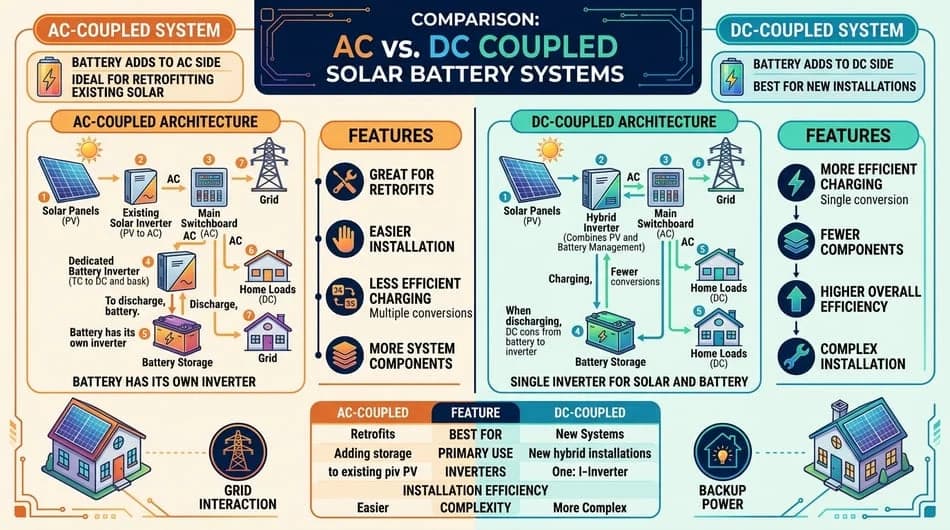
AC vs DC Coupled Solar Batteries: Which Should You Choose?
AC vs DC coupled solar batteries compared: efficiency, costs ($8K-$18K), and ins...

How Many Solar Panels Do I Need to Run Off the Grid?
Most off-grid homes need about 8 to 16 solar panels rated at 400 watts, dependin...
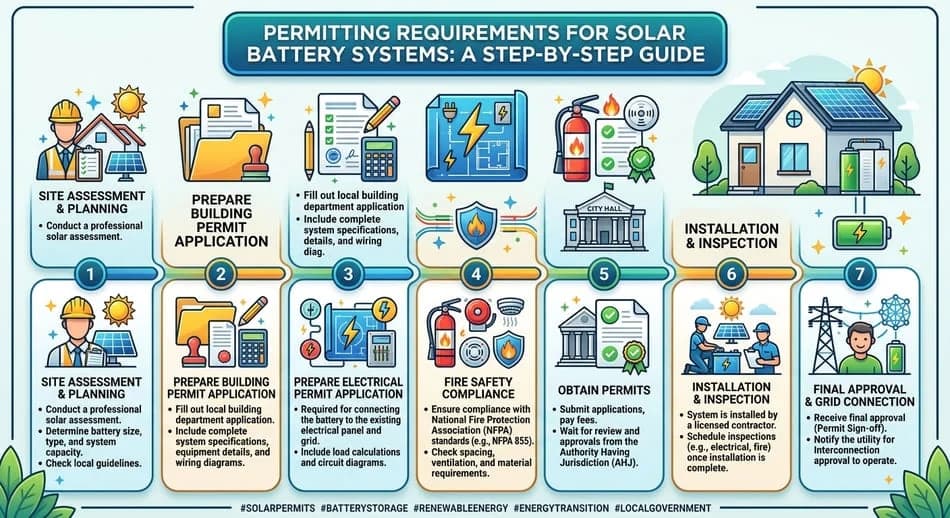
Solar Battery Permit Requirements: What You Need to Know
A solar battery usually needs local approval and a utility review before it can ...