
how many solar panels do you need

Solar Installation Soft Costs Explained: Permitting, Labor, And Hidden Fees

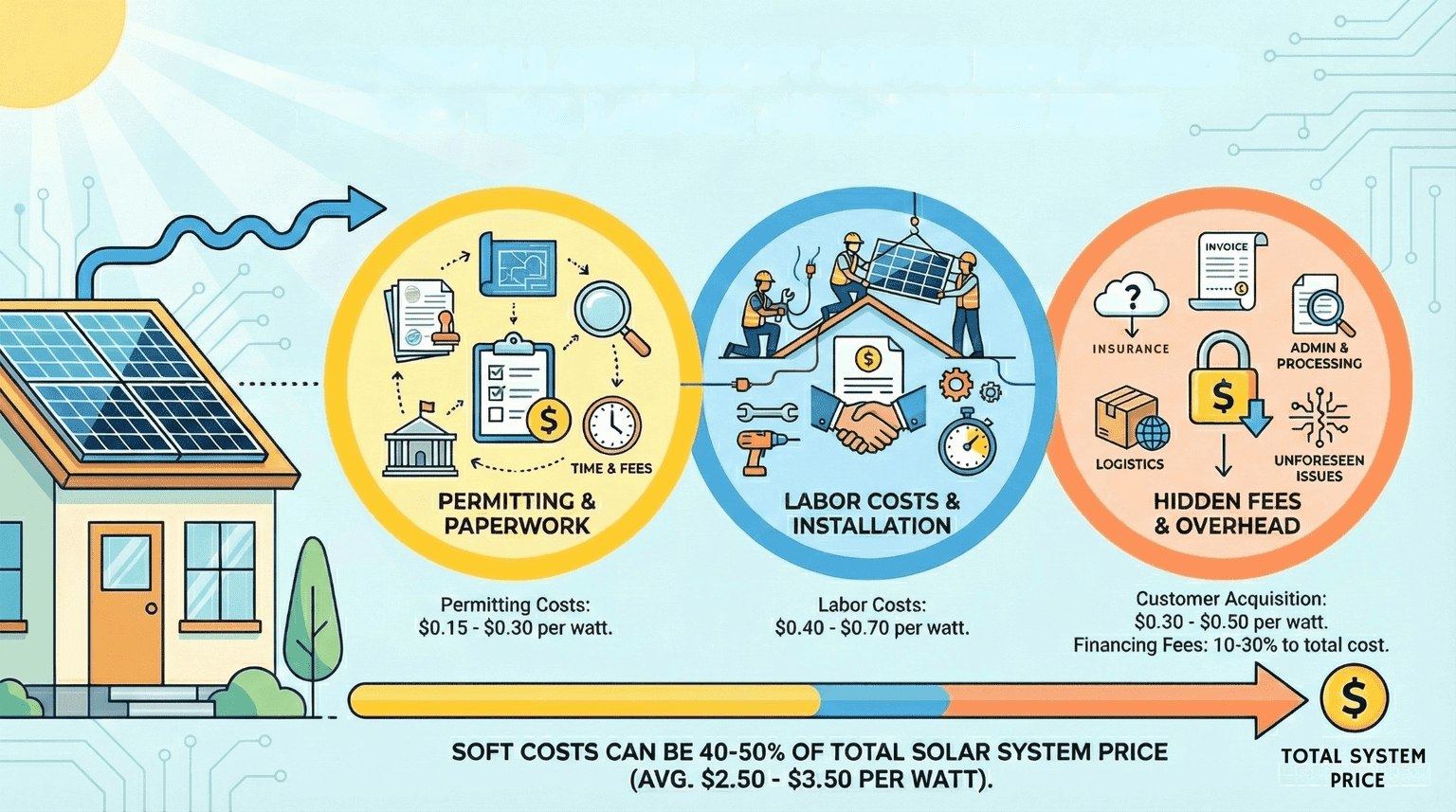
Solar energy cost in the United States averages between $2.50 and $3.50 per watt for residential installations, but hardware accounts for only 50-60% of this price. The remaining 40-50% consists of soft costs, non-equipment expenses including permitting ($0.15-$0.30 per watt), labor ($0.40-$0.70 per watt), customer acquisition ($0.30-$0.50 per watt), and financing fees that can add 10-30% to total project costs.

Key factors that increase solar energy cost in America:

Permitting and inspections: Multiple approval layers across 18,000+ local jurisdictions create documentation requirements and processing delays that add 2-8 weeks to project timelines

Interconnection procedures: Utility review processes vary by service territory, with wait times ranging from 2 weeks to 6 months depending on location

Fragmented regulations: Unlike countries with standardized national solar codes, U.S. installers navigate different requirements for each municipality, utility, and state

Labor and installation complexity: Roof-specific mounting, electrical panel upgrades (averaging $1,500-$3,000), and code compliance work increase crew hours

Customer acquisition costs: Residential solar marketing and sales expenses run 3-5 times higher than commercial projects due to smaller system sizes

For a typical 8 kW residential system costing $24,000, approximately $9,600-$12,000 represents soft costs rather than panels, inverters, or batteries. Understanding these expense categories allows homeowners to compare proposals accurately, identify cost-reduction opportunities, and select installers who manage approval processes efficiently. 

This guide breaks down each soft cost component, explains why American solar prices exceed international rates, and provides actionable strategies to control expenses while building a high-performance system with substantial battery backup capability.

understanding components solar soft expenses

Understanding the Components of Solar Soft Expenses in America

Soft expenses exist outside of solar panels, inverters, and battery systems. They introduce delays, uncertainty, and additional service calls, making a detailed strategy essential for controlling installation costs from the start. The primary cost drivers include regulatory approvals, workforce expenses, and financing arrangements. Each category carries distinct documentation requirements and scheduling demands. Many homeowners wonder about the nature of soft expenses. Consider permitting processes, inspection procedures, utility connection protocols, engineering services, marketing activities, and charges linked to loan products. The breakdown below identifies where budget and time typically accumulate.

Permitting and inspection procedures. Application forms, plan revisions, and on-site evaluations generate waiting periods that translate to overhead expenses.

Utility connection protocols. Service provider backlogs and paperwork requirements determine project timelines and ultimate solar costs.

Workforce deployment and electrical system modifications. Roofing challenges, breaker panel constraints, and wiring installation extend labor requirements and service visits, with solar workforce development initiatives working to address these challenges.

Client outreach and preliminary assessments. Lead development, property evaluations, bid preparation, and technical drawings all contribute to soft expenses.

Loan arrangements and distribution charges. Interest rates, setup fees, and intermediary costs appear in the final proposal, requiring careful review of these items.

The Department of Energy characterizes soft expenses as non-equipment costs including permitting, loan products, client acquisition, and business operations that factor into homeowner pricing.

Determining Total Solar Installation Costs Including Soft Expenses

Homeowners researching installation pricing encounter broad price variations. This variance becomes logical when accounting for roof construction, panel configuration, electrical service capacity, and municipal regulations. The most effective initial approach involves comparing per-watt pricing while verifying what the quote encompasses. This method provides accurate cost assessment for your property and streamlines contractor discussions.

Request two specific figures. First, obtain system pricing expressed as dollars per watt based on DC capacity rating. Second, demand an itemized breakdown separating equipment from soft expenses, incorporating battery storage when planning extended backup capability. Ensure the proposal identifies mandatory electrical modifications and any roofing or structural improvements. Clarify responsibility for reinspection charges should scheduling delays occur. These details explain significant cost differences between adjacent municipalities.

Apply per-watt pricing for accurate evaluations.

Verify what's included: battery backup systems, electrical panel replacement, metering equipment work, structural reinforcements, and roof repairs.

Identify soft expense categories: permitting costs, inspection fees, utility connection charges, engineering and oversight, sales and administrative functions, financing expenses.

When evaluating residential solar costs, request that installers coordinate project schedules with utility approval windows to minimize redundant site visits.

regulations influence solar installation pricing

How Regulations Influence Solar Installation Pricing

Requirements vary across municipalities and utility providers. An upfront verification checklist facilitates approvals and safeguards project schedules. Reducing administrative friction lowers installation costs without affecting hardware quality.

Sales Tax on Equipment

Verify your state's taxation policy for solar hardware and battery systems. Certain jurisdictions exempt portions of the installation through solar tax exemptions.

Confirm local tax additions before finalizing agreements. Minor percentage differences still impact final solar costs.

Permitting and Inspection Protocols

Obtain the complete documentation list your local authority requires. Employ standardized checklists and drawing formats to minimize plan revisions through streamlined solar permit applications.

Numerous jurisdictions now provide automated or digital review processes. NREL data indicates that SolarAPP+ shortened permit processing by approximately 14.5 business days in 2023 across implementing communities, reducing holding costs and staff hours.

Utility Connection Schedules

File a comprehensive application package that conforms to utility specifications. Incorporate electrical diagrams, equipment specifications, load analyses, property maps, and labeling protocols through proper solar interconnection procedures.

Reference NREL's SolarTRACE database to understand typical permitting and connection durations for your region and establish achievable timelines.

Quick Reference Chart

Home Battery Systems Strategy Table
Soft Expense Factor Strategy for Substantial Home Battery Systems
Sales Tax Confirm equipment and storage exemptions. Match contract terms with applicable tax regulations.
Permitting Apply standardized documentation and labeling. Verify electronic submission to accelerate review periods.
Inspections Pre-label all equipment and circuit schedules. Prepare milestone photographs for remote review when permitted.
Utility Connection Follow utility documentation precisely. Supply load calculations, site diagrams, and access information initially.

For Webflow: Copy the code below

Paste this into an Embed element in Webflow:

<style>
  .battery-table {
    width: 100%;
    border-collapse: collapse;
    margin: 20px 0;
  }
  
  .battery-table thead {
    background-color: #2c3e50;
    color: white;
  }
  
  .battery-table th {
    padding: 16px;
    text-align: left;
    font-weight: 600;
    border: 1px solid #34495e;
  }
  
  .battery-table td {
    padding: 16px;
    border: 1px solid #e0e0e0;
    vertical-align: top;
  }
  
  .battery-table tbody tr:nth-child(even) {
    background-color: #f9f9f9;
  }
  
  .battery-table tbody tr:hover {
    background-color: #f0f7ff;
  }
  
  .battery-table .factor-column {
    font-weight: 600;
    color: #2c3e50;
    width: 25%;
  }
  
  .battery-table .strategy-column {
    color: #555;
    width: 75%;
  }
</style>

<table class="battery-table">
  <thead>
    <tr>
      <th>Soft Expense Factor</th>
      <th>Strategy for Substantial Home Battery Systems</th>
    </tr>
  </thead>
  <tbody>
    <tr>
      <td class="factor-column">Sales Tax</td>
      <td class="strategy-column">Confirm equipment and storage exemptions. Match contract terms with applicable tax regulations.</td>
    </tr>
    <tr>
      <td class="factor-column">Permitting</td>
      <td class="strategy-column">Apply standardized documentation and labeling. Verify electronic submission to accelerate review periods.</td>
    </tr>
    <tr>
      <td class="factor-column">Inspections</td>
      <td class="strategy-column">Pre-label all equipment and circuit schedules. Prepare milestone photographs for remote review when permitted.</td>
    </tr>
    <tr>
      <td class="factor-column">Utility Connection</td>
      <td class="strategy-column">Follow utility documentation precisely. Supply load calculations, site diagrams, and access information initially.</td>
    </tr>
  </tbody>
</table>

Strategies That Reduce Soft Expenses for Large Battery Backup Projects

High-capacity backup installations increase engineering requirements. The solution involves early technical planning and organized documentation. Careful preparation decreases installation costs while maintaining system performance and code compliance.

Establish backup requirements, verify electrical capacity, and adopt consistent installation practices. These decisions eliminate change orders and compress timelines whether implementing whole-house backup or carefully designed critical circuit panels.

Establish backup parameters immediately. Identify circuits and select whole-house or essential-loads protection to avoid redesign work.

Conduct initial electrical evaluation. Assess service capacity, feeder conditions, grounding systems, available breaker positions, and code requirements. Authorize any panel or service upgrades before submitting permit applications.

Adopt consistent design and installation methods. Uniform cable organization, conduit pathways, labeling practices, and mounting techniques enable crews to work efficiently and achieve first-time inspection approval while avoiding costly installation revisions.

Prepare authority-ready documentation packages. Include technical drawings, equipment specifications, labels, and a photographic plan for critical project stages. Inspection officials appreciate organized paperwork.

Insist on itemized proposals. Request separate line items for permitting, inspections, utility connections, engineering, project coordination, sales functions, and financing to understand how soft expenses affect total installation costs throughout the project.

For substantial home battery installations, maintaining precise plans becomes simpler by selecting the best solar battery systems that accommodate whole-house electrical demands and integrate large solar arrays efficiently while minimizing redesign requirements.

why american solar cost exceed international rates

Why American Solar Costs Exceed International Rates

Global comparisons highlight procedural complexity and jurisdictional fragmentation. Multiple municipalities, numerous utilities, varied regulatory frameworks. Each inconsistency adds working hours that increase installation costs according to NREL's solar cost analysis. Residential installations represent smaller absolute capacity, amplifying acquisition and labor expenses per project. Utility requirements also change by service territory, increasing documentation work for diagrams, ratings, and labeling. Standardized procedures and uniform packages reduce cost gaps at the individual project scale.

Managing Solar Installation Expenses for Your Home

Homeowners can influence costs through process management. Approach soft expenses as distinct tasks with defined checklists for permits, inspections, and utility connections through professional solar permitting services. Combine thorough documentation with quality electrical work and standardized construction practices. This maintains predictable installation costs and minimizes rework.

Plan ahead for substantial home battery systems to ensure extended backup capability and smooth approval processes. Whether planning residential solar design, commercial solar design, or off-grid solar system design, construct a high-performance system using repeatable methods so installation costs remain controlled from contract execution through system activation and ongoing operation with support from Solar Permit Solutions.

Conclusion

Understanding soft expenses transforms solar installation from an overwhelming expense into a manageable investment. The gap between American solar costs and international rates stems largely from fragmented approval processes, varied municipal requirements, and project-specific documentation demands rather than hardware pricing alone. Homeowners who recognize these non-equipment expenses gain the leverage needed to negotiate effectively and avoid budget surprises.

Success begins with asking the right questions before signing contracts. Demand itemized proposals that separate equipment from soft costs through an overview of solar permitting requirements. Verify what your jurisdiction requires for permitting and inspections, then work with installers who maintain standardized documentation and proven approval processes. Coordinate utility connection timelines early through proper interconnection agreements to prevent costly delays and redundant site visits. When planning substantial battery backup capacity, invest time in upfront electrical assessments to identify service upgrades before permit submission rather than discovering limitations mid-project.

The most effective cost management strategy combines thorough planning with transparency. Track each soft expense category, permitting, inspections, utility connections, engineering, sales, and financing options, as distinct budget items with clear accountability. Select contractors who demonstrate familiarity with local approval processes and maintain relationships with authorities having jurisdiction. This preparation reduces revision cycles, accelerates inspections, and keeps your project moving forward without expensive change orders.

Ultimately, controlling soft costs means controlling your timeline, protecting your budget, and ensuring the system you install delivers the performance and backup capability your home requires. For those new to solar energy, your beginner's guide to solar provides foundational knowledge. Apply the strategies outlined in this guide to build a high-quality solar installation that provides reliable energy independence without unnecessary expenses eating into your long-term savings.

FAQs

How does homeowners' insurance respond to rooftop solar and battery installation?

Most insurance providers classify roof-mounted solar arrays as dwelling components and include them under standard coverage, though premium rates or deductible amounts may adjust. Inform your insurer before installation begins, confirm wind and hail protection, and inquire whether additional coverage is necessary for battery systems or electrical modifications.

What safety certifications should my large battery backup system satisfy?

Request an energy storage system certified to UL 9540, with evaluation per UL 9540A where mandated, and installation following NFPA 855 plus local regulations (including NEC rapid shutdown requirements). Maintain manufacturer clearance specifications and labeling; your local authority will verify these during inspection visits.

How do I calculate backup duration for my residence?

Document essential loads and their wattage requirements, sum the anticipated daily kilowatt-hour consumption, then compare against your battery's usable energy capacity. Verify the inverter's continuous power rating matches the peak simultaneous load. Include a buffer for limited sunlight or severe weather, and account for reduced solar recharging during power outages to maximize runtime.

Can I reduce soft costs by handling permits and paperwork myself?

While technically possible, self-permitting often increases costs through documentation errors, revision cycles, and extended approval timelines. Professional installers maintain standardized drawing templates, established relationships with local authorities, and familiarity with jurisdiction-specific requirements that accelerate approvals through expert solar permitting guidance. Unless you possess electrical engineering experience and thorough knowledge of local codes, contractor-managed permitting typically delivers faster, more cost-effective results despite the service fee. Contact us for professional assistance with your solar permitting needs.

Do financing options significantly impact total solar installation costs?

Financing arrangements substantially affect overall project expenses through interest charges, origination fees, and dealer compensation built into loan products. Cash purchases eliminate these soft costs entirely. Solar loans and power purchase agreements introduce financing charges that can add 10-30% to total system costs over the loan term. Carefully compare cash pricing against financed options, examining annual percentage rates, dealer fees, and total payment amounts to understand the true cost difference before selecting a payment method. Consider the 2025 solar tax credit deadline when evaluating payment timing.

Contact us

Get in touch today

We are dedicated to providing top-notch solar permit services to homeowners, business owners, DIY, and solar installers. Contact us today.

Check - Elements Webflow Library - BRIX Templates

Thank you

Thanks for reaching out. We will get back to you soon.
Oops! Something went wrong while submitting the form.
Solar COMPANIES SUPPORTING
Solar Permit Solutions
Choosing Solar Permit Solutions means benefiting from our fast turnaround times, comprehensive packages, and dedicated support team.

We take the hassle out of the permitting process so you can focus on your solar installation.
Partners / Sponsors