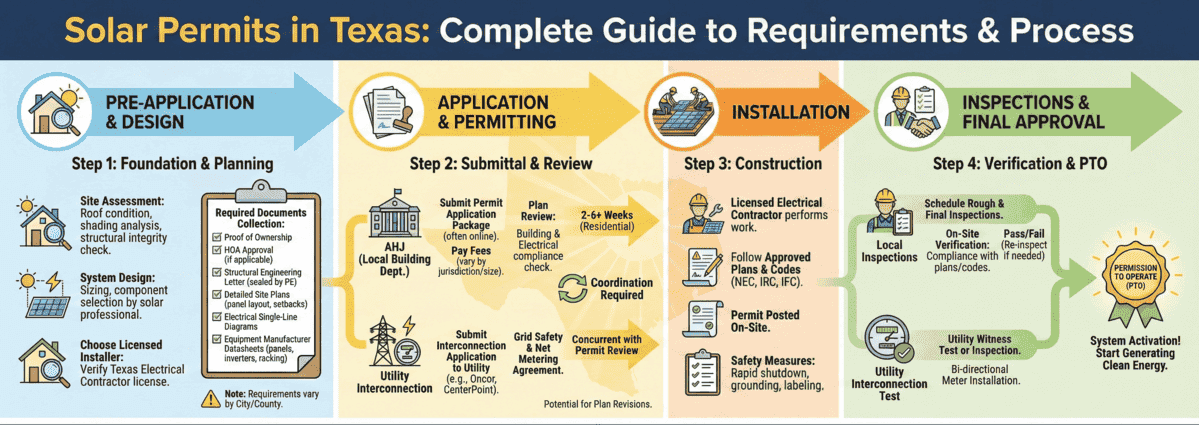
Texas solar permits are required for all grid-tied solar installations, with costs ranging from $50 to $500 depending on system size and municipality. The permitting process typically takes 2-4 weeks and requires compliance with the National Electrical Code (NEC) and International Building Code (IBC). Required documentation includes site plans showing panel placement with exact roof dimensions, electrical single-line diagrams illustrating system connections from panels through inverters to your main electrical service, structural engineering calculations proving roof load capacity, equipment specifications with manufacturer data sheets for all components, and utility interconnection agreements.
Systems exceeding 10kW require professional engineering stamps on plans regardless of whether the installation is residential or commercial. Major Texas cities operate distinct permitting systems: Houston charges $250-$500 with online applications and three-phase inspections, Dallas requires $300-$600 with separate electrical permits, Austin offers $200-$400 streamlined green energy permits with fast-track processing, and San Antonio charges $275-$525 requiring CPS Energy approval for all installations.
Recent Updates (January 2026): This guide has been updated to reflect new Texas solar consumer protection laws (SB 1036 & SB 1697) that took effect in September 2025, requiring solar retailer registration with TDLR and PUCT-developed consumer information guides for all utilities. All permit costs, processing timelines, and city-specific requirements have been verified with local building departments for accuracy.
Solar Permits in Texas: Complete Guide to Requirements & Process
Solar energy adoption in Texas continues to rise, making it crucial for homeowners and contractors to understand the permitting process. Whether you’re planning a residential installation or commercial project, navigating solar permits can seem daunting. This comprehensive guide will walk you through everything you need to know about obtaining solar permits in Texas.
Understanding Solar Permit Requirements in Texas
Before starting your solar project, you’ll need to gather essential documentation and understand state-specific regulations. Basic requirements typically include:
- Property ownership documentation
- Detailed system design plans
- Electrical diagrams
- Structural engineering reports
- Homeowners’ association approval (if applicable)
Texas state law requires all solar installations to comply with the National Electrical Code (NEC) and International Building Code (IBC). Residential permits generally have simpler requirements than commercial ones, though both require professional certification.
How to get solar permit in Texas
The application process follows these key steps:
- Submit completed application forms
- Provide detailed technical drawings
- Include site plans and electrical diagrams
- Schedule preliminary inspections
- Await permit approval
Avoid common mistakes like incomplete documentation or incorrect measurements. Most municipalities require professional engineering stamps on plans for systems over 10kW.
Solar Permit Costs and Timeline
Permit costs vary significantly across Texas cities:
- Houston: $250-$500
- Dallas: $300-$600
- Austin: $200-$400
- San Antonio: $275-$525
Processing typically takes 2-4 weeks, though some cities offer expedited options. Consider additional costs like engineering reviews and inspection fees. Many municipalities offer fee reductions for energy-efficient improvements.

Solar Permit Solutions
Skip the Permit Headaches
We design plan sets that pass inspection the first time. Code-compliant, PE-stamped, accepted by AHJs nationwide.
Municipal Variations in Texas Solar Permits
Houston
- Online application system
- Required professional engineer approval
- Three-phase inspection process
Dallas-Fort Worth
- Paper and digital submission options
- Strict HOA compliance requirements
- Separate electrical permits needed
Austin
- Streamlined green energy permits
- Solar-ready program incentives
- Fast-track processing available
San Antonio
- CPS Energy approval required
- Special historic district considerations
- Combined building/electrical permits
Working with Solar Contractors
Choose contractors who:
- Hold valid Texas licenses
- Have experience with local permitting
- Provide comprehensive documentation assistance
- Handle inspection scheduling
Professional contractors should manage permit applications and coordinate with local authorities, ensuring compliance throughout the process.
Expediting Your Solar Permit
Speed up approval by:
- Submitting complete documentation initially
- Following pre-submission checklists
- Responding promptly to information requests
- Using experienced local contractors
Some jurisdictions offer fast-track processing for an additional fee. Having all required documents ready before submission can significantly reduce delays.
Ready to start your solar journey? Remember that proper permitting is crucial for a legal and safe installation. While the process may seem complex, working with qualified professionals and following local guidelines ensures a smooth transition to clean energy.
Note: Consider checking with your local municipality for the most current requirements, as regulations may change.

Texas Solar Rights: What Your HOA Can and Cannot Do
Texas law strongly protects homeowners’ rights to install solar panels, even in communities governed by homeowners associations. Understanding these protections helps you navigate HOA approval processes and pushback effectively.
Texas Property Code Section 202.010: Your Legal Foundation
Texas Property Code Section 202.010 establishes that HOAs and property owners associations cannot prohibit or restrict property owners from installing solar energy devices. This protection applies to all residential properties in Texas, regardless of what your HOA’s covenants, conditions, and restrictions (CC&Rs) state.
The law defines “solar energy device” broadly under Texas Tax Code Section 171.107, covering traditional solar panels, microinverters, power optimizers, mounting systems, and as of May 2025, solar roof tiles.
Key Legislation Protecting Texas Solar Homeowners
House Bill 362 (2011) established the foundation for solar rights in Texas. This landmark legislation amended Texas Property Code Section 202.010 to prevent HOAs from outright banning solar installations. However, the law includes specific exceptions where HOAs retain some regulatory authority.
Senate Bill 1626 (2015) closed a significant loophole that developers exploited. Before this bill, developers could prohibit solar installations during the “development period” of a subdivision, which was poorly defined and could last for years. SB 1626 now limits this restriction to developments with fewer than 51 planned residential units, and only during the actual development phase.
House Bill 431 (May 29, 2025) expanded protections to explicitly include solar roof tiles in the definition of “solar energy device.” This ensures that newer integrated solar products like Tesla Solar Roof receive the same legal protections as traditional panel systems. HOAs cannot prohibit or unreasonably restrict solar roof tile installations.
What Your HOA CAN Regulate
While HOAs cannot ban solar outright, Texas law permits certain reasonable restrictions:
Aesthetic Requirements:
- Panel color must be silver, bronze, or black tones
- Panels must conform to the slope of the roof
- Panels must be parallel to the roofline
- Panels cannot extend higher than the roofline
Placement Restrictions:
- Ground-mounted systems cannot extend above the homeowner’s fence line
- Equipment cannot be installed ahead of the front building line
- HOAs can designate preferred placement locations on your roof
The 10% Production Rule: Challenging HOA Placement Restrictions
If your HOA designates a specific location for your solar panels that would significantly reduce energy production, Texas law provides a remedy. You can petition for an alternate location if you can demonstrate that the HOA’s designated placement would decrease your estimated annual energy production by more than 10%.
To make this case, use modeling tools provided by the National Renewable Energy Laboratory (NREL), specifically the PVWatts Calculator at pvwatts.nrel.gov. Document the production estimates for both locations and submit this analysis with your alternate placement request.
What to Do If Your HOA Denies Your Solar Application
- Request written explanation citing the specific covenant or restriction being applied
- Respond in writing with citations to Texas Property Code Section 202.010, HB 362, SB 1626, and HB 431
- Request board review if the Architectural Review Committee made the initial denial
- Seek mediation through your HOA’s dispute resolution process
- Consult an attorney specializing in HOA law if the denial persists
- Contact advocacy organizations like Texas Solar Energy Society (TXSES) or Solar United Neighbors Texas
Utility Interconnection and Permission to Operate (PTO)
Obtaining your building permit is only part of the solar installation process. Before your system can legally generate electricity and connect to the grid, you must complete utility interconnection and receive Permission to Operate (PTO). This process is separate from building permit requirements under SB1202 and follows its own timeline.
Understanding the Texas Utility Landscape
Deregulated Areas (ERCOT Territory): Most of Texas operates within the Electric Reliability Council of Texas (ERCOT) grid, covering approximately 90% of the state’s electric load. In deregulated areas, Transmission and Distribution Utilities (TDUs) like Oncor, CenterPoint, and AEP Texas handle physical infrastructure, while Retail Electric Providers (REPs) handle billing and customer service.
Municipal Utilities: Cities like Austin (Austin Energy), San Antonio (CPS Energy), and others operate their own municipal utilities outside the deregulated market. These utilities handle both infrastructure and customer billing, creating a more streamlined single-point-of-contact interconnection process.
Electric Cooperatives: Rural areas are often served by electric cooperatives like Pedernales Electric Cooperative or Bluebonnet Electric Cooperative. Each co-op has its own interconnection procedures and policies.
The Interconnection Process: Step-by-Step
Step 1: Submit Interconnection Application
Your solar installer typically handles this submission. Required documentation includes completed utility interconnection application form, system specifications (panels, inverters, total capacity in kW), single-line electrical diagram, site plan, proof of building permit application, and installer licensing documentation.
Step 2: Utility Engineering Review
The utility reviews your application to ensure your system meets technical requirements. Review timelines vary: simple residential systems (under 10kW) take 2-4 weeks, larger systems (10-25kW) take 3-6 weeks, and systems requiring transformer upgrades may take 6-12 weeks or longer.
Step 3: Interconnection Agreement Execution
Once engineering review is complete, you’ll receive an interconnection agreement specifying technical requirements, metering arrangements, insurance requirements, and terms for excess generation compensation.
Step 4: Meter Installation
Depending on your utility, this involves installing a bidirectional net meter, dual metering, or reprogramming existing smart meters. Typically occurs within 1-2 weeks after agreement execution.
Step 5: PTO Issuance
After your system passes inspection and the meter is installed, the utility issues Permission to Operate authorizing you to energize your system, begin generating electricity, and export excess power to the grid.
Critical Warning: Never Energize Before PTO
Operating your solar system before receiving official PTO carries serious consequences:
- Legal Penalties: Fines up to $15,000 in some jurisdictions
- Safety Risks: Endangers utility workers and can damage equipment
- Insurance Implications: May void homeowners insurance coverage
- Interconnection Denial: Utilities can permanently deny interconnection
Interconnection Timelines by Utility Type

2025 Texas Solar Consumer Protection Laws
The 89th Texas Legislative Session passed significant consumer protection legislation affecting solar installations. These laws focus on protecting homeowners from predatory sales practices and ensuring installer accountability.
Senate Bill 1036: Solar Retailer Registration
Effective Dates: Contract provisions September 1, 2025; Registration requirements September 1, 2026
SB 1036, authored by Senator Judith Zaffirini, establishes comprehensive regulations for residential solar sales in Texas, responding to documented cases of misleading sales practices and inadequate contract disclosures.
Mandatory Contract Requirements (Effective September 1, 2025):
- Contracts must state installation will be performed by a licensed electrical contractor
- Electrical contractor’s name and TDLR license number must be conspicuously displayed
- Contracts must confirm permits will be obtained
- Clear disclosure of system costs, financing terms, and projected savings
- Standardized cancellation rights and procedures
Registration Requirements (Effective September 1, 2026):
- Solar retailers must register with Texas Department of Licensing and Regulation (TDLR)
- Solar salespersons must obtain individual registration
- Operating without registration results in civil and administrative penalties
Senate Bill 1697: Utility Solar Information Guide
Effective Date: September 1, 2025
SB 1697 requires the Public Utility Commission of Texas (PUCT) to develop a comprehensive guide helping customers understand home solar energy options, including best practices, financial considerations, design considerations, questions to ask providers, and interconnection process explanations. All regulated utilities must link to this guide on their websites.
How to File a Consumer Complaint
For complaints about solar sales practices or contracts signed after September 1, 2025:
- Online: tdlr.texas.gov
- Phone: (800) 803-9202
- Mail: TDLR, P.O. Box 12157, Austin, TX 78711
Responsible Agencies: Who Regulates Solar in Texas
Texas Department of Licensing and Regulation (TDLR)
TDLR Oversees:
- Electrical Contractor Licensing: All electrical work must be performed by licensed electricians. Verify licenses at tdlr.texas.gov/electricians
- Solar Retailer Registration (2026): Registration of solar sales companies and salespersons under SB 1036
- Consumer Complaints: Complaints against electrical contractors and registered solar retailers
Public Utility Commission of Texas (PUCT)
PUCT Oversees:
- Utility Regulation: Interconnection standards, REP licensing, net metering rules
- Consumer Protection: Complaints against REPs, interconnection disputes, billing issues
- Policy Development: Solar information guide (SB 1697), distributed generation rules
State Fire Marshal’s Office (SFMO)
SFMO Oversees:
- Battery Energy Storage Systems: NFPA 855 compliance, fire safety standards
- Fire Code Compliance: Installation safety, emergency access requirements
Local Building Departments (AHJ)
Your city or county building department serves as the primary permitting authority:
- Houston: houstonpermittingcenter.org | (832) 394-8860
- Dallas: dallascityhall.com/departments/sustainable development | (214) 948-4480
- Austin: austintexas.gov/department/development-services | (512) 978-4000
- San Antonio: sanantonio.gov/DSD | (210) 207-1111
- Fort Worth: fortworthtexas.gov/departments/development-services | (817) 392-2222
Common Permitting Delays and How to Avoid Them
Cities with Known Permitting Challenges
Irving: According to Environment Texas’s March 2025 report, Irving has developed a reputation among solar installers as one of the most challenging jurisdictions. Multiple installers reported avoiding Irving entirely. For battery storage, one company reported turning down 80% of requested projects due to requirements exceeding standard codes. Strongly consider third-party permitting under SB1202 if you live in Irving.
Mesquite: Data from Ohm Analytics shows that while Mesquite approves most solar permits within a median of three business days, 10% of permits take 27 days (approximately five weeks) or longer. This inconsistency makes project planning difficult.
Dallas: The permitting process involves sequential review by building, electrical, and fire department staff rather than concurrent review. This extends timelines and can make it difficult to know application status.
Common Causes of Permit Delays
Incomplete Documentation is the most frequent cause. Missing items include unsigned structural calculations, missing equipment spec sheets, inadequate site plans, and incomplete load calculations.
Code Interpretation Disputes occur because different AHJs interpret NEC requirements differently, particularly regarding rapid shutdown, conductor sizing, and grounding requirements.
Staffing Shortages at building departments lead to review backlogs. Smaller jurisdictions may have limited electrical plan review expertise.
Battery Storage Scrutiny adds complexity due to NFPA 855 and local fire code requirements, particularly for indoor installations.
Strategies for Faster Permit Approval
Use Third-Party Permitting (SB1202): Provides guaranteed two-business-day AHJ certification
Submit Complete Applications: Incomplete applications cause most delays
Choose Experienced Installers: Familiarity with your AHJ prevents issues
Consider Timing: Submit during lower-volume periods (November-February)
Use Online Systems: Often process faster than paper submissions
Conclusion
Successfully navigating the solar permit process in Texas requires careful attention to local requirements, thorough documentation, and compliance with state electrical and building codes. While permit costs and processing times vary across Texas municipalities, understanding the fundamental requirements of site plans, electrical diagrams, structural calculations, and equipment specifications positions your project for efficient approval. Working with experienced solar professionals who understand Texas-specific regulations significantly reduces approval delays and ensures installations meet all safety standards from the outset. The investment in proper permitting protects your property value, validates insurance coverage, and guarantees safe grid interconnection for decades of reliable solar energy production. As Texas continues expanding renewable energy infrastructure to support growing electricity demand, properly permitted solar installations contribute to the state’s energy independence goals while delivering substantial utility savings. Whether installing a residential rooftop system or large-scale commercial array, prioritizing permit compliance from project inception establishes the foundation for long-term solar success. Texas homeowners and businesses can confidently transition to clean energy by partnering with qualified contractors who handle permitting complexities while ensuring full regulatory compliance throughout the installation process.
FAQs
Latest Update – January 2026
Skip the Permit Headaches
We design plan sets that pass inspection the first time. Code-compliant, PE-stamped, accepted by AHJs nationwide.
Frequently Asked Questions
Solar permit costs in Texas vary significantly by municipality and system size, typically ranging from $50 to $500 for residential installations. Major cities like Houston, Dallas, and Austin charge different fee structures, with some calculating costs as a percentage of total project value while others use flat rates based on system kilowatt capacity. Additional fees may include plan review charges, electrical inspection costs, and engineering review expenses for larger systems. Commercial installations and systems exceeding 10kW generally incur higher permit fees due to increased complexity and additional engineering requirements. Some Texas municipalities offer fee reductions for energy-efficient improvements or renewable energy installations, potentially lowering overall permitting costs. Contact your local building department for specific fee schedules, as rates update periodically and may include separate charges for building, electrical, and utility interconnection permits.
Solar permit approval timelines in Texas typically range from 2-4 weeks for standard residential applications, though duration varies based on municipality workload and application completeness. Some Texas cities offer expedited review options for additional fees, potentially reducing approval time to 1-2 weeks for straightforward projects. Complex commercial installations or systems requiring additional engineering review may take 6-8 weeks or longer depending on jurisdictional requirements. Incomplete applications significantly extend timelines as they require resubmission after corrections, often restarting the review clock. Factors affecting approval speed include building department staffing levels, seasonal application volumes, plan complexity, and whether professional engineering stamps are included with initial submission. Submitting complete documentation with all required attachments, accurate measurements, and proper certifications helps minimize delays and accelerates the approval process across Texas jurisdictions.
Texas requires professional engineering stamps on solar plans for systems exceeding 10kW capacity, regardless of whether the installation is residential or commercial. For smaller residential systems under 10kW, engineering calculations proving structural adequacy are still necessary, though some municipalities may accept contractor-prepared plans if the contractor holds appropriate licenses. Licensed professional engineers must verify that roof structures can support panel weight, wind loads, and other environmental factors specific to Texas climate conditions. Commercial solar installations universally require engineering certification due to increased complexity, larger system sizes, and heightened structural considerations. Many solar contractors employ in-house engineers or partner with engineering firms to provide necessary calculations and stamps as part of their permitting services. Attempting to bypass engineering requirements results in permit denials, project delays, and potential safety hazards that compromise installation integrity and void equipment warranties.
Texas law allows property owners to install solar panels on their own homes, though you must still obtain all required permits and pass inspections regardless of who performs the work. However, electrical work connecting solar systems to the grid legally requires a licensed electrician in Texas, making fully DIY installations challenging for most homeowners. Building departments may scrutinize owner-installed systems more carefully, requiring detailed documentation proving electrical competency and code compliance. Licensed contractors provide several advantages including handling permit applications, ensuring code compliance, coordinating inspections, and offering warranties on installation workmanship. Professional installers familiar with common permit denial issues navigate the approval process more efficiently than inexperienced DIY installers. Consider that improper installations create fire hazards, void equipment warranties, complicate future property sales, and may result in insurance coverage denial. For off-grid solar systems with battery storage, additional electrical expertise ensures safe integration of energy storage components with solar arrays and home electrical systems.
Texas solar permit applications require comprehensive documentation demonstrating installation safety and code compliance. Essential documents include detailed site plans showing exact panel placement, roof dimensions, setbacks from roof edges, and property boundaries with accurate measurements. Electrical single-line diagrams must illustrate system connections from panels through inverters, disconnects, and integration with existing electrical service, including proper circuit breaker or fuse sizing. Structural engineering calculations proving roof load capacity for panel weight, wind uplift, and seismic considerations are mandatory, particularly for systems over 10kW. Equipment specifications including manufacturer data sheets for panels, inverters, and power optimizers verify component certifications and compatibility. Additional required items include utility interconnection applications, proof of property ownership, homeowner association approval if applicable, contractor license verification, and completed permit application forms. Some Texas municipalities request fire setback diagrams, shade analysis reports, or additional engineering certifications. Working with qualified solar permit professionals ensures complete documentation packages that prevent application rejections and minimize approval delays. The American Solar Energy Society provides additional resources for understanding documentation requirements specific to Texas installations.
No, Texas law prohibits HOAs from outright denying solar panel installations. Texas Property Code Section 202.010, strengthened by House Bill 362 (2011), Senate Bill 1626 (2015), and House Bill 431 (2025), protects homeowners' rights to install solar energy devices. However, HOAs can impose reasonable aesthetic restrictions such as requiring panels to be black, bronze, or silver in color, parallel to the roofline, and not extending above the roofline. HOAs can also require prior approval through their Architectural Review Committee, but they cannot deny installations that meet these reasonable requirements. If your HOA denies your application, respond in writing citing Texas Property Code Section 202.010 and consult with an attorney if the denial persists.
For complaints about solar sales practices or contracts signed after September 1, 2025, file with TDLR at tdlr.texas.gov or (800) 803-9202. For electrical work quality complaints, file through TDLR's electrician licensing program. For disputes with your retail electric provider about interconnection or billing, contact PUCT at puc.texas.gov or (512) 936-7000. Document all issues thoroughly with photos, contracts, and communications before filing.
After passing inspection, your building department issues a certificate of completion. Your installer submits this to your utility along with interconnection documentation. The utility schedules meter installation, conducts final verification, and issues Permission to Operate (PTO). Only after receiving written PTO can you energize your system. Timeline from passed inspection to PTO is typically 1-4 weeks depending on your utility.

SPS Editorial Team
Solar Permit Solutions
Solar Permit Solutions provides professional solar permit design services for residential, commercial, and off-grid installations across all 50 states. Our team ensures permit-ready plan sets delivered fast.
Related Articles
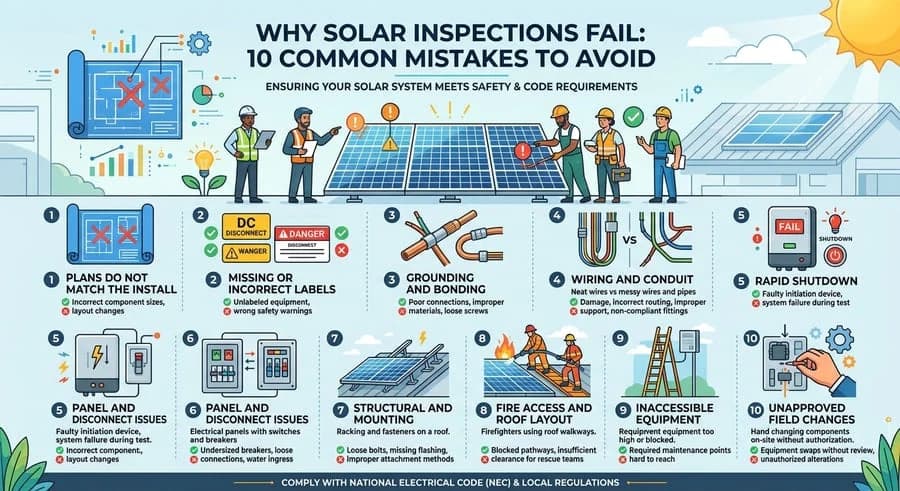
Why Solar Inspections Fail: 10 Common Mistakes to Avoid
Discover the 9 critical reasons solar inspections fail and how to avoid costly m...

Solar Grounding And Bonding: How To Pass Inspection Every Time
Learn how to pass solar grounding and bonding inspections every time. Avoid comm...
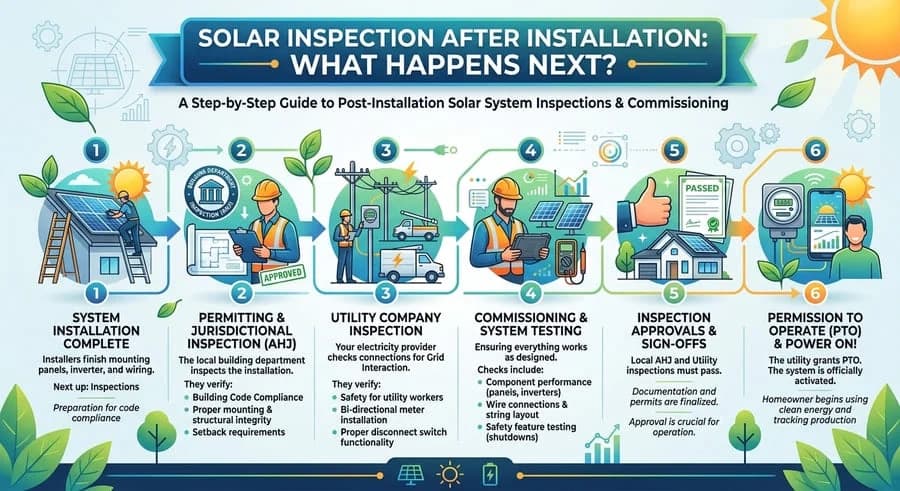
Solar Inspection After Installation: What Happens Next?
Learn how to pass your solar inspection by following essential tips for obtainin...