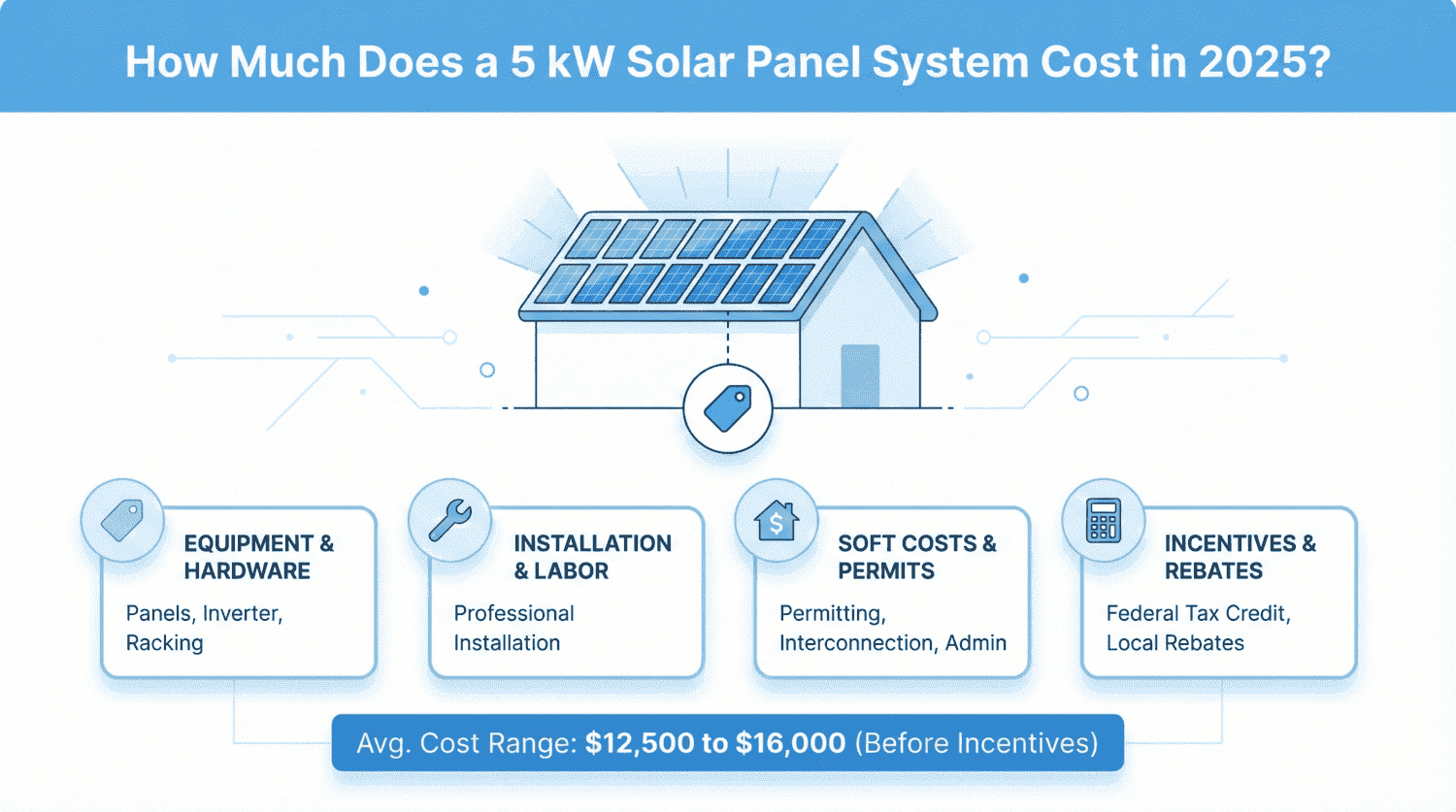
5kW Solar System Cost (2025): $13,550 on average before incentives, $9,485 after 30% federal tax credit (expires December 31, 2025).
Energy Production: 7,260 kWh annually, approximately 20 kWh daily.
System Size: 12 to 15 solar panels depending on panel wattage (400W to 450W).
Coverage: Powers 70% to 85% of average US household electricity consumption.
State Price Range: $10,100 (Arizona) to $15,250 (Massachusetts).
Payback Period: 6 to 10 years based on electricity rates and incentives.
Tax Credit Deadline: Homeowner-owned systems must be installed by December 31, 2025, to qualify for the 30% federal credit.
A 5kW solar panel system represents the ideal entry point for small to medium homes seeking to reduce electricity costs. With the federal tax credit ending for residential installations at the end of 2025, homeowners have a limited window to maximize savings. Proper permitting through local building departments ensures code compliance and qualifies installations for net metering programs that credit excess solar production. Whether planning a DIY installation or working with professional solar permit design services, this guide covers everything needed about pricing, energy output, permit requirements, and maximizing return on investment in 2025.

How Much Does A 5kW Solar System Cost In 2025?
The average cost of a 5kW solar system in 2025 sits at $13,550 before incentives, translating to approximately $2.71 per watt. This pricing reflects real installation data from across the country and represents a significant decrease from previous years. According to the International Energy Agency Renewables 2024 report, global solar capacity continues expanding rapidly, driving equipment costs to historic lows and making 2025 an opportune time for homeowners to invest in solar energy.
National Average Pricing Breakdown
A standard 5kW residential solar installation includes several cost components. Equipment costs, covering solar panels, inverters, and mounting hardware, typically account for 50% to 60% of the total price. Labor and installation represent another 20% to 25%, while permits, inspections, and interconnection fees comprise the remaining 15% to 25%. Understanding how long does it takes to get a solar permit helps homeowners budget appropriate timelines for their projects.
Cost After Federal Tax Credit (30% ITC)
The Residential Clean Energy Credit provides the most significant federal incentive for residential solar installations. At 30% of total system cost, a $13,550 installation generates a $4,065 tax credit, resulting in a net cost of $9,485. For systems at the lower end ($10,100), the after-credit cost drops to $7,070. Higher-priced installations at $15,250 still benefit significantly, with the final cost reaching $10,675 after the credit.
Important Tax Credit Update: The 30% federal tax credit for homeowner-owned residential solar systems ends December 31, 2025, following the One Big Beautiful Bill Act signed in July 2025. There is no phase-out period. Homeowners must have systems fully installed by year-end to qualify. Third-party-owned systems through leases or power purchase agreements (PPAs) remain eligible for the credit through 2027, and battery storage under third-party ownership qualifies through 2032.
Solar Permit Solutions
Affordable Solar Permit Plans
Don't let permit costs slow your project. Professional plan sets at competitive prices — all 50 states, fast turnaround.
Price Per Watt Comparison
Evaluating solar costs on a per-watt basis provides the most accurate comparison method. The 2025 national average of $2.71 per watt for a 5kW system compares favorably to larger installations, though economies of scale typically reduce per-watt costs for bigger systems. A 5kW system at $2.71 per watt costs less per watt than systems under 4kW, which often run $3.00 to $3.50 per watt due to fixed installation costs being spread across fewer panels.
5kW Solar System Cost By State
Geographic location significantly impacts solar installation costs. States with mature solar markets, abundant installers, and streamlined permitting processes typically offer lower prices. Resources like EnergySage provide comprehensive marketplace data on state and local pricing that helps homeowners compare quotes and understand regional cost variations.
Lowest Cost States (Arizona, Texas, Florida)
Arizona leads the nation with 5kW solar system costs averaging just $10,100, benefiting from intense competition among installers and simplified permitting processes. Texas follows closely at $10,600, where Texas solar permit requirements vary by municipality but generally support rapid deployment. Florida rounds out the top three at $10,850, combining strong solar resources with competitive installer pricing.
Highest Cost States (Massachusetts, New York, Colorado)
Massachusetts tops the cost chart at $15,250 for a 5kW system, reflecting higher labor costs and complex permitting requirements. New York follows at $14,600, though strong state incentives often offset the higher upfront investment. Colorado rounds out the higher-cost states at $14,300, where altitude considerations and specialized mounting requirements add to installation complexity.
State-by-State Pricing Table
The following table displays 2025 average costs for 5 kW solar systems across major solar markets:
Note: Prices reflect 2025 averages. After ITC costs only apply for systems installed by December 31, 2025.
What Factors Affect 5kW Solar System Pricing?
Multiple variables influence the final cost of a 5kW solar installation beyond geographic location. Understanding these factors helps homeowners evaluate quotes accurately and identify opportunities for cost optimization without sacrificing quality or performance.
Equipment Quality And Panel Efficiency
Solar panel efficiency directly impacts both cost and long-term value. Standard efficiency panels (17% to 19%) cost less upfront but require more roof space. Premium high-efficiency panels (20% to 22%) command higher prices but generate more power per square foot, making them ideal for space-constrained installations. A 5kW system using standard 400W panels requires approximately 13 panels, while 450W high-efficiency panels reduce the count to 11 or 12.
Inverter selection also affects pricing significantly. String inverters offer the lowest cost option at $1,000 to $1,500 for a 5kW system. Microinverters, installed on each panel individually, cost $1,500 to $2,500 but provide panel-level monitoring and better performance in partial shading conditions. Power optimizers with a central inverter fall between these options at $1,200 to $2,000.
Roof Complexity And Installation Challenges
Roof characteristics significantly impact installation costs. Simple, south-facing roofs with standard asphalt shingles represent the ideal scenario, minimizing labor and equipment requirements. Complex roofs with multiple angles, dormers, skylights, or obstacles require additional mounting hardware and longer installation times, potentially adding $500 to $2,000 to project costs.
Roof material also influences pricing. Tile and slate roofs require specialized mounting brackets and more careful installation techniques, adding $1,000 to $3,000 compared to standard shingle installations. Metal roofs typically cost less to install than shingles due to simpler attachment methods, potentially saving $500 to $1,000.
Local Labor Costs And Permitting Fees
Regional labor rates create substantial cost variations across markets. Metropolitan areas with higher living costs typically see installation labor rates 20% to 40% above rural areas. Permitting fees vary equally dramatically, ranging from $100 in streamlined jurisdictions to $1,000 or more in complex regulatory environments. The SolSmart solar permitting resources help communities streamline processes. Working with professionals who understand AHJ solar requirements helps navigate local regulations efficiently.
Supply Chain And Tariff Impacts
Global supply chain dynamics continue influencing solar equipment costs in 2025. While panel prices have declined significantly from pandemic-era highs, tariff policies on imported solar equipment create market uncertainty. The REN21 Global Status Report tracks worldwide renewable energy trends affecting equipment availability and pricing. Domestic manufacturing incentives aim to stabilize pricing while building US-based production capacity. Current tariff structures add approximately 15% to 25% to imported panel costs, though these policies remain subject to change.
How Much Energy Does a 5kW Solar System Produce?
Energy production from a 5kW solar system depends primarily on geographic location, roof orientation, and local weather patterns. The NREL solar research division provides location-specific production estimates based on historical solar irradiance data and continues advancing photovoltaic technology research.
Annual kWh Output By Location
The national average production for a 5 kW solar system reaches 7,260 kWh annually. However, actual output varies by approximately 35% between the sunniest and cloudiest regions. Phoenix, Arizona, systems produce around 8,824 kWh per year, while Seattle, Washington, installations generate closer to 5,467 kWh annually. Most locations fall somewhere between these extremes, with production correlating directly to average peak sun hours.
Daily And Monthly Production Estimates
Daily production from a 5 kW system averages 15 to 25 kWh depending on season and location. Summer months typically produce 30% to 50% more electricity than winter months due to longer days and more direct sunlight angles. Monthly production ranges from 400 kWh in cloudy winter conditions to 800 kWh during peak summer months in sunny climates.
Energy Production By US City
The following table shows expected energy output from a 5 kW solar system across major US cities:
Source: Production estimates based on NREL data for south-facing installations with standard tilt angles.
Peak Sun Hours And Regional Variations
Peak sun hours measure the equivalent hours of full-intensity sunlight a location receives daily. The southwestern United States averages 5.5 to 6.5 peak sun hours, while the Pacific Northwest and Northeast average 3.5 to 4.5 hours. A 5 kW system produces roughly 5 kWh per peak sun hour, making this metric essential for accurate production estimates. Seasonal variations significantly impact peak sun hours, with summer days providing 6 to 8 hours in most locations, while winter drops to 2 to 4 hours.
Is a 5kW Solar System Enough for Your Home?
Determining whether a 5kW system meets household energy needs requires comparing expected production against actual consumption. The Union of Concerned Scientists’ renewable energy resources provide comprehensive information on how solar energy reduces both electricity costs and environmental impact for residential applications.
Average Household Energy Consumption
Energy consumption varies dramatically based on home size, climate, and lifestyle factors. The average US household uses approximately 10,632 kWh annually, or about 886 kWh per month. Small homes and apartments typically use 500 to 700 kWh monthly, making a 5 kW system an excellent match. Medium-sized homes consuming 700 to 900 kWh monthly find that a 5 kW system covers 80% to 100% of their needs in sunny climates. Larger homes with consumption exceeding 1,000 kWh monthly may require 7 kW to 10 kW systems for full offset.
Appliances And Devices A 5kW System Can Power
A 5 kW solar system generating 600 kWh monthly can power essential household appliances, including refrigeration (50 kWh), lighting (50 kWh), entertainment systems (30 kWh), computers and electronics (40 kWh), and standard HVAC operation in moderate climates (200 to 300 kWh). High consumption items like electric water heaters (400 kWh), pool pumps (150 kWh), and electric vehicle charging (300 to 400 kWh) may push requirements beyond 5 kW system capacity.
When To Consider A Larger System
Homeowners should consider larger solar installations when monthly consumption exceeds 800 kWh, when planning to add electric vehicles or heat pumps, or when roof space allows for expanded capacity. Upgrading from 5kW to 7kW or 10kW systems provides better long-term value than installing a second system later. For properties with extensive energy needs, commercial solar design services accommodate larger installations with specialized engineering requirements.
5kW Solar System Permit Requirements
Nearly all jurisdictions require permits for residential solar installations, regardless of system size. Understanding solar permit guide requirements helps homeowners prepare accurate documentation and avoid costly delays. Permit requirements typically include building permits for structural considerations and electrical permits for wiring and connection to the grid.
Building Permit Documentation
Building permits for 5kW solar installations require detailed site plans showing panel placement, setbacks from roof edges, property boundaries, and access pathways. Documentation must demonstrate compliance with local zoning ordinances and structural requirements. Most jurisdictions require roof structural analysis confirming the ability to support additional panel weight and wind loads. The NC DEQ residential solar tips provide helpful guidance applicable to homeowners across many states.
Electrical Permit And NEC Compliance
Electrical permits ensure solar installations meet National Electrical Code requirements for safety and proper integration with existing electrical systems. Required documentation includes single-line diagrams showing system connections, conductor sizing calculations, overcurrent protection specifications, and rapid shutdown compliance. Following solar permitting best practices ensures first-time approval and avoids revision requests.
Engineering Stamps And Structural Requirements
Many jurisdictions require professional engineering stamps on permit documents for systems exceeding certain thresholds. While 5kW residential systems often qualify for simplified permit processes, some areas mandate engineering certification regardless of size. Professional engineers verify structural calculations, electrical designs, and code compliance before stamping plan sets. States like California require extensive documentation, making familiarity with solar permitting in California particularly valuable.
Utility Interconnection And Net Metering
Connecting a 5kW solar system to the utility grid requires interconnection approval from the local utility company. This process involves submitting system specifications, proof of proper installation, and inspection documentation. Net metering policies determine how excess solar production gets credited and vary significantly by state. Some utilities, like SDG&E in California, follow specific interconnection protocols detailed in guides like the SDG&E solar installation process.
Available Incentives And Rebates For 5kW Systems
Federal, state, and local incentives can substantially reduce 5kW solar system costs. However, recent legislative changes have significantly altered the federal incentive landscape, making 2025 a critical year for homeowners considering solar investment.
Federal Investment Tax Credit (30%)
The federal Investment Tax Credit has historically provided the most significant incentive for residential solar installations. At 30% of total system cost, a $13,550 installation generates a $4,065 tax credit. This credit applies to equipment, labor, permitting, and installation costs. Battery storage systems added alongside solar panels also qualify for the credit.
Critical 2025 Deadline: The One Big Beautiful Bill Act, signed into law on July 4, 2025, eliminates the 30% residential solar tax credit (Section 25D) after December 31, 2025. Unlike previous schedules that planned a gradual phase-out through 2035, there is now no transition period. Homeowners must have systems fully installed and operational by year-end 2025 to claim the credit. Third-party-owned systems (leases and PPAs) remain eligible through December 2027, with battery storage under third-party ownership qualifying through 2032.
State Level Solar Incentives
Many states offer additional incentives beyond federal programs. State tax credits, renewable energy credits (SRECs), performance-based incentives, and property tax exemptions vary significantly by location. With the federal credit ending for homeowner-owned systems, state incentives become increasingly important. For homeowners in regions like Southern California, understanding local requirements for Los Angeles solar permits or San Diego solar permit requirements helps maximize available benefits.
Local Utility Rebate Programs
Some utilities offer direct rebates for solar installations, typically ranging from $200 to $1,000 for residential systems. These programs vary by utility service territory and often have limited funding that depletes quickly. Municipal utilities and electric cooperatives sometimes offer additional incentives not available from investor-owned utilities. Checking with local utilities ensures no available rebates go unclaimed.
DIY vs Professional Installation For 5kW Systems
The decision between DIY and professional installation involves weighing cost savings against potential risks and complications. With the December 2025 tax credit deadline approaching, the installation timeline becomes especially critical. Understanding the full scope of requirements helps homeowners make informed decisions about solar permit services and installation approaches.
Pros And Cons Of DIY Solar Installation
DIY solar installation offers potential cost savings of 30% to 50% by eliminating labor charges. Homeowners with electrical experience and roof work comfort may successfully complete installations. However, significant drawbacks exist:
- Equipment warranties often require professional installation for validity
- Permit approval may require licensed contractor involvement in many jurisdictions
- Improper installation creates safety hazards and potential fire risks
- Failed inspections result in costly corrections and delays
- DIY timelines may extend past the December 2025 tax credit deadline
- Some incentive programs exclude DIY installations
Why Professional Installation Delivers Better ROI
Professional installation typically delivers superior long-term value despite higher upfront costs. Licensed installers maintain equipment warranties, navigate permitting efficiently, and ensure code-compliant installations that pass inspection on the first attempt. Finding qualified professionals through the NABCEP-certified installer directory helps homeowners connect with properly credentialed solar contractors who meet industry certification standards.
Understanding the full solar installation timeline helps set realistic expectations. Professional installations typically complete in 1 to 3 days of on-site work, though permitting and interconnection extend total project timelines to 4 to 8 weeks. Given the December 2025 deadline for the federal tax credit, starting projects early in 2025 is essential for homeowners wanting to claim the 30% credit.
How Solar Permit Solutions Streamlines The Process
Solar Permit Solutions provides comprehensive permit design services that bridge the gap between DIY ambitions and professional requirements. Homeowners and installers benefit from expert plan set preparation, engineering stamps, and documentation that meets AHJ requirements across all 50 states. This approach allows cost savings on installation labor while ensuring permit-ready documentation that passes inspection. For homeowners in the Pacific Northwest, Seattle solar permit design services address regional requirements specific to Washington state. Those interested in complete energy independence can explore off-grid solar system design options for battery-integrated configurations.
Solar Panel Lifespan And End Of Life Considerations
Solar panels in a 5kW system typically last 25 to 30 years with proper maintenance. Most manufacturers offer 25-year performance warranties guaranteeing at least 80% of original output. Inverters may need replacement after 10 to 15 years, adding approximately $1,000 to $2,000 to lifetime costs. Understanding EPA solar panel end-of-life regulations helps homeowners plan for responsible disposal or recycling when panels eventually reach retirement age.
Conclusion
A 5kW solar system represents an excellent entry point for homeowners seeking to reduce electricity costs and environmental impact. With 2025 pricing at historic lows, the financial case for residential solar remains strong. However, the elimination of the 30% federal tax credit after December 31, 2025, creates urgency for homeowners wanting to maximize savings. Those who act now can still claim approximately $4,000 in federal tax credits on an average installation.
Whether working with professional installers or tackling aspects of the project independently, proper permitting remains essential for safety, code compliance, and incentive eligibility. Solar Permit Solutions provides the expertise needed to navigate complex requirements across all 50 states, ensuring projects proceed smoothly from design through final inspection and utility interconnection.
Act Now: With the federal tax credit ending December 31, 2025, and typical project timelines running 4 to 8 weeks, homeowners should begin the solar process immediately to ensure installation completion before the deadline. Contact Solar Permit Solutions today for a customized quote on permit design services that streamline the path to clean, affordable solar energy for your home.
FAQs
How Much Does A 5kW Solar System Cost In 2025?
A 5kW solar system costs $10,100 to $15,250 in 2025 before incentives, with the national average at $13,550. After applying the 30% federal tax credit (available only for systems installed by December 31, 2025), most homeowners pay between $7,000 and $10,675 out of pocket. State pricing varies significantly based on local labor costs, permitting fees, and available incentives.
Affordable Solar Permit Plans
Don't let permit costs slow your project. Professional plan sets at competitive prices — all 50 states, fast turnaround.
Frequently Asked Questions
A 5kW solar system costs $10,100 to $15,250 in 2025 before incentives, with the national average at $13,550. After applying the 30% federal tax credit (available only for systems installed by December 31, 2025), most homeowners pay between $7,000 and $10,675 out of pocket. State pricing varies significantly based on local labor costs, permitting fees, and available incentives.
Yes, but only until December 31, 2025. The One Big Beautiful Bill Act signed in July 2025 eliminated the 30% residential solar tax credit for homeowner-owned systems after this date. There is no phase-out period. Systems must be fully installed by year-end to qualify. Third-party-owned systems (leases/PPAs) remain eligible through 2027.
A 5kW solar system can fully power a small to medium home using around 600 to 700 kWh monthly. The average US household consumes approximately 886 kWh per month, so a 5kW system covers 70% to 85% of typical energy needs. Homes with high energy consumption may require larger 7kW to 10kW systems.
The payback period for a 5kW solar system ranges from 6 to 10 years with the federal tax credit, depending on electricity rates and available incentives. Homeowners in high-rate states like California and Massachusetts see faster payback of 5 to 7 years. Without the federal credit (for systems installed after 2025), payback periods may extend to 8 to 14 years.
A 5kW solar system produces approximately 15 to 25 kWh per day, depending on location and weather conditions. The national average is about 20 kWh daily. Sunnier regions like Arizona and Nevada produce closer to 24 kWh daily, while cloudier areas like Seattle average around 15 kWh per day.
Yes, nearly all jurisdictions require building and electrical permits for 5kW solar installations. Permit requirements include site plans, electrical diagrams, structural calculations, and equipment specifications. Most residential systems under 10kW qualify for simplified permit processes, though requirements vary by state and local AHJ regulations.
A 5kW solar system typically includes 12 to 15 solar panels, depending on panel wattage. Using standard 400W panels, approximately 13 panels are needed. Higher efficiency 450W panels reduce the count to around 11 panels, requiring less roof space while achieving the same output.

SPS Editorial Team
Solar Permit Solutions
Solar Permit Solutions provides professional solar permit design services for residential, commercial, and off-grid installations across all 50 states. Our team ensures permit-ready plan sets delivered fast.
Related Articles
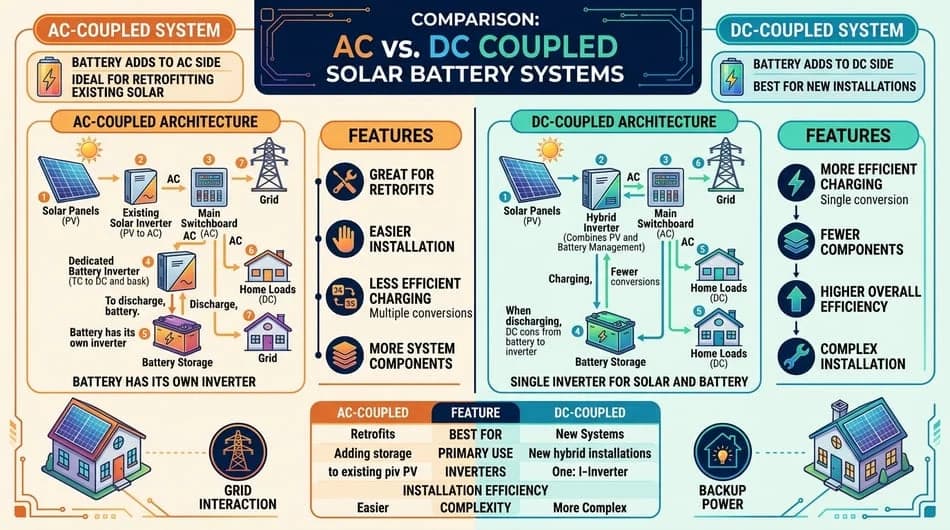
AC vs DC Coupled Solar Batteries: Which Should You Choose?
AC vs DC coupled solar batteries compared: efficiency, costs ($8K-$18K), and ins...
How Many Solar Panels Do I Need to Run Off the Grid?
Most off-grid homes need about 8 to 16 solar panels rated at 400 watts, dependin...
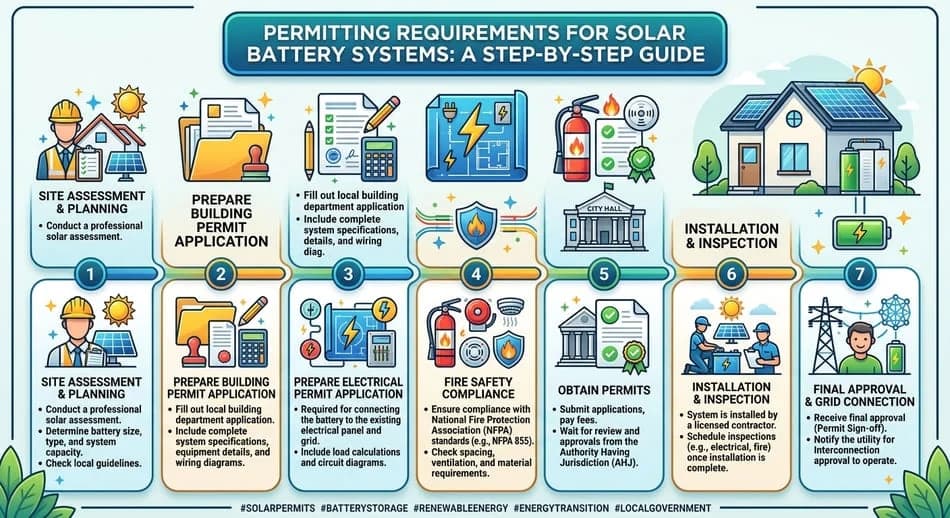
Solar Battery Permit Requirements: What You Need to Know
A solar battery usually needs local approval and a utility review before it can ...