
Rhode Island solar installations require more than just permits. Homeowners must also complete utility interconnection applications with Rhode Island Energy, pass municipal inspections, and meet NEC 2023 electrical code requirements that took effect December 1, 2025. The federal solar tax credit ends December 31, 2025 under the One Big Beautiful Bill Act, creating immediate urgency for Rhode Island residents planning installations.
Key requirements for Rhode Island solar installations:
- Utility interconnection through Rhode Island Energy with processing times varying by system size and complexity
- NEC 2023 compliance including rapid shutdown requirements, arc-fault protection, and updated conductor sizing standards
- Municipal inspections covering electrical, structural, and final sign-off before grid connection activation
- Net metering or REG program enrollment for systems up to 25 kW residential with credits at full retail rates
The Rhode Island Office of Energy Resources and State Building Code Commission established these standardized regulations to create uniform permitting across all municipalities. Processing times typically range from 2 to 6 weeks depending on system complexity and completeness of documentation. Solar systems convert DC electricity from panels to AC power through inverters for grid connection. Applicants must include weatherproofing methods, structural engineering details, and energy storage specifications when applicable. Licensed contractors can expedite the application process and ensure compliance with state building codes.
What Is Rhode Island’s Consolidated Solar Permitting System?
Rhode Island’s consolidated permitting system creates a reliable, standardized pathway for solar project approvals. Rather than juggling separate construction and electrical authorizations, applicants complete one comprehensive form. This integration eliminates duplicate paperwork and accelerates project timelines.
Authority Behind the Regulations:
The Rhode Island Office of Energy Resources partnered with the Rhode Island State Building Code Commission to develop these standards. Every city and town across the state implements the same application framework, creating consistency regardless of location. Solar permit services in Houston follow similar standardized approaches established by state authorities.
Essential Definitions:
Familiarize yourself with these fundamental terms before starting your application:
- AC (Alternating Current): Standard electrical flow format powering homes and businesses.
- DC (Direct Current): Electricity format generated directly from photovoltaic panels before conversion.
- Inverter: Technology converting panel-generated DC power into grid-compatible AC electricity.
- PV System (Solar Photovoltaic System): Complete assembly of panels and equipment transforming sunlight into usable power.

Rhode Island Utility Interconnection Process
Rhode Island Energy (formerly National Grid) handles all solar interconnection applications for the state. The interconnection process runs parallel to permitting and should begin early to avoid project delays. Without utility approval, your solar system cannot legally connect to the grid or generate credits.
Interconnection Application Requirements
Rhode Island Energy requires specific documentation for interconnection approval. Submit your application concurrent with or shortly after your permit application to maintain project momentum.
Required documentation includes:
- Completed interconnection application form (available through Rhode Island Energy portal)
- Single-line electrical diagram showing system configuration and connection points
- Equipment specification sheets for inverters, panels, and rapid shutdown devices
- Proof of permit application or approval from the local authority having jurisdiction
- Site plan showing meter location, main service panel, and proposed solar equipment placement
- W-9 form for REG program participants
Processing Timeline and Requirements
Rhode Island law establishes specific timeframes for utility response to interconnection requests. Rhode Island Energy must acknowledge receipt within three business days and notify applicants of completeness within ten business days.
For residential systems under 25 kW that comply with UL 1741 standards, no feasibility study fee applies. Larger systems or those requiring engineering review may need impact studies, which the utility must complete within 90 days of receiving a completed application. The interconnection service agreement must be finalized within 175 calendar days for standard applications or 200 days when detailed studies are required.
System modifications must be completed within 270 to 360 calendar days from the interconnection service agreement date. Planning your installation timeline around these requirements helps ensure you meet the December 31, 2025 tax credit deadline.
Choosing Between Net Metering and the REG Program
Rhode Island homeowners must select either net metering or the Renewable Energy Growth (REG) program during interconnection. You cannot participate in both simultaneously, and this choice significantly impacts your long-term returns.
Net metering provides bill credits at the full retail rate (currently averaging 27.92 cents per kWh) for excess generation. Credits roll over month-to-month, and as of February 2024, participants can request cash payouts for excess credits or transfer them to other accounts. Residential systems can be sized up to 25 kW and must generate no more than 125% of historical on-site consumption based on a three-year average.
The REG program offers fixed performance-based incentive payments under 15 or 20-year contracts. For the 2025 program year, Rhode Island Energy pays 33.85 or 32.35 cents per kWh depending on system classification. This program provides predictable, guaranteed income but requires all generated electricity to flow to the grid rather than offsetting on-site consumption first.
The REG program opens April 1st each year with 9 MW DC capacity allocated for small-scale projects on a first-come, first-served basis. Applications must be submitted through Rhode Island Energy’s interconnection portal, and projects must become operational within 24 months of approval.
NEC 2023 Electrical Code Requirements for Rhode Island Solar
Rhode Island adopted NEC 2023 with an effective date of December 1, 2025. All new solar installations must comply with these updated electrical code requirements. The State Building Code Standards Committee adopted Chapters 3 through 9 of NEC 2023 with no changes, while implementing Rhode Island-specific amendments to Article 90 and Chapters 1 and 2 for consistency with state statutes.
Rapid Shutdown Requirements (NEC 690.12)
Rapid shutdown systems protect firefighters and emergency responders by quickly reducing voltage on rooftop conductors. NEC 2023 maintains and clarifies these critical safety requirements.
Key rapid shutdown specifications:
- Conductors must be reduced to 80 volts or less within 30 seconds of rapid shutdown initiation
- Module-level power electronics (MLPEs) or compliant rapid shutdown equipment required for all new installations
- Rapid shutdown initiation device must be located at a readily accessible location outside the building
- Array boundary defined as one foot from the array in all directions
Inspectors verify rapid shutdown compliance during final electrical inspection. Systems that fail to meet these requirements cannot receive approval for grid connection.
Arc-Fault Protection Requirements
NEC 2023 requires arc-fault circuit protection for DC circuits in PV systems. Arc faults can cause fires, and these protective devices detect and interrupt dangerous arcing conditions before they cause damage.
Most modern inverters and module-level power electronics include integrated arc-fault detection that satisfies code requirements. Verify that your equipment carries appropriate certifications and listings before installation.
Disconnecting Means (NEC 690.13)
Proper disconnect placement and labeling ensures safe system isolation for maintenance and emergencies.
Disconnect requirements include:
- PV system disconnecting means must be installed at a readily accessible location
- Disconnects must be grouped with or located near the main service disconnecting means when possible
- All disconnects must be permanently marked to identify them as PV system disconnects
- Directory required at main service showing location of all disconnects if not grouped together
Conductor Sizing and Grounding
NEC 2023 maintains strict requirements for conductor sizing, temperature correction, and conduit fill calculations. Undersized conductors create fire hazards and cause voltage drop that reduces system performance.
Critical conductor considerations:
- Temperature correction factors must be applied based on expected ambient conditions
- Conduit fill calculations must account for all conductors in shared raceways
- Equipment grounding conductors must be sized according to Table 250.122 based on overcurrent device ratings
- Grounding electrode system must comply with Article 250 requirements
Energy Storage System Requirements (NEC 706)
When battery storage accompanies your solar installation, additional NEC 706 requirements apply. Rhode Island’s statewide permit application requires supplementary documentation for energy storage components.
Battery installation requirements:
- Disconnecting means located within sight of and within 50 feet of the energy storage system
- Ventilation requirements for battery enclosures based on manufacturer specifications
- Signage identifying energy storage system location, type, and voltage
- Working space clearances maintained per NEC 110.26

Solar Permit Solutions
Skip the Permit Headaches
We design plan sets that pass inspection the first time. Code-compliant, PE-stamped, accepted by AHJs nationwide.
Rhode Island Solar Inspection Requirements
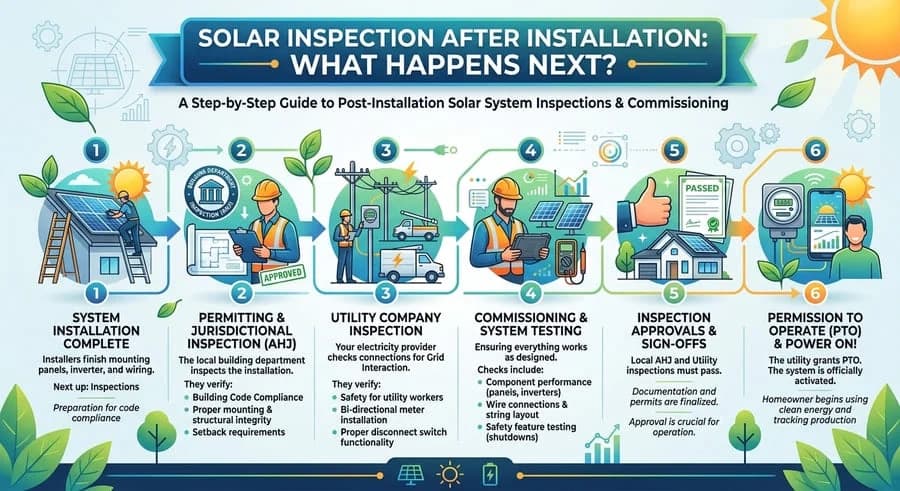
Municipalities conduct plan reviews and inspections to verify code compliance, structural adequacy, and electrical safety. Some jurisdictions require multiple inspections during installation, while others consolidate reviews into a final inspection before authorizing utility interconnection.
Typical Inspection Sequence
Most Rhode Island solar installations require three to four inspections depending on system configuration and local requirements.
- Rough electrical inspection: Conducted before conductors are covered or enclosed. Inspectors verify conductor routing, junction box placement, and conduit installation.
- Structural inspection: For roof-mounted systems, inspectors verify racking attachment, roof penetration sealing, and load distribution. Ground-mounted systems require foundation and setback verification.
- Final electrical inspection: Comprehensive review of the completed system including disconnect placement, labeling, rapid shutdown functionality, and grounding connections.
- Utility witness test: Rhode Island Energy may require a witness test before activating the interconnection and installing the production meter.
Documentation Required at Inspection
Have the following documentation available on-site for all inspections: approved permit set with stamped drawings, equipment specification sheets and listings, inspection correction list from any prior inspections, and manufacturer installation instructions for all major components. Reinspection fees vary by municipality and typically range from $50 to $150 per visit. More importantly, each reinspection adds days or weeks to your project timeline, potentially pushing completion past critical deadlines.
- Property Details: Document ownership information and installation location addresses.
- System Specifications: Record total capacity measurements (AC and DC ratings), connection points, and mounting methods. Understanding electrical fundamentals for solar projects helps ensure accurate system documentation.
- Energy Storage Information: Document battery system specifications when included, noting intended function and power source. The EPA provides guidance on proper solar equipment management and compliance.
- Contractor Information: Submit business credentials, addresses, and license documentation for all participating professionals. Professional solar services ensure all contractor requirements meet state standards.
- Roofing and Structural Details: Catalog existing roof composition, water barrier strategies, and engineering specifications for mounting hardware. Proper solar panel racking systems are critical for structural integrity.
- Electrical and Layout Diagrams: Include single-line electrical schematics and physical layouts with complete manufacturer specifications. Green Building Advisor offers technical resources for proper diagram preparation.
- Site Plan: Ground installations require detailed property diagrams showing system placement. Off-grid solar system design professionals can help create compliant site plans.
- Certification Forms: Projects exceeding 15 kW AC capacity need additional certification paperwork. Commercial solar design expertise becomes essential for larger installations.
Common Inspection Failure Points
Understanding common failure points helps contractors and homeowners prepare systems for successful inspection. Failed inspections delay projects and can jeopardize tax credit eligibility if they push completion past December 31, 2025.
Frequently cited inspection deficiencies:
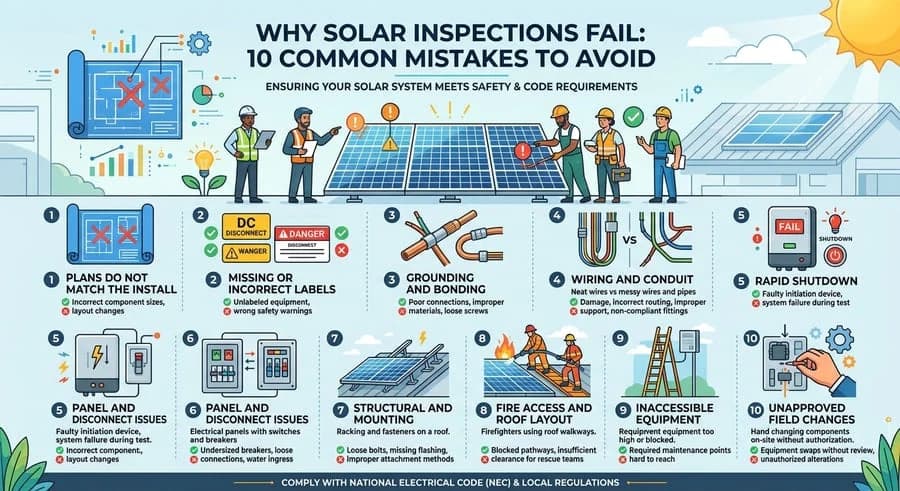
- Improper labeling: Missing or incorrect labels on disconnects, combiner boxes, and conduit runs. All labels must be permanent, weather-resistant, and clearly visible.
- Missing placards: Fire department placards indicating PV system presence must be installed per local fire code requirements.
- Conductor support deficiencies: Cables must be properly secured at specified intervals using listed hardware.
- Roof penetration issues: Inadequate flashing, sealant, or waterproofing around mounting attachments and conduit penetrations.
- Rapid shutdown non-compliance: Equipment not listed for rapid shutdown function or initiation device located in inaccessible location.
- Grounding deficiencies: Missing equipment grounding connections, undersized grounding electrode conductors, or improper bonding.
Rhode Island Installation Timeline Reality
Understanding realistic project timelines helps determine whether you can complete installation before the deadline.
Typical Rhode Island solar installation timeline:
- Permitting: 2-6 weeks depending on municipality and system complexity
- Equipment procurement: 2-4 weeks for panel, inverter, and racking delivery
- Installation: 1-3 days for typical residential systems
- Inspection scheduling and completion: 1-2 weeks
- Utility interconnection activation: 1-2 weeks after passing inspection
- Total realistic timeline: 8-16 weeks minimum from contract signing to operational system
Given current high demand, many installers report extended timelines. Some areas of the country are seeing contract-to-installation periods of 4-6 months. Rhode Island homeowners should act immediately if they intend to capture the tax credit.
Rhode Island Net Metering Rules and Credits
Net metering allows Rhode Island solar customers to receive bill credits for excess electricity sent to the grid. Understanding program rules helps homeowners maximize returns and properly size their systems.
System Size Limits and Eligibility
Rhode Island’s net metering program capacity limits vary by customer type and application:
- Residential customers: Systems up to 25 kW AC
- Non-residential customers: Systems up to 100 kW for standard net metering
- Virtual net metering: Projects up to 10 MW per site for eligible entities (municipalities, educational institutions, hospitals, commercial/industrial customers)
- Sizing requirement: Systems must be designed to generate no more than 100% of historical consumption based on a three-year average (or estimated annual usage for new construction)
Credit Calculation and Billing
Rhode Island net metering credits are calculated at the full retail rate for generation up to 125% of on-site consumption during a billing period. This rate currently averages 27.92 cents per kWh for residential customers.
Important billing provisions:
- Credits roll over month-to-month as dollar values, not kilowatt-hours
- Excess credits beyond 125% of consumption are credited at the utility’s avoided cost rate
- As of February 2024, customers can request cash payouts for excess credits
- Credits can be transferred to other accounts under the same ownership
- Rhode Island Energy may administer credits on a 12-month estimated basis for residential systems 25 kW and smaller
Recent Net Metering Changes
For projects initiated after April 15, 2023, the renewable net-metering credit is reduced by 20%, subject to a statewide capacity limit of 275 MW. This reduction reflects changing program economics as solar adoption increases.
Additionally, new net-metering systems must be sited outside core forests, with exceptions for “preferred sites,” including brownfields, rooftops, parking canopies, and previously developed areas. These siting requirements aim to balance renewable energy growth with environmental conservation.
Rhode Island State Solar Incentives
Beyond net metering and the REG program, Rhode Island offers additional incentives that improve solar economics. These state-level benefits remain available regardless of federal tax credit status.
Sales Tax Exemption
Rhode Island provides a 100% sales tax exemption on all solar equipment and installation purchases, eliminating the state’s 7% sales tax. This exemption applies automatically and requires no separate application.
Property Tax Exemption
Renewable energy systems used in residential and manufacturing sectors are exempt from property taxes. Your solar installation adds value to your home without increasing your property tax burden.
Renewable Energy Fund Grants
The Renewable Energy Fund (REF), administered by the Rhode Island Commerce Corporation, provides grants for qualifying renewable energy projects. Note that REF grants cannot be combined with REG program participation. Homeowners must choose between REF grants plus net metering or the REG program alone.
Affordable Solar Access Pathways (ASAP) Program
The ASAP program provides qualifying households in environmental justice areas access to affordable rooftop solar through an innovative lease structure. PosiGen serves as the lease provider, offering solar installations with minimal upfront costs to eligible participants.
Conclusion
Securing your solar permit in Rhode Island doesn’t have to be overwhelming. The state’s unified permitting framework simplifies what was once a fragmented process into a single, straightforward application. By understanding the requirements upfront and preparing your documentation carefully, you can avoid design mistakes that lead to permit denials and move forward with your solar installation confidently. Whether you’re installing a residential rooftop system or a commercial ground-mount array, following these guidelines ensures compliance with state regulations while accelerating your path to clean energy independence. Solar permit expediting services can further streamline the approval process. Take the time to gather accurate system specifications, work with licensed contractors, and submit complete documentation to make your Rhode Island solar project a success. For more insights, explore the Department of Energy’s solar blog and NREL’s renewable energy research.
FAQs
What is the benefit of Rhode Island’s statewide solar permit application?
Rhode Island’s unified permitting system combines building and electrical permits into one streamlined application. This consolidation eliminates redundant paperwork, reduces processing delays, and creates consistency across all municipalities. Instead of navigating different requirements in each town, applicants follow the same standardized process statewide, saving both time and effort. Understanding how long solar permits take helps set realistic project timelines. Solar permit services in Los Angeles also benefit from standardized permitting approaches.
Skip the Permit Headaches
We design plan sets that pass inspection the first time. Code-compliant, PE-stamped, accepted by AHJs nationwide.
Frequently Asked Questions
Rhode Island's unified permitting system combines building and electrical permits into one streamlined application. This consolidation eliminates redundant paperwork, reduces processing delays, and creates consistency across all municipalities. Instead of navigating different requirements in each town, applicants follow the same standardized process statewide, saving both time and effort.
You'll use the same statewide application form regardless of mounting type. However, ground-mounted installations require additional documentation, specifically a detailed site plan showing system placement on your property. Rooftop systems focus more on structural engineering details and weatherproofing methods for the mounting hardware.
Applications for systems with energy storage require supplementary information about the battery components. You'll need to specify the storage system's intended purpose, its charging methodology, and its technical specifications. This information helps permitting authorities ensure proper electrical integration and safety compliance for the complete installation.
Systems rated at 15 kW AC capacity or higher trigger additional certification requirements beyond the standard application. These larger installations demand extra documentation to verify structural integrity, electrical safety, and code compliance. Plan for extended review timelines when submitting applications for commercial-scale projects.
Licensed solar contractors and electricians familiar with Rhode Island's permitting requirements typically handle application submissions. These professionals understand the technical specifications, documentation standards, and local building codes necessary for approval. Working with experienced contractors reduces errors and ensures your application includes all required components from the start.

SPS Editorial Team
Solar Permit Solutions
Solar Permit Solutions provides professional solar permit design services for residential, commercial, and off-grid installations across all 50 states. Our team ensures permit-ready plan sets delivered fast.
Related Articles
Why Solar Inspections Fail: 10 Common Mistakes to Avoid
Discover the 9 critical reasons solar inspections fail and how to avoid costly m...

Solar Grounding And Bonding: How To Pass Inspection Every Time
Learn how to pass solar grounding and bonding inspections every time. Avoid comm...
Solar Inspection After Installation: What Happens Next?
Learn how to pass your solar inspection by following essential tips for obtainin...