
how many solar panels do you need

Solar Incentives By State: Complete Guide To Rebates, Tax Credits, And Savings In 2026

Solar incentives vary by state and can reduce your installation costs by 25% to 60% depending on where you live. With the federal solar tax credit no longer available directly to homeowners in 2026, state and local incentives have become the primary way to lower solar costs.

Key solar incentives available in 2026 include:

  • State tax credits ranging from 15% to 25% of installation costs (up to $5,000 in New York)
  • Sales tax exemptions eliminating 5% to 8% in upfront costs in most states
  • Property tax exemptions preventing increased home assessments after solar installation
  • Net metering programs compensating solar owners for excess electricity at retail rates
  • Solar Renewable Energy Credits (SRECs) worth $4 to $85 per megawatt-hour depending on state
  • Utility rebates offering $500 to $6,000 in upfront savings

States with the strongest solar incentive packages include New Jersey (SuSI program worth $10,200+ over 15 years), New York (25% state tax credit plus 15-year property tax exemption), Illinois (SREC program worth $10,000-$12,000 over 15 years), and Maryland (up to $7,500 for income-qualified residents plus SRECs). Other states like Hawaii and Nevada also offer compelling programs worth exploring.

Starting in 2026, homeowners must choose between purchasing solar outright to claim local incentives or entering Third-Party Ownership arrangements like leases and PPAs to benefit from the federal tax credit indirectly.

Acting fast pays off when it comes to solar incentives. The value of most programs decreases over time as solar adoption grows and equipment costs continue to drop.

Below you'll find local solar incentives organized by state.

Arizona

California

Colorado

Connecticut

Florida

Illinois

Maryland

Massachusetts

Minnesota

New York

New Jersey

Ohio

Texas

Virginia

arizona solar incentives

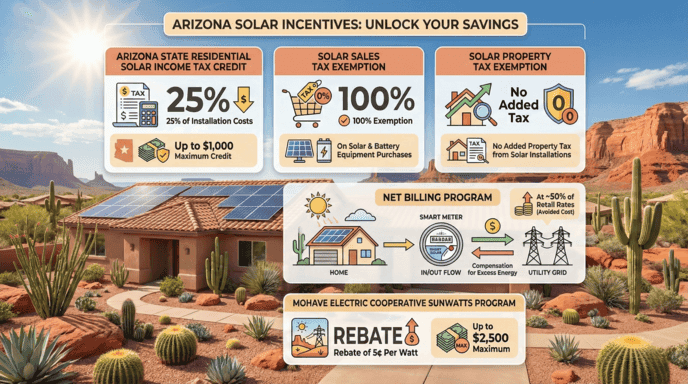
Arizona Solar Incentives

In Arizona (often called the "Sunshine State"), solar panels make perfect sense for homeowners wanting to convert sunlight into savings. Even better, Arizona provides several incentives that boost your energy cost savings. Homeowners considering going solar with SRP in Arizona can take advantage of multiple programs.

Arizona Solar Incentives Table
Incentive Name Implementing Body Value
Arizona State Residential Solar Income Tax Credit State of AZ 25% of installation costs up to $1,000
Solar Sales Tax Exemption State of AZ 100% sales and use tax exemption for solar and battery technologies
Solar Property Tax Exemption State of AZ 100% property tax exemption for the value added by solar and battery technologies
Net Billing Investor-owned utilities Solar owners receive compensation for excess production based on Resource Comparison Proxy (RCP), currently around 50% of retail rates
Mohave Electric Cooperative SunWatts Renewable Energy Incentive Program Mohave Electric Cooperative Rebate of 5 cents per watt of solar capacity installed, up to $2,500

Keep in mind that efforts are underway to weaken Arizona's net billing policy. However, Arizonans can lock in the current policy by installing solar before any changes take effect.

California Solar Incentives

High energy costs and plenty of sunshine make California an excellent state for solar. In fact, California offers relatively few solar incentives because solar already costs far less than purchasing electricity from a utility. For a comprehensive breakdown, see our California solar incentives and rebates guide.

Still, here are some California solar incentives worth knowing about.

California Solar Incentives Table
Incentive Name Implementing Body Value
The Self-Generation Incentive Program (SGIP) CPUC Rebates for battery storage up to $1,000 per kWh of capacity installed
Property Assessed Clean Energy (PACE) Financing State of CA Solar financing through property tax assessments
Solar Rebate Rancho Mirage Energy Authority $500
Solar Stipend Sacramento Municipal Utility District (SMUD) $150
DAC-SASH GRID Alternatives Low- and no-cost solar installations for qualifying low-income households in disadvantaged communities

Colorado Solar Incentives

Colorado enacted a clean energy bill in 2023 that includes funding to streamline permitting for local solar energy projects. This complements existing state and local solar incentives. Understanding whether solar permits are necessary helps homeowners navigate the installation process.

Colorado Solar Incentives Table
Incentive Name Implementing Body Value
Solar Sales Tax Exemption State of CO 100% sales and use tax exemption for solar and battery technologies
Solar Property Tax Exemption State of CO 100% property tax exemption for the value added by solar and battery technologies
Residential Energy Upgrade (RENU) Loan State of CO Low-cost, long-term financing up to $75,000
Weatherization Assistance Program (WAP) Colorado Energy Office No-cost solar installations for qualifying applicants
Energy Smart Colorado Renewable Energy Rebate CORE (Pitkin and Eagle Counties) Rebate covering 25% of solar project costs up to $2,500
City of Boulder's Solar Rebate Ordinance City of Boulder Rebate for 15% of the city sales and use tax paid on materials and permits for solar installation
Solarize Summit High Country Conservation Center Up to $1,950 in rebates for eligible residents of Breckenridge, Frisco, and unincorporated Summit County
Solar Rewards Xcel Energy Upfront rebate of $1 per watt of solar capacity installed (up to 7 kW)

Additional Utility-Based Solar Incentives in Colorado

These Colorado utilities also provide some form of rebate or rewards program:

  • San Miguel Power Association 
  • Colorado Springs Utilities 
  • Aspen Electric 
  • Holy Cross Energy 
  • La Plata Electric Association 
  • Black Hills Energy

Connecticut Solar Incentives

Connecticut has the second-highest average electricity price in the US, making solar panels a powerful tool for massive energy cost savings. That said, Connecticut doesn't overflow with solar incentives, but every bit helps.

Connecticut Solar Incentives Table
Incentive Name Implementing Body Value
Solar Sales Tax Exemption State of CT 100% sales and use tax exemption for solar and battery technologies
Solar Property Tax Exemption State of CT 100% property tax exemption for the value added by solar and battery technologies
The Residential Energy Solutions Program State of CT Compensation for electricity produced by residential solar systems

Connecticut's Residential Energy Solutions Program

The Residential Energy Solutions program took over from net metering in 2022, giving solar owners two compensation options.

The "netting option" works similarly to traditional net metering programs but adds direct payments for each kilowatt-hour of solar generation. The "buy-all option" lets you sell all your solar production to your utility for on-bill credit compensation at a flat rate per kWh.

As of this writing, these appear to be Connecticut's only solar incentives, though checking with your local government and utility provider is worthwhile.

Florida Solar Incentives

Abundant sunshine and a thriving rooftop solar industry make Florida perfect for going solar. A handful of state and local incentives sweeten the deal. For FPL customers, our FPL solar guide covers everything you need to know about costs and installation.

Florida Solar Incentives Table
Incentive Name Implementing Body Value
Property Tax Exemption State of FL Property tax exemption for 100% of the value added by solar and/or battery storage
Sales Tax Exemption State of FL Sales tax exemption for solar energy systems
Property Assessed Clean Energy (PACE) State of FL Solar financing through property tax assessments
Net Metering State of FL Compensation for excess solar generation at retail utility rates
Boynton Beach Energy Edge Rebate City of Boynton Beach Up to $1,500 for systems 5 kW or larger
Dunedin Solar Energy Grant Program City of Dunedin $0.25 per watt of solar power generated for a maximum grant of $2,500

Illinois Solar Incentives

Illinois demonstrates how solar incentives can make solar appealing in states without exceptionally high electricity prices or constant sunshine. The launch of the Adjustable Block Program in 2019 boosted solar's financial benefits and sparked residential, utility, and community adoption.

Illinois Solar Incentives Table
Incentive Name Implementing Body Value
Illinois Shines Program State of IL Awards participants one renewable energy credit (REC) for every 1,000 kWh of solar production for 15 years, which can be sold on marketplaces for cash
Special Property Value Assessments State of IL Value added by solar won't raise your property taxes
Illinois Solar for All State of IL No-cost solar program reserved for eligible low-income homeowners
Net Metering State of IL Residential solar owners receive compensation for excess production at retail electricity rates

Note on the Illinois Shines Program:

Based on 2025 SREC values, an average residential solar system would generate between $10,000 and $12,000 over 15 years.

Maryland Solar Incentives

Maryland provides several solar and battery incentives that can significantly cut the cost of these home upgrades while maximizing energy cost savings.

Maryland Solar Incentives Table
Incentive Name Implementing Body Value
Sales Tax Exemption State of MD 100% exemption from state sales tax on solar purchases
Property Tax Exemption State of MD 100% property tax exemption for the home value added by solar energy equipment
Maryland Solar Access Program State of MD Up to $7,500 for income-qualified residents
Net Metering State of MD Residential solar owners receive compensation for excess production at retail electricity rates
Energy Storage Income Tax Credit State of MD State income tax credit covering 30% of total battery cost, capped at $5,000
Solar Renewable Energy Credits State of MD SRECs valued at $50 per 1,000 kWh of solar production, as of December 2025

SREC values fluctuate over time, but at current rates, an average system producing 7,000 kWh annually would generate over $350 per year.

Local Government Solar Incentives in Maryland

Beyond the state property tax exemption, several counties offer local property tax credits worth up to $5,000 annually. These include:

  • Baltimore County 
  • Anne Arundel County 
  • Prince George's County 
  • Harford County

Consult a licensed tax advisor to create a strategy for claiming these local incentives.

Massachusetts Solar Incentives

Massachusetts solar incentives feature a state tax credit and rebate program, plus generous municipal rebate programs. Homeowners should take advantage of these incentives now, as program funding typically decreases over time.

Massachusetts Solar Incentives Table
Incentive Name Implementing Body Value
Sales Tax Exemption State of MA 100% exemption from state sales tax on solar purchases
Property Tax Exemption State of MA 100% property tax exemption for the home value added by solar energy equipment
Net Metering State of MA Residential solar owners receive compensation for excess production at retail electricity rates
Solar Massachusetts Renewable Target (SMART) Rebate Program State of MA Compensation for kWh of production based on utility and system specifications
Solar Tax Credit State of MA State tax credit covering 15% of project costs, up to $1,000

Utility-Based Solar Incentives in Massachusetts

Massachusetts also features numerous municipal rebate programs you can combine with state and federal incentives to significantly reduce solar costs.

  • Municipal utilities offering rebate programs include:
  • Ipswich Electric Light Department 
  • Shrewsbury Electric & Cable Operations 
  • Wakefield Municipal Gas and Light Department 
  • Reading Municipal Light Department 
  • Hudson Light & Power 
  • Concord Municipal Light and Power 
  • Taunton Municipal Lighting Plant

Minnesota Solar Incentives

Despite not being the sunniest state, Minnesota has several solar-friendly policies and utility-based incentives.

Minnesota Solar Incentives Table
Incentive Name Implementing Body Value
Net Metering State of MN Solar owners receive compensation at retail rates for excess production exported onto the grid
Sales Tax Exemption State of MN 100% state sales tax exemption on solar equipment
Property Tax Exemption State of MN 100% exemption from real property taxes
Minnesota Power SolarSense Minnesota Power Upfront rebate of $0.29 per kWh of expected annual average production, up to $5,000
Xcel Energy Solar*Rewards Xcel Energy Annual incentive of $0.03 per kWh of solar production over 10 years. Larger incentives available for income-qualified households

At least three public utilities in Minnesota also offer rebate programs for residential solar installations:

  • Rochester Public Utilities – $500 
  • Owatanna Public Utilities – $500 
  • Austin Utilities – $500

Combine these upfront rebates with the 30% federal solar tax credit* to substantially lower the cost of rooftop solar!

*Update: Now that the "One Big Beautiful Bill" is law, residential solar systems must be installed by December 31, 2025 to qualify for the federal solar tax credit. Starting in 2026, homeowners cannot claim a federal solar tax credit.

new york solar rebates

New York Solar Rebates

New York arguably offers the best solar incentive programs for homeowners nationwide. In most cases, you can have over half your project costs covered by some form of incentive. Homeowners in the Con Edison service area can explore our guide on going solar with Con Edison in New York for additional details.

New York Solar Incentives Table
Incentive Name Implementing Body Value
NY State Tax Credit NY State 25% of solar expenditure up to $5,000
Sales Tax Exemption NY State State sales tax exemption on solar equipment
Property Tax Exemption NY State 15-year property tax exemption on the value solar adds to your home
Net Metering NY State Two options: Phase One plus CBC or Value of Distributed Energy Resources (VDER) or Value Stack
PSEG Long Island Battery Storage Rewards PSEG Long Island Compensation for discharging battery storage during high electricity demand events in summer

New Jersey Solar Rebates

New Jersey features perhaps the most valuable incentive in the country with its Successor Solar Incentive (SuSI). Combined with the federal solar tax credit, Garden State residents can slash their solar costs by well over 50%.

New Jersey Solar Incentives Table
Incentive Name Implementing Body Value
Sales Tax Exemption State of NJ 100% state sales tax exemption for solar purchases
Property Tax Exemption State of NJ 100% property tax exemption for the value added by solar PV systems
Successor Solar Incentive Program (SuSI) State of NJ Earn and sell SREC-IIs valued at $85 for each MW of electricity the system produces for 15 years
Net Metering State of NJ Residential solar owners receive compensation for excess production at retail electricity rates

NJ SuSI Program at a Glance

Through the SuSI program, solar owners can earn and sell SREC-IIs valued at $85 for each MW of electricity their system produces for 15 years. With an average system producing approximately 8 MW per year, that totals $680 annually and $10,200 over 15 years.

Ohio Solar Incentives

According to the Office of the Ohio Consumers' Counsel, Ohio hosts over 200 solar companies and is positioned for rapid growth throughout the 2020s. Beyond the 30% federal solar tax credit*, the state provides several incentives encouraging homeowners to fuel Ohio's expanding solar industry. Our guide on going solar with AEP Ohio provides utility-specific information.

*Update: Now that the "One Big Beautiful Bill" is law, residential solar systems must be installed by December 31, 2025 to qualify for the federal solar tax credit. Starting in 2026, homeowners cannot claim a federal solar tax credit.

Ohio Solar Incentives Table
Incentive Name Implementing Body Value
Net Metering State of OH Compensation for excess solar generation exported onto grid, varies by utility provider
Sales Tax Exemption State of OH Exemption for state sales tax on solar purchases
Solar Renewable Energy Credits (SRECs) State of OH SRECs valued at $4 per MWh of generation
ECO-Link Program State of OH Low-cost financing for home improvement projects including rooftop solar
Ohio Property-Assessed Clean Energy (PACE) Financing Ohio PACE Solar financing through property tax assessments

Local Government Incentives

Several solar incentives at city and county levels can further lower the cost of solar:

Local property tax exemptions in Cleveland and Cincinnati prevent the value added by your solar system from increasing your property taxes Low-interest financing through the Hamilton County Home Improvement Program

texas solar incentives

Texas Solar Incentives

Plenty of sunshine and minimal shade make Texas ideal for rooftop solar. However, most incentives come from local and utility sources rather than the state level, so spending extra time researching incentives for your area pays off.

Texas State and Local Government Solar Incentives

Texas Solar Incentives Table
Incentive Name Implementing Body Value
Property Tax Exemption Texas Comptroller Exemption from property tax based on value added by solar energy system
City of Sunset Valley's Solar Energy Conservation Rebate City of Sunset Valley $1.00 per watt of solar capacity installed up to $3,000

Texas Utility-Based Solar Incentives

Most solar incentives in Texas come from utilities. These include:

Texas Solar Incentives Table
Incentive Name Implementing Body Value
Austin Energy Rebate Austin Energy Rebate up to $2,500
Solar PV Rebate San Marcos Electric Utility (SMTX) Rebate up to $2,500
SMART Source Solar PV Program AEP Texas North Company Rebate up to $6,000
SMART Source Solar PV Program AEP Texas Central Company Rebate up to $5,000
Oncor Residential Solar Program Oncor Electric Delivery Rebates for eligible solar & battery projects
Garland Power & Light Buyback Program Garland Power & Light Purchases excess solar production for $0.0669 per kWh
Denton Municipal Electric (DME) Solar Rebate Denton Municipal Electric (DME) Solar rebate with an average award of $4,000
New Braunfels Utilities Solar Rebate New Braunfels Utilities Solar rebate up to $3,000

Virginia Solar Incentives

Virginia offers several solar incentives alongside the 30% federal solar tax credit* that can make rooftop solar more affordable than purchasing electricity from a utility provider.

*Update: Now that the "One Big Beautiful Bill" is law, residential solar systems must be installed by December 31, 2025 to qualify for the federal solar tax credit. Starting in 2026, homeowners cannot claim a federal solar tax credit.

Virginia Solar Incentives Table
Incentive Name Implementing Body Value
Property Tax Exemption State of VA Value of solar energy system won't increase your property tax valuation
Net Metering State of VA Residential solar owners receive compensation for excess generation at retail value
Solar Renewable Energy Credits (SRECs) State of VA Market value of $55 per SREC in June 2023 would produce $400-500 per year for the average residential system

Conclusion

Solar incentives vary dramatically from state to state, and understanding what's available in your area can make the difference between a good investment and a great one. With the federal solar tax credit no longer available directly to homeowners starting in 2026, local and state incentives have become more important than ever.

Whether you're considering a direct purchase or exploring Third-Party Ownership options like leases and PPAs, the key is acting quickly. Incentive programs tend to decrease in value over time as solar adoption increases and program budgets get depleted. According to the U.S. Energy Information Administration, electricity prices continue rising, making solar an increasingly attractive investment. States like New Jersey, New York, Illinois, and Maryland offer particularly strong incentive packages that can offset a significant portion of your installation costs.

Take time to research the specific incentives available through your state government, local municipalities, and utility providers. Combining multiple incentives, such as state tax credits with utility rebates and property tax exemptions, maximizes your savings potential. For residential solar design assistance or commercial solar projects, working with experienced professionals ensures you capture every available benefit. Homeowners interested in battery backup systems may also want to explore off-grid solar system design options.

FAQs

What happened to the federal solar tax credit for homeowners in 2026?

Starting in 2026, homeowners can no longer claim the federal solar tax credit directly. The "One Big Beautiful Bill" eliminated the residential solar tax credit, meaning homeowners who want to benefit from federal incentives must now enter into Third-Party Ownership arrangements like solar leases or Power Purchase Agreements. Under these arrangements, a business owns the system, claims the federal tax credit, and passes some savings to the homeowner through reduced energy costs.

Can I combine multiple solar incentives in my state?

Yes, in most cases you can stack multiple incentives to maximize your savings. For example, you might combine a state tax credit with a utility rebate, sales tax exemption, and property tax exemption. However, some programs have restrictions, so check the specific requirements for each incentive. Consulting with a licensed tax advisor helps ensure you claim all eligible incentives without running into conflicts between programs.

How do Solar Renewable Energy Credits (SRECs) work?

SRECs represent the environmental benefits of generating solar electricity. For every 1,000 kWh (or 1 MWh) of solar energy your system produces, you earn one SREC. You can then sell these credits on open marketplaces to utilities that need to meet renewable energy requirements. SREC values fluctuate based on supply and demand in each state's market. States like New Jersey, Maryland, and Illinois have active SREC programs that can generate hundreds or even thousands of dollars annually for solar owners. The EPA provides detailed information on how these programs work alongside net metering.

What is net metering and why does it matter?

Net metering allows you to send excess electricity your solar panels generate back to the grid in exchange for credits on your utility bill. When your system produces more power than you're using (typically during midday), the surplus flows to the grid and your meter essentially runs backward. Later, when you need more power than your panels produce (at night or on cloudy days), you draw from the grid and use those credits. Net metering policies vary by state and utility, with some offering full retail rate compensation while others provide reduced rates. States like Nevada have specific NV Energy net metering requirements that homeowners should understand. According to SEIA, net metering remains one of the most important policy mechanisms supporting residential solar adoption.

How long do solar incentive programs typically last?

Solar incentive programs don't last forever. Most have sunset dates, funding caps, or declining value structures built in. For instance, utility rebate programs often have annual budgets that run out, and state programs frequently reduce incentive amounts as solar adoption grows. The Illinois Shines Program and New Jersey's SuSI program offer compensation for 15 years, but enrollment windows can close. Acting sooner rather than later locks in current incentive values before programs change or end. Solar Permit Solutions can help you navigate the permitting process quickly to meet program deadlines.

Do solar incentives apply to battery storage systems?

Many states now offer incentives specifically for battery storage, either as standalone programs or as add-ons to solar incentives. California's Self-Generation Incentive Program (SGIP) provides rebates up to $1,000 per kWh of battery capacity. Maryland offers a 30% state income tax credit for battery storage capped at $5,000. New York's PSEG Long Island Battery Storage Rewards compensates homeowners for discharging batteries during peak demand periods. Adding battery storage to your solar system can qualify you for additional incentives while providing backup power and greater energy independence. For questions about your solar project, contact our team for personalized guidance.

Contact us

Get in touch today

We are dedicated to providing top-notch solar permit services to homeowners, business owners, DIY, and solar installers. Contact us today.

Check - Elements Webflow Library - BRIX Templates

Thank you

Thanks for reaching out. We will get back to you soon.
Oops! Something went wrong while submitting the form.
Solar COMPANIES SUPPORTING
Solar Permit Solutions
Choosing Solar Permit Solutions means benefiting from our fast turnaround times, comprehensive packages, and dedicated support team.

We take the hassle out of the permitting process so you can focus on your solar installation.
Partners / Sponsors