
how many solar panels do you need

Colorado Solar Permit Guide 2026: Requirements, Costs & Timeline

Colorado solar permits typically take 10-30 days for residential systems and 30-60 days for commercial installations. Costs range from $100 to $500 for home solar projects and $500 to $2,000+ for commercial systems, depending on jurisdiction and system size.

You need three permits to install solar panels in Colorado: a building permit ($150-$500), an electrical permit ($75-$200), and a zoning permit (fees vary by location). Major cities like Denver, Boulder, and Fort Collins offer expedited processing that can reduce wait times to 3-7 days for an additional $200-$500 fee.

The permitting process follows four main steps: (1) submit a complete application with engineering documents and site plans; (2) the building department reviews for code compliance (7-45 days); (3) receive permit approval and pay fees; and (4) pass inspections after installation before connecting to the grid. Missing any required documentation causes delays averaging 2-4 weeks.

Colorado ranks among the top states for solar energy adoption, with over 4,000 megawatts of installed solar capacity. The combination of 300+ days of annual sunshine, the 30% federal Investment Tax Credit, state renewable energy standards, and net metering policies makes Colorado ideal for solar installations. However, understanding Colorado's permitting requirements is essential; installing without proper permits can result in $500-$5,000 fines, required system removal, and inability to claim tax credits.

Colorado solar permitting varies significantly by location. Denver processes applications through an online ePlan system in 10-15 business days. Boulder offers 3-day expedited review and maintains pre-approved mounting systems lists. Rural counties may have simpler requirements but longer processing times due to limited staff. Understanding which Authority Having Jurisdiction (AHJ) governs your location determines which codes apply, what fees you'll pay, and how long approval takes.

Solar permitting in Colorado ensures that your system meets National Electrical Code safety standards, complies with local building codes for structural integrity, and integrates properly with utility grids. Whether you're a homeowner exploring residential solar, a business planning a commercial array, a DIY enthusiast tackling your own installation, or a solar installer managing multiple projects, navigating Colorado's permitting landscape requires careful attention to federal, state, and local requirements.

This comprehensive guide covers permit types and requirements, application processes, engineering documentation needs, cost breakdowns, common challenges and solutions, inspection procedures, and how professional solar permit services streamline approval timelines.

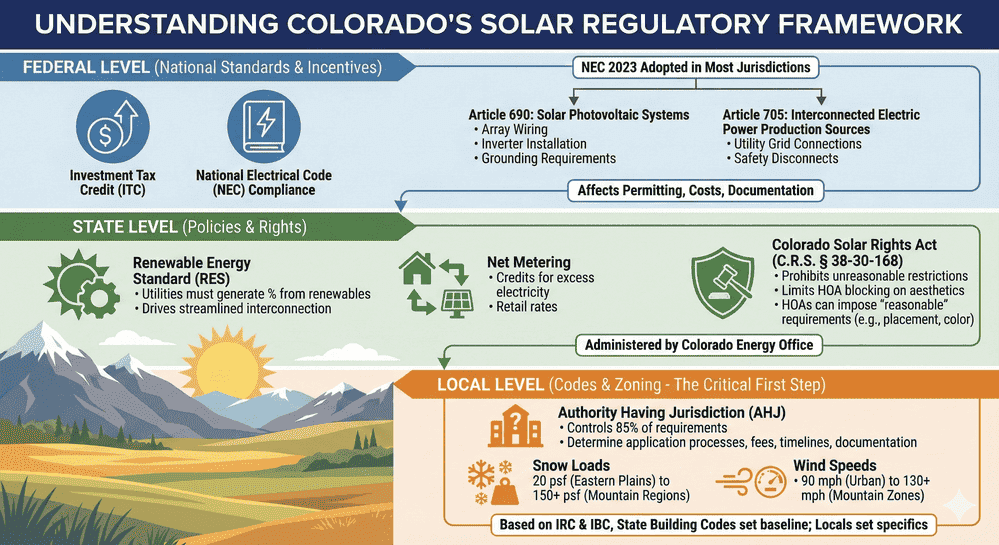
Colorado solar regulatory framework diagram showing federal, state, and local requirements

Understanding Colorado's Solar Regulatory Framework

Colorado solar regulations operate on three levels: federal (Investment Tax Credit and National Electrical Code), state (Renewable Energy Standard and net metering policies), and local (building codes and zoning ordinances). Each level adds specific requirements that affect permitting timelines, costs, and documentation needs.

Federal electrical standards mandate National Electrical Code (NEC) compliance for all solar installations. Colorado adopts NEC 2023 in most jurisdictions. Two critical NEC articles govern solar: Article 690 (Solar Photovoltaic Systems), covering array wiring, inverter installation, and grounding requirements; and Article 705 (Interconnected Electric Power Production Sources), addressing utility grid connections and safety disconnects.

Colorado's Renewable Energy Standard (RES) requires utilities to generate increasing percentages from renewable sources, driving streamlined solar interconnection processes. Net metering credits solar owners for excess electricity sent to the grid at retail rates. The Colorado Energy Office administers state solar programs.

The Colorado Solar Rights Act (C.R.S. § 38-30-168) prohibits unreasonable restrictions on solar installations, limiting HOA authority to block solar projects based purely on aesthetic concerns. However, HOAs retain rights to impose "reasonable" requirements like rear-slope placement or color-matched panels.

State building codes based on the International Residential Code (IRC) and International Building Code (IBC) establish minimum structural standards. Colorado's high-altitude environment requires special engineering attention; snow loads range from 20 pounds per square foot in eastern plains to 150+ psf in mountain regions. Wind speed requirements similarly vary from 90 mph in urban areas to 130+ mph in mountain zones.

Local municipalities in Colorado control 85% of solar permitting requirements. While state codes provide baseline standards, cities and counties determine application processes, fee structures, review timelines, and specific documentation requirements. Understanding which Authority Having Jurisdiction (AHJ) governs your location is the critical first step.

Types of Solar Permits Required in Colorado

Colorado solar installations require three distinct permit types: building permits verify structural integrity and snow load capacity, electrical permits ensure National Electrical Code compliance and safe grid interconnection, and zoning permits confirm land-use compliance and adherence to aesthetic standards.

Building Permits

Building permits cost $150-$500 for residential systems and verify structural safety. For roof-mounted installations, building departments evaluate whether existing structures can support panel weight (typically 3-4 pounds per square foot), mounting equipment loads, and Colorado's site-specific snow accumulation.

Required building permit documentation includes a site plan showing property boundaries and setbacks (typically 5-15 feet from property lines), roof structural calculations demonstrating load capacity, mounting system specifications with manufacturer engineering data, wind load analysis using ASCE 7 wind speed maps, attachment details showing lag screw penetration depths (minimum 2.5 inches into structural members), and a PE stamp from a Colorado-licensed professional engineer for systems exceeding 10 kW in most jurisdictions.

Electrical Permits

Electrical permits cost $75-$200 for residential systems and ensure NEC 2023 compliance. These permits verify proper conductor sizing, overcurrent protection, grounding systems, and safe utility interconnection.

Required electrical permit documentation includes a single-line electrical diagram showing all system components from the solar array through the utility interconnection point, equipment specifications with data sheets for solar modules and inverters (UL 1741 listings), wire sizing calculations demonstrating conductors meet NEC ampacity requirements (typically 125% of maximum current), overcurrent protection details, grounding and bonding plans meeting NEC Article 690.43 requirements, and rapid shutdown system specifications complying with NEC 690.12 requirements.

Zoning Permits

Zoning permits address land-use compliance and typically cost $100-$300. These permits verify installations meet height restrictions, setback requirements, lot coverage limits, and aesthetic standards.

Zoning considerations vary dramatically by location: urban areas maintain strict requirements, with height limits typically capping roof-mounted systems at existing roofline height. Suburban planned communities add HOA requirements, including architectural review committee approval (30-60 day process). Rural areas offer more flexibility with larger setbacks but fewer aesthetic restrictions.

HOA Approval Requirements

HOA approval is legally mandatory for properties within planned communities. The Colorado Solar Rights Act protects solar installations but allows HOAs to impose "reasonable restrictions" regarding placement, appearance, and installation methods.

The HOA approval process typically involves submitting applications to architectural review committees with system plans and visual renderings, attending committee meetings to address concerns, negotiating acceptable compromises on placement or appearance, and obtaining written approval before government permit applications.

Our guide on navigating HOA solar panel restrictions provides specific strategies for working with architectural review committees and case law supporting solar rights when HOAs impose unreasonable barriers.

Step-by-Step Colorado Solar Permitting Process

The Colorado solar permitting process involves five sequential phases: pre-application (3-7 days), application submission (1-2 days), review (7-45 days), permit issuance (same day), and inspections (1-2 weeks after installation).

Pre-Application Preparation

Step 1: Identify Your Authority Having Jurisdiction (AHJ)

Your AHJ determines all permitting requirements, costs, and timelines. For properties within incorporated city limits, city building departments have jurisdiction. For unincorporated areas, county building departments administer permits.

Step 2: Review Local Requirements

Each Colorado jurisdiction publishes specific permitting requirements. Denver's solar permitting portal provides comprehensive guides with application checklists, sample plan sets, and pre-approved equipment lists.

Step 3: Prepare Engineering Documentation

Engineering documentation quality determines permit approval likelihood. Colorado's unique climate requirements (extreme snow loads, high-altitude conditions, and variable wind exposure) demand location-specific calculations rather than generic templates.

PE stamps from Colorado-licensed professional engineers are required for commercial solar design projects of any size in most jurisdictions, residential systems over 10 kW in Denver/Boulder/Aurora, and residential systems over 12 kW in some rural counties.

Document Submission Requirements

Complete permit applications in Colorado require 7-10 document categories: a completed application form, a site plan showing property boundaries and system location, a roof plan with module placement and attachment details, structural calculations with a PE stamp, electrical drawings (single-line diagram), equipment specifications (data sheets), an interconnection application, and HOA approval (when applicable).

Most Colorado jurisdictions now accept electronic submission through online portals (Denver ePlan, Boulder electronic permitting) or email (PDF format).

Review and Approval Timeline

Colorado permit review involves sequential evaluation by multiple departments: initial intake review (1-3 business days), building division review (40% of review time), electrical division review (30% of review time), fire department review (20% of review time), and utility review (10% of review time, parallel process).

Colorado solar permitting timelines vary significantly by jurisdiction:

Colorado Solar Permitting Timelines
Location Residential Timeline Commercial Timeline Expedited Available?
Denver 10-15 business days 30-45 business days Yes (5-day)
Boulder 7-14 business days 20-30 business days Yes (3-day)
Colorado Springs 15-20 business days 45-60 business days No
Fort Collins 10-14 business days 30-40 business days Yes (7-day)
Aurora 10-15 business days 30-45 business days Limited
Rural Counties 5-30 business days 30-90 business days Varies

Colorado solar permit requirements by county comparison chart

National Electrical Code

County-by-County Colorado Solar Permit Requirements

Denver County Solar Permits

Denver operates Colorado's most sophisticated permitting program, processing 600+ solar applications annually through a fully digital ePlan system. The city's online portal requires electronic submissions in specific formats and provides real-time application status tracking.

Our Denver solar permit services navigate the city's technical requirements efficiently, preparing applications in formats matching ePlan specifications.

Denver Key Requirements:

  • Online submission mandatory through ePlan portal
  • PE stamp required for residential systems over 10 kW and all commercial installations
  • Fire access pathways: 3-foot clear perimeter, 6-foot access corridors on larger roofs
  • Standard fees: $150-$500 residential, $500-$1,500 commercial
  • Review timeline: 10-15 business days standard, 5-day expedited available for $300

Boulder County Solar Permits

Boulder County and the City of Boulder maintain separate permitting authorities. The city offers more streamlined processes, including pre-approved mounting systems lists, enabling over-the-counter permit issuance for qualifying residential projects.

The Boulder Solar Grant Program provides additional financial incentives ($500-$2,500 for income-qualified residents) that can offset permit preparation and fee costs.

Boulder City Key Requirements:

  • Expedited processing: 3-7 day turnaround for systems under 10 kW
  • PE stamp required for commercial and residential exceeding 10 kW
  • Standard fees: $200-$600 depending on system size
  • Pre-approved equipment lists enable fast-track review

Residential solar design services familiar with Boulder's preferences can prepare applications matching city expectations.

Aurora Solar Permitting

Aurora's permitting process follows standard Colorado procedures. Our Aurora solar permit services streamline applications through the city's standard submission systems.

Aurora Key Characteristics:

  • Standard processing: 10-15 business days typical
  • PE stamp required for systems exceeding 10 kW residential, all commercial
  • Fees: $175-$600 depending on system size
  • Limited expedited options occasionally available

Rural Colorado County Permitting

Rural counties typically maintain less formal permitting processes but still require compliance with state building codes. These jurisdictions face significant capacity constraints: limited staff, restricted office hours, and generalist inspectors covering multiple trades.

Common Rural County Characteristics: Simpler applications with less prescriptive documentation requirements, longer processing times despite simpler requirements (single inspectors serving 1,000+ square miles), lower fees ($100-$400 residential, 50-70% less than urban areas), and more flexibility with personal relationships mattering significantly.

The DSIRE database provides county-specific incentive information throughout Colorado.

Colorado Solar Permit Costs and Fees

Colorado solar permit fees range from $100-$500 for residential systems to $500-$2,000+ for commercial installations, representing 0.5-2% of total project costs.

Residential Permit Fee Structure

Most Colorado jurisdictions calculate residential solar permit fees using three methods:

Valuation-Based Fees (55% of jurisdictions): Fees calculated as a percentage of total system value, typically $3-$8 per $1,000.

Example of an 8 kW residential system valued at $24,000:

  • Base building permit: $240
  • Electrical permit: $75
  • Plan review: $120
  • Technology fee: $15
  • Total: $450

Capacity-Based Fees (30% of jurisdictions): Fees calculated per kilowatt, typically $15-$40 per kW.

Flat Fee Structure (15% of jurisdictions): Fixed fees with tiers:

  • Small systems (<10 kW): $200-$350
  • Medium systems (10-25 kW): $350-$600
  • Large residential (>25 kW): $600-$1,000

Additional Cost Considerations

Beyond base permit fees, budget for:

Engineering Costs: PE stamps ($500-$2,500), structural calculations ($300-$1,500 residential, $1,500-$5,000 commercial), and electrical design services ($200-$600 residential, $800-$2,500 commercial).

Professional Services: Permit expediting ($200-$500), permit preparation services ($300-$1,000), HOA application assistance ($50-$500).

Revision and Resubmission: Plan correction fees ($50-$200 per cycle), re-inspection fees ($75-$150 per failed inspection), and amendment fees ($100-$300).

Utility Interconnection: Application fees ($0-$500), metering upgrades ($0-$2,000), and impact studies ($500-$5,000 for larger systems).

The Solar Energy Industries Association's Colorado page tracks current state-level programs that may offset some permitting costs.

Common Colorado Solar Permitting Challenges

Colorado solar permitting faces three recurring challenges causing most application delays and rejections.

Challenge 1: Inadequate Snow Load Calculations

Colorado's dramatic snow load variation (from 20 pounds per square foot in eastern plains to 150+ psf in mountain regions) creates the most common permit rejection cause. Generic solar templates using assumed 30 psf snow loads fail in Colorado where actual values vary by county, elevation, and microclimate factors.

Solution: Work with Colorado-licensed engineers experienced with regional variations. Engineers should reference current ASCE 7-16 snow load maps specifically for Colorado, apply county-specific ground snow load values, and include balanced and unbalanced load scenarios.

Challenge 2: Fire Department Access Requirements

Colorado's wildfire risk creates strict rooftop access requirements. International Fire Code Section 605.11 requires clear pathways around solar arrays. Many applicants maximize module coverage without considering access requirements, creating designs that violate fire code.

Solution: Design arrays with 3-foot clear perimeter around all edges on roofs exceeding 250 square feet, create 6-foot-wide access corridors on roofs exceeding 2,000 square feet, and coordinate with local fire marshals early in design phase.

Challenge 3: HOA Conflicts and Delays

Colorado's 8,000+ homeowner associations govern 40% of state housing units, creating significant permitting complications. Architectural review committees meet monthly, creating 30-day minimum review cycles.

Solution: Invoke Colorado Solar Rights Act (C.R.S. § 38-30-168) protections early, document all HOA interactions in writing, and propose compromise solutions. Present professional renderings, provide comparable neighborhood examples, and obtain neighbor letters supporting installation.

Our guide on navigating HOA solar panel restrictions provides specific strategies and case law supporting solar rights.

Inspection and Final Approval Process

Colorado solar systems must pass 2-4 required inspections before legal operation: rough-in inspection (structural), electrical rough-in inspection, final inspection, and sometimes utility inspection.

Required Inspection Types

Rough-In Inspection (Structural): Conducted after mounting hardware installation but before module attachment. The inspector verifies proper attachment to structural members (minimum 2.5 inches penetration), correct flashing integration, and fire pathway compliance.

Electrical Rough-In Inspection: Conducted after conduit and wiring installation. The inspector evaluates conduit routing, wire sizing, junction box placement, grounding conductor installation, and disconnect locations.

Final Inspection: Comprehensive examination after complete installation. The inspector verifies all equipment is properly installed and labeled, electrical connections are completed correctly, system grounding is verified, proper equipment clearances are maintained, and the installation matches approved plans.

Common Inspection Failures

Structural failures (18% rate): inadequate lag bolt depth, missing or improper flashing, attachment to roof decking instead of structural members, and insufficient fire pathways.

Electrical failures (22% rate): Missing or incorrect equipment labels (35% of electrical failures), improper wire sizing, grounding discontinuity, non-functional rapid shutdown systems, and disconnect placement violations.

Final inspection failures (15% rate): Approved plans not available on-site, equipment substitutions without amendments, permit placard not posted, missing manufacturer documentation.

Final Approval and Permission to Operate

After passing all required inspections, building departments issue final approval documentation. Submit this to the utility provider to receive interconnection authorization and Permission to Operate (PTO).

Understanding the complete Permission to Operate requirements ensures you meet all utility prerequisites. Understanding the solar interconnection agreement process helps prepare applications meeting utility requirements.

Only after receiving utility permission to operate can you legally operate your solar system. Operating before PTO authorization violates utility agreements and prevents net metering credit accumulation. The ACEEE Colorado database provides information on state programs requiring proof of permitted installations.

How Solar Permit Solutions Streamlines Your Colorado Permit Process

Solar Permit Solutions eliminates permitting complexity by managing the entire approval process for residential, commercial, DIY, and installer projects throughout Colorado. Our services reduce average permitting timelines 30-40% compared to DIY applications through first-submission approval rates exceeding 95%.

Expert Colorado Permit Processing

Our team specializes exclusively in Colorado solar permitting, maintaining current knowledge across urban, suburban, mountain, and rural areas. We understand Denver's ePlan formatting requirements, Boulder's pre-approved equipment lists, Colorado Springs' military installation coordination, and rural county relationship-based approval practices.

Our comprehensive services include jurisdiction research, application preparation, engineering coordination (Colorado-licensed PE procurement), building department liaison, HOA approval assistance, utility interconnection processing, and inspection coordination.

Multi-Audience Expertise

For Homeowners: Complete technical detail management without requiring engineering knowledge, plain language explanations, and peace of mind.

For DIY Enthusiasts: Professional-quality permit packages without full installation service costs. Our off-grid solar system design services support independent projects.

For Solar Installation Companies: Business scaling without internal permit staff expansion, white-label services, volume pricing (20-40% discounts), and multi-state coordination. Complement with modern solar permit design tools.

For Commercial Property Owners: Complex requirement navigation, comprehensive engineering documentation, and utility rate optimization consultation.

For reference, review our California solar permitting guide to see how Colorado's process differs; Colorado's stricter structural requirements and HOA prevalence create unique challenges.

Conclusion

Successfully navigating Colorado's solar permitting landscape requires understanding multi-layered regulations, preparing comprehensive documentation, and coordinating with multiple agencies. While the permitting process may initially seem complex, proper preparation and attention to jurisdiction-specific requirements ensure smooth approvals.

Key success factors include starting processes 60-90 days before intended installation, working with Colorado-licensed professional engineers familiar with state-specific requirements, preparing complete applications on first submission, coordinating HOA approvals early, and maintaining proactive communication with building departments and utilities.

FAQS

How long does it take to get a solar permit in Colorado?

Colorado solar permitting takes 10-30 days for residential systems and 30-60 days for commercial installations on average. Major cities like Denver and Boulder process standard residential applications in 10-15 business days. Rural counties may take 20-30 days despite simpler requirements.

Expedited processing reduces timelines to 3-7 days in participating jurisdictions for additional fees of $200-$500. Projects requiring extensive engineering review, utility impact studies, or HOA approval extend beyond standard timelines. Starting the permitting process 60-90 days before intended installation provides a buffer for unexpected delays.

Do I need a permit for solar panels in Colorado?

Yes, permits are legally required for virtually all solar installations in Colorado. Colorado building codes mandate permits for structural modifications, electrical system additions, and land use changes.

Installing without proper permits creates serious consequences: fines ranging from $500 to $5,000, required system removal and reinstallation, difficulty selling property, homeowner's insurance complications, inability to claim the federal Investment Tax Credit, utility interconnection denial, and potential criminal charges in cases of egregious violations.

What permits are required for solar panels in Colorado?

Colorado solar installations require three primary permits: building permits ($150-$500 residential) verify structural safety, electrical permits ($75-$200 residential) ensure NEC compliance, and zoning permits (fees vary $0-$300) confirm land-use conformance.

Additionally, properties within homeowner associations require HOA architectural approval, which is legally mandatory under Colorado law. The Colorado Solar Rights Act prevents outright solar bans but allows "reasonable" restrictions.

How much do solar permits cost in Colorado?

Colorado solar permit costs range from $100 to $500 for residential systems and $500 to $2,000 for commercial installations. Additional costs beyond base permit fees include professional engineer stamps ($500-$2,500), structural calculations ($300-$1,500 residential), electrical design services ($200-$600 residential), permit preparation services ($300-$1,000), and utility interconnection charges ($0-$500 application fees, potentially $2,000-$20,000 if grid upgrades are required).

Can I install solar panels without a permit in rural Colorado?

No, permits are required for solar installations throughout Colorado, including all rural and unincorporated areas. Colorado state law requires permits for all permanent electrical installations and structural modifications regardless of property location or population density.

Rural property owners face identical consequences as urban residents for unpermitted work: civil fines, required system removal, inability to claim federal tax credits, insurance complications, obstacles selling property, and utility interconnection denial.

What happens during a solar inspection in Colorado?

Colorado solar inspections involve physical on-site examination by certified inspectors. Most jurisdictions require 2-4 separate inspections: structural rough-in after mounting hardware installation, electrical rough-in after conduit and wiring installation, comprehensive final inspection after complete installation, and sometimes utility inspection before grid interconnection.

Common inspection failure causes include missing or incorrect equipment labels (35% of electrical failures), grounding discontinuities (20%), inadequate fire access pathways (15%), and equipment substitutions without amendments (12%).

Does Colorado offer expedited solar permitting?

Yes, several Colorado jurisdictions offer expedited solar permitting programs. Denver offers a 5-day review for an additional fee of $300, Boulder offers a 3-day review for $200-$300, and Fort Collins offers a 7-day review for $200. Colorado Springs and most rural counties don't offer expedited services.

Expedited fees are in addition to standard permit costs and don't guarantee approval, only faster review timelines. Applications with deficiencies requiring corrections lose fast-track benefits.

Contact us

Get in touch today

We are dedicated to providing top-notch solar permit services to homeowners, business owners, DIY, and solar installers. Contact us today.

Check - Elements Webflow Library - BRIX Templates

Thank you

Thanks for reaching out. We will get back to you soon.
Oops! Something went wrong while submitting the form.
Solar COMPANIES SUPPORTING
Solar Permit Solutions
Choosing Solar Permit Solutions means benefiting from our fast turnaround times, comprehensive packages, and dedicated support team.

We take the hassle out of the permitting process so you can focus on your solar installation.
Partners / Sponsors