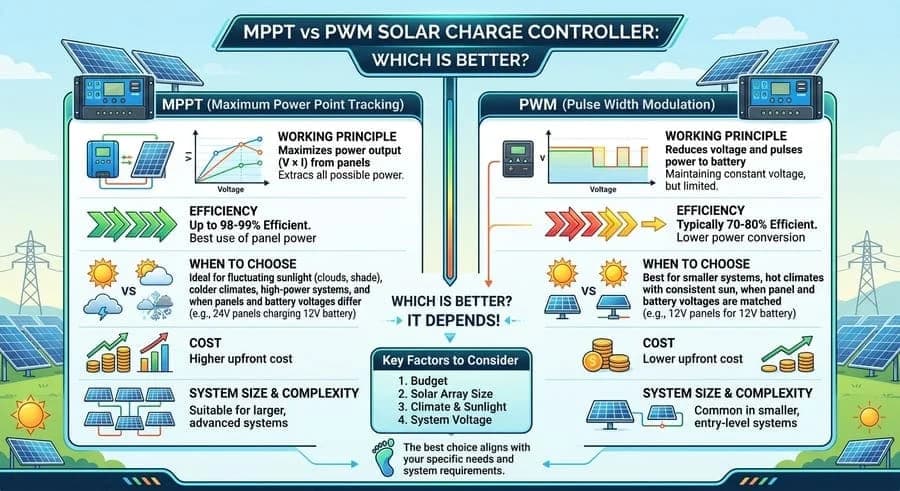
Choosing between an MPPT and PWM solar charge controller affects how efficiently a battery-based solar system can use the power available from its PV array. The right choice depends on the solar array voltage, battery-bank voltage, system size, controller ratings, budget, and the way the system is designed.
Quick Answer: MPPT vs. PWM
MPPT charge controllers generally provide more usable energy than PWM controllers when the PV array operates at a substantially higher voltage than the battery bank. MPPT controllers track the solar array’s maximum power point and use power conversion to deliver an appropriate voltage and current to the battery.
PWM controllers are simpler and generally less expensive. They can be appropriate for smaller systems where the solar module voltage is closely matched to the battery system and the additional energy harvest of MPPT does not justify the additional cost.
For larger battery-based solar systems, higher-voltage PV arrays, limited roof or mounting space, and applications where maximizing available solar energy matters, MPPT is often the more flexible choice.
Important: A grid-tied PV system without battery storage may not use a separate solar charge controller. In many such systems, MPPT functionality is incorporated into the inverter. A separate charge controller is primarily relevant to battery-based, off-grid, and hybrid solar systems.
MPPT vs PWM: Comparison
|
Feature |
MPPT |
PWM |
|
Full name |
Maximum Power Point Tracking |
Pulse Width Modulation |
|
Main function |
Tracks PV maximum power point and converts power for battery charging |
Regulates charging through controlled PV-to-battery switching |
|
Energy harvest |
Generally higher when PV voltage is substantially above battery voltage |
Lower when there is significant PV-to-battery voltage mismatch |
|
PV voltage flexibility |
Generally greater |
More limited |
|
Electronics |
More sophisticated |
Simpler |
|
Upfront cost |
Usually higher |
Usually lower |
|
Best fit |
Larger or higher-voltage battery-based systems |
Smaller, simpler, voltage-matched systems |
|
12V battery systems |
Yes |
Yes |
|
24V battery systems |
Yes |
Yes, when appropriately matched |
|
48V battery systems |
Available |
Depends on controller and PV configuration |
|
High-voltage PV array |
Often advantageous |
Generally less suitable |
What Is a Solar Charge Controller?
A solar charge controller regulates the electrical connection between a photovoltaic array and a battery bank. In a battery-based PV system, the controller helps manage battery charging and prevents the PV source from delivering charging conditions outside the battery or controller’s allowable operating range.
Charge controllers can be standalone devices or integrated into other power-electronics equipment. The system architecture matters, especially when distinguishing grid-connected PV from battery-based systems.
Solar Permit Solutions
Need Solar Permit Plans?
Professional, permit-ready solar plan sets delivered fast. Residential and commercial projects across all 50 states.
What Is an MPPT Solar Charge Controller?
MPPT stands for Maximum Power Point Tracking. Solar panels do not produce their maximum power at every voltage. Their voltage and current vary with operating conditions, including irradiance and temperature. For controller-specific voltage and current limits, see MPPT technical documentation.
An MPPT controller seeks an operating point near the PV array’s maximum power point and uses power conversion to provide the battery with a suitable charging voltage and current.
A PV array may operate at a higher voltage than the nominal battery voltage. An MPPT controller can convert available PV power into a suitable battery charging voltage while increasing available charging current, subject to conversion losses and controller limits.
What Is a PWM Solar Charge Controller?
PWM stands for Pulse Width Modulation. A PWM controller regulates the charging process by rapidly switching the connection between the PV array and battery. The PV source is pulled toward the battery voltage rather than being independently operated at its maximum-power voltage.
When the panel’s maximum-power voltage is substantially higher than the battery voltage, PWM generally cannot capture the same amount of available PV power that an MPPT system can.
MPPT vs PWM: What’s the Main Difference?
The fundamental difference is how the controller uses the voltage available from the solar array.
An MPPT controller attempts to operate the PV array near its maximum power point and then converts the resulting power to an appropriate battery charging voltage. A PWM controller does not independently track the PV array’s maximum power point in the same way.
The actual difference depends on module characteristics, battery voltage, temperature, irradiance, wiring, controller efficiency, and operating conditions.
Is MPPT More Efficient Than PWM?
MPPT can provide greater energy harvest than PWM when there is a significant difference between the PV array’s operating voltage and the battery charging voltage. However, there is no single percentage that applies to every system.
Avoid generic claims such as ‘MPPT always produces 30% more power.’ Evaluate PV Vmp, Voc, array configuration, battery charging voltage, PV current, controller efficiency, temperature, irradiance, wiring losses, and controller limits.
MPPT vs PWM for 12V Batteries
Both technologies can be used with 12V battery systems. The important question is not simply whether the battery is ’12V’; you also need to look at the actual PV module specifications.
For a small, simple system with appropriately matched components, PWM may be practical. MPPT becomes more attractive when PV voltage is substantially higher than battery voltage, the array is larger, mounting space is limited, or maximizing energy harvest matters.
MPPT vs PWM for 24V Batteries
A 24V battery bank can use either MPPT or PWM when the controller and PV array are properly matched. MPPT provides more design flexibility when the PV array operates at a substantially higher voltage than the battery bank.
Always verify the controller’s maximum PV voltage and maximum charging current before selecting it.
MPPT vs PWM for 48V Batteries
48V battery systems are common in larger off-grid and battery-based solar applications. Controller selection should be based on the complete electrical design rather than a simple rule that one technology is always better. For additional PV and storage system best-practice guidance, see NREL’s PV and energy storage O&M best practices.
Check PV array maximum open-circuit voltage, PV operating voltage, PV short-circuit current, controller maximum PV voltage/current, maximum battery charging current, battery chemistry, protection, future expansion, and manufacturer requirements.
When Should You Choose MPPT?
MPPT is often appropriate when the system benefits from greater PV-voltage flexibility or improved energy harvesting. Consider MPPT when PV voltage is substantially higher than battery voltage, the system is larger, available mounting space is limited, or the design uses an off-grid solar design.
When Does PWM Make Sense?
PWM can make sense when simplicity and upfront equipment cost are important and the PV array is appropriately matched to the battery system. Potential applications include small solar battery systems, simple RV or portable systems, and appropriately matched PV modules and batteries.
PWM is not automatically a bad choice. It is a different technology with different system-design constraints.
How Do You Size an MPPT Charge Controller?
Charge-controller sizing requires more than dividing panel watts by battery voltage. For preliminary PV sizing, SPS also provides a solar panel calculator. A simplified current estimate is required charging current ≈ PV array power ÷ battery charging voltage.
Example: a 1,000W PV array and a 24V battery system give 1,000W ÷ 24V = 41.7A. A simplified 25% calculation gives 41.7A × 1.25 = 52.1A. This suggests looking at a controller with at least this level of charging-current capacity, subject to manufacturer specifications and the actual system design.
Also verify maximum PV open-circuit voltage, PV operating voltage, maximum PV short-circuit current, maximum PV input current, maximum battery charging current, battery voltage and chemistry, temperature derating, wiring, overcurrent protection, and future expansion.
Can You Replace a PWM Controller With an MPPT Controller?
Sometimes, but do not assume it is a direct drop-in replacement. Compare PV Voc and Vmp, PV current, battery-bank voltage, controller charging-current rating, maximum PV input voltage, wiring, overcurrent protection, disconnect requirements, grounding and bonding, mounting and ventilation, and manufacturer requirements.
The new controller must be compatible with both the PV array and battery bank.
Do Grid-Tied Solar Systems Need a Separate Charge Controller?
Not necessarily. A conventional residential solar design without battery storage generally uses an inverter to convert PV DC output into AC electricity. Depending on inverter architecture, MPPT functionality may be integrated into the inverter.
A separate charge controller becomes relevant when the PV system is charging batteries or when the system architecture specifically requires one.
MPPT vs PWM: Which One Should You Use?
Use the system’s electrical characteristics to make the decision. MPPT is generally the more flexible option when the PV array operates at a substantially higher voltage than the battery, when the array is larger, or when maximizing available PV energy is important.
PWM can be appropriate for smaller, simpler systems where PV and battery voltages are appropriately matched and minimizing equipment cost is important.
For larger projects, the controller should be reviewed as part of the complete commercial solar design and electrical system.
Frequently Asked Questions
Is MPPT better than PWM?
MPPT can provide greater energy harvest when PV voltage is substantially higher than battery charging voltage. PWM can remain practical for smaller systems with appropriately matched PV and battery voltages.
How much more efficient is MPPT than PWM?
There is no single percentage that applies to every system. The difference depends on PV voltage, battery voltage, temperature, irradiance, controller efficiency, and system configuration.
Can I use an MPPT controller with a 12V battery?
Yes, provided the MPPT controller is rated for the battery voltage and the PV array stays within the controller’s voltage and current limits.
Can I use MPPT with a 24V or 48V battery?
Yes. Many MPPT controllers are designed for multiple battery-bank voltages. Always verify the specific controller’s allowable battery voltage and maximum PV input ratings.
Can PWM work with a 24V battery?
Yes, but the PV array must be appropriately matched to the battery system and the controller’s specifications.
Can I replace PWM with MPPT?
Often, but the PV array, battery voltage, controller ratings, wiring, circuit protection, and installation requirements should be checked before making the change.
What size MPPT controller do I need?
Controller sizing depends on PV array wattage, battery voltage, maximum PV voltage, PV current, charging-current requirements, equipment ratings, and applicable design requirements. Do not size a controller from wattage alone.
Does MPPT work better in cloudy weather?
An MPPT controller does not create energy when sunlight is unavailable. Charging output still falls as irradiance falls.
Do I need an MPPT or PWM controller for a grid-tied solar system?
Not necessarily. In many grid-tied systems, MPPT functionality is incorporated into the inverter. A separate charge controller is primarily associated with battery-based PV architectures.
What should I check before buying a charge controller?
Check the PV array’s Voc, Vmp, Isc and operating current; battery-bank voltage and chemistry; controller maximum PV voltage and current; charging-current capacity; environmental ratings; and manufacturer installation requirements.
Need Solar Permit Plans?
Professional, permit-ready solar plan sets delivered fast. Residential and commercial projects across all 50 states.

SPS Editorial Team
Solar Permit Solutions
Solar Permit Solutions provides professional solar permit design services for residential, commercial, and off-grid installations across all 50 states. Our team ensures permit-ready plan sets delivered fast.
Related Articles
Why Solar Inspections Fail: 10 Common Mistakes to Avoid
Discover the 9 critical reasons solar inspections fail and how to avoid costly m...

Solar Grounding And Bonding: How To Pass Inspection Every Time
Learn how to pass solar grounding and bonding inspections every time. Avoid comm...
Solar Inspection After Installation: What Happens Next?
Learn how to pass your solar inspection by following essential tips for obtainin...