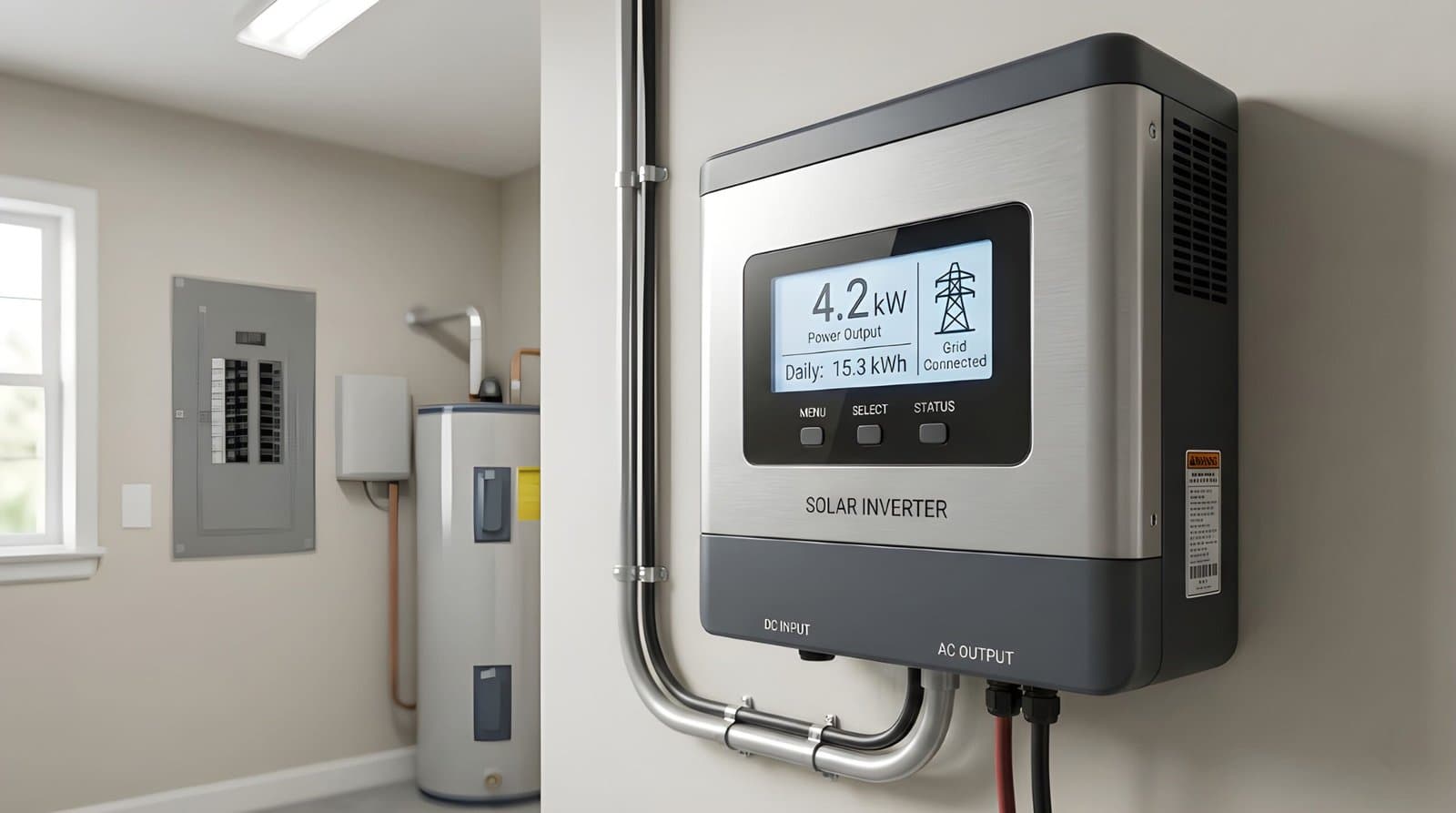
Solar panels can save money and reduce carbon footprint for decades, but there’s a critical component that won’t last as long: the inverter. Understanding inverter lifespan and when to budget for replacement is key to protecting your investment and avoiding unexpected costs.
Solar inverters last between 10 to 25 years depending on the type, with string inverters averaging 10 to 15 years and microinverters reaching 20 to 25 years. These devices convert DC electricity from solar panels into AC power for home use, making them essential components that directly impact system performance and return on investment. Learning solar energy basics helps property owners make informed decisions about equipment selection.
Quick breakdown by inverter type:
- String inverters: 10 to 15 years, replacement cost $800 to $2,500
- Microinverters: 20 to 25 years, replacement cost $150 to $350 per unit
- Hybrid inverters: 10 to 15 years, higher upfront cost but integrated battery management
- Off-grid inverters: 5 to 10 years due to continuous cycling and thermal stress
Several factors affect inverter longevity, including installation quality, ventilation, climate conditions, and maintenance frequency. Since solar panels typically last 25 to 30 years, most property owners should budget for at least one inverter replacement during their system’s lifetime. Replacement costs typically represent 10 to 15% of total system expenses over a 20-year period.
This guide covers lifespan expectations by inverter category, warning signs of failure, maintenance best practices, and cost analysis to help property owners maximize their solar investment. For detailed comparisons, review our inverter types guide.
Understanding Solar Inverters: Functions and Categories
A solar inverter converts electricity produced by PV modules into a form that powers homes, business offices, or factories. As a critical system component, the inverter determines how efficiently photovoltaic technology delivers usable power.
Several types of inverters exist in present-day systems. String inverters work in residential solar design and small commercial rooftop systems, connecting solar panels in a series configuration. Hybrid inverters (all-in-one units) manage inputs to lithium battery storage and the grid. Microinverters mount behind each panel, making them ideal for partial shading situations.
Off-grid inverters operate in systems isolated from the utility grid, commonly found in remote areas or RV solar setups. Proper off-grid system design ensures optimal inverter performance. The lifespan and performance of each inverter type vary based on its design and workload. Microinverters represent newer technology in solar power systems and typically outlast string inverters. Hybrid inverters perform more complex functions but require only regular maintenance.
Expected Service Duration by Inverter Category
Inverter service life depends on model, technology, and environmental conditions. According to the International Energy Agency (2024) and industry data, inverters can function for 10 years or more, with advanced models surviving as long as 25 years. Real-world longevity usually varies significantly from stated warranty periods because of environmental stress, load, and heat. Property owners should understand these timelines to schedule and fund realistic replacements while safeguarding their earnings.
Reputable manufacturers quote expected service lives of 10 to 15 years in their technical documentation. Longevity depends on proper, well-ventilated installation. Microinverters last longer compared to central and string models. Industry data on solar electricity basics supports these expectations.
Due to high operating temperatures and continuous load cycling, off-grid solar inverters have shorter lifespans, typically lasting 5 to 7 years. Industry reports from 2024 indicate that well-maintained inverters operating in moderate climates usually outlive their expected lifetimes.

Critical Elements That Impact Inverter Longevity
Thermal stress poses the biggest threat to inverter investments. Even the best inverters degrade faster when under stress, badly installed, or neglected during maintenance. Capacitor wear accelerates when internal temperatures exceed 50 degrees Celsius. Inverters in unventilated or hot climate areas face higher repair chances, as cooling systems work less efficiently.
Load management also plays a significant role. Running an inverter continuously near its rated capacity or subjecting it to cyclical loading wears out electrical components. An oversized inverter generally stays cooler and delivers longer service life. Environmental conditions matter too. Humidity, dirt, or salt in coastal air corrodes circuit boards, while UV rays damage protective casings. Understanding arc fault protection helps prevent electrical failures.
Manufacturing quality often determines long-term resilience. Reputable manufacturers use higher-grade capacitors, conformal coatings, better surge protection, and tight manufacturing standards. Installation quality significantly impacts outcomes. Poor wiring or tight spacing can trigger over-temperature shutdowns and cause components to fatigue faster. Review your single line diagrams to verify proper system configuration.
Field comparisons in 2024 found that inverters installed in desert regions experienced higher failure rates than units in temperate climates. Regular inspections and maintenance extend service life, with maintenance quality rivaling technology choice in determining total longevity. Academic institutions studying renewable energy have documented similar patterns.
Solar Permit Solutions
Need Solar Permit Plans?
Professional, permit-ready solar plan sets delivered fast. Residential and commercial projects across all 50 states.
Recognizing Failure Symptoms Before Complete Breakdown
Recognizing early warning signs of inverter failure helps avoid costly downtime and ensures consistent power flow. Inverters rarely stop working without prior warning indicators, and timely repair work can extend their life. Property owners should pay close attention to visual alerts as well as inverter and system behavior.
The most widely reported early signs of inverter failure include:
- Frequent fault codes or shutdowns due to overheating or grid instability problems
- Voltage or frequency fluctuation creating irregular AC output
- Decreased power conversion efficiency, visible as reduced system output even in bright sunlight
- Noisy fans, abnormal humming, or crackling sounds indicating internal wear
- Frozen displays or missing monitoring connections preventing accurate data logging
- Multiple protection alerts triggering simultaneously, such as overcurrent or ground fault warnings, signaling internal component failure
- Blinking power-off lights showing the unit runs on battery mode even when mains power is available
For RV and mobile setups, early inverter repair proves essential since vibration and temperature swings inside a running vehicle wear internal components even faster. Understanding DIY solar risks helps property owners make informed repair decisions.

Proven Strategies to Maximize Inverter Service Life
Several practices help extend inverter life and maximize system performance. Resources on solar PV basics provide foundational knowledge for maintenance planning.
Regular Maintenance
The primary requirement for extending the life and improving the effectiveness of a solar inverter is consistent maintenance. Most solar inverters fail because of maintenance negligence and excessive heating, both of which can be avoided with a few simple steps.
Regular visual examination every few months helps identify dust layers, loose connections, and corrosion. Routine cleaning of air filters and vents (for both indoor and outdoor installations) prevents inverter overheating. Manufacturer dashboards for monitoring performance help detect early anomalies in output. Proper fuse servicing ensures electrical safety throughout the system.
Firmware Updates
Frequent firmware updates stabilize software and maintain high efficiency levels. Proper inverter placement in well-ventilated indoor areas away from direct sunlight and moisture prevents over-temperature shutdown. Slightly oversizing the inverter relative to array size reduces continuous full-load stress and increases inverter longevity.
Quarterly inverter checks and thorough annual cleaning maintain optimal performance. Professional servicing every two years on a regular basis helps prevent damage to inverters. Understanding installation revisions helps track system modifications over time.
When to Replace: Cost Analysis and Timing Decisions
Knowing when to replace an inverter represents a fundamental decision for owners since many evolving financial and technical factors come into play. While many people focus on how long solar inverters last, the more practical question involves when replacement becomes necessary.
Modern string inverters can last 10 to 15 years, while microinverters can exceed 20 years with proper maintenance. Regular maintenance and tuning substantially extend inverter lifetime, but efficiency decreases over time. Over ten years, efficiency loss can reach 2 to 5% due to component wear, with capacitor degradation representing a significant concern. Research on PV systems documents these degradation patterns.
Inverter lifetime varies depending on system size and technology. Solar inverter replacement costs range considerably based on available options.
Small residential 5 to 10 kW string inverters typically cost $800 to $1,800. Residential microinverter systems in the 5 to 15 kW range may require $2,000 to $3,500 for replacement. Generally, cheaper inverters lack warranty coverage. Even expensive inverter types eventually need replacement due to degradation.
Premium inverter models typically feature advanced monitoring and hybrid functions. Even with higher upfront costs, these inverters require lower maintenance. Replacement or maintenance costs can be deferred longer. For commercial solar design projects, budget planning becomes especially critical.
Solar inverter lifetime replacement costs can be estimated at 10 to 15% of total system costs for a regular 20-year backup plan. When repair expenses reach 40 to 50 percent of new unit cost, replacement becomes the wiser decision. The inverter’s reliability, defined by the manufacturer, can be expressed with an MTBF (mean time between failures) figure.
How Engineering Quality Determines Durability
The durability of solar panels and inverters depends to a certain extent on design and environmental factors. Even so, inverter longevity heavily depends on engineering quality. In 2024, quality manufacturers showed field reliability rates of 95% and above, ensuring equipment lasts for 10 years in operation. The percentage drops lower in generic brands lacking proper quality control. Technical principles covered in photovoltaics fundamentals explain these engineering standards.
Quality inverters deliver excellent thermal management with high MPPT efficiency, enabling survival of around 15 to 20 years.
Hybrid inverters designed for high-temperature and humidity zones come with IP65-rated enclosures and extended warranties up to 20 years, making them ideal for humid locations paired with high-performing LiFePO4 batteries. Compliance with rapid shutdown requirements ensures safety standards are met.

Climate and Location Effects on Performance
Solar inverter lifespan shows significant differences between tropical and temperate regions. In tropical areas, installations experience more humidity and higher ambient temperatures, resulting in 10 to 20% shorter service life compared to temperate region installations. Heat accelerates capacitor aging, and insufficient IP protection allows moisture and humidity to contact inner circuit boards and components, causing corrosion. Agricultural applications using solar energy systems face similar climate challenges.
Coastal installations also experience reduced inverter lifespan. Salt, moisture, and particles in the air corrode inverter housing and enter poorly sealed units to corrode contacts. Using IP65-rated inverters with anti-corrosive coatings and performing routine cleaning dramatically increases lifespan.
Conversely, inverters last longer in cold areas due to reduced thermal strain, but frequent freeze-thaw cycles can corrode connectors and seals. In desert or high-UV areas, inverters require proper shading and protection to prevent overheating. Installers adapt to location-specific challenges by providing special shading and cooling features. Understanding your grid connection options helps optimize system design for local conditions.
Off-Grid Systems: Unique Lifespan Challenges
Off-grid systems operate under more challenging conditions, affecting inverter longevity significantly. These systems manage continuous load variations and depend heavily on battery charge and discharge cycles. Regular cycling generates considerable heat in components, reducing average service life to 8 to 15 years. Technical analysis of energy systems explores these operational challenges.
Battery compatibility also plays an important role. Connecting mismatched batteries and inverters may cause power or voltage surges, stressing internal components. High-quality LiFePO4 batteries, properly balanced and maintained, reduce this stress and increase longevity.
Off-grid users should invest in ventilation, surge protection, and system diagnostics with regular inspection schedules to maintain performance. Oversizing inverters by 10 to 20% above average load capacity prevents peak demand overloading. Proper design and maintenance increase off-grid inverter life significantly. Technical studies on solar system optimization provide additional insights.
Conclusion
Solar inverter lifespan depends on type, manufacturing quality, installation environment, climate conditions, and maintenance consistency. String inverters typically require replacement after 10 to 15 years, while microinverters can operate effectively for 20 to 25 years. Proactive maintenance, proper ventilation, and correct system sizing improve investment returns and extend service life.
Property owners should budget for inverter replacement as part of long-term system costs, typically 10 to 15% of total system expenses over a 20-year period. Evaluating warranty coverage, replacement costs, and manufacturer reliability before installation ensures long-term system performance. Prioritizing quality equipment now prevents thousands of dollars in repairs and efficiency losses throughout the system’s operational life.
For professional assistance with solar system design and permitting, explore Solar Permit Solutions for comprehensive permit design services. Browse our solar resources for additional guidance, or contact our team with specific questions.
FAQs
Need Solar Permit Plans?
Professional, permit-ready solar plan sets delivered fast. Residential and commercial projects across all 50 states.
Frequently Asked Questions
Residential string inverters usually last 10 to 15 years, while microinverters can reach 20 to 25 years with proper installation and maintenance.
Heat and thermal stress. Excessive temperatures accelerate capacitor wear and degrade internal components faster than any other factor. Proper ventilation and shaded installation locations significantly extend service life.
Minor issues like capacitor or fan failure can often be repaired. However, when repair costs exceed 40 to 50% of a new unit's price, replacement becomes the more economical choice.
No. Solar panels typically last 25 to 30 years, outlasting most inverters. Property owners should plan for at least one inverter replacement during the solar system's operational life.
Yes. Microinverters benefit from distributed architecture and lower thermal stress, allowing them to outlast central string inverters by 5 to 10 years on average.
Consistent maintenance significantly increases service life. Regular inspections, proper ventilation, firmware updates, and keeping the unit clean can add several years to an inverter's operational lifespan.
String inverters typically include 5 to 10 year warranties, with options to extend to 15 or 20 years. Microinverters generally come with 20 to 25 year standard warranties, reflecting their longer expected service life.

SPS Editorial Team
Solar Permit Solutions
Solar Permit Solutions provides professional solar permit design services for residential, commercial, and off-grid installations across all 50 states. Our team ensures permit-ready plan sets delivered fast.
Related Articles
How Many Solar Panels Do I Need to Run Off the Grid?
Most off-grid homes need about 8 to 16 solar panels rated at 400 watts, dependin...
Solar Battery Permit Requirements: What You Need to Know
A solar battery usually needs local approval and a utility review before it can ...
How To Add A Battery To Your Existing Solar System
Adding a battery to your solar system costs $10,000-$20,000. Save with 30% feder...