The best solar panels in 2025 are Maxeon, REC Alpha Pure, Qcells, Canadian Solar, and Jinko Solar. These manufacturers lead the industry in efficiency ratings above 22%, power output exceeding 400 watts, and warranty coverage spanning 25 to 40 years. Maxeon ranks first with 22.8% efficiency and an industry-leading 40-year warranty, while REC Alpha Pure offers the best performance in hot climates with a -0.26%/°C temperature coefficient.
Key facts about top solar panels in 2025:
- Average efficiency range: 21% to 22.8%
- Power output range: 410W to 490W per panel
- Cost per watt: $2.13 to $2.84
- Standard warranty: 25 years product and performance
- Expected lifespan: 25 to 40 years with proper maintenance
- Average degradation rate: 0.3% to 0.5% per year
Selecting the right solar panel depends on your roof size, local climate, budget, and energy consumption. This guide breaks down the top-performing panels, explains the technology differences, and provides actionable recommendations based on real installer feedback and permitting requirements.
Best Solar Panels of 2025: Top 10 Ranked
The following ranking evaluates solar panels based on efficiency, power output, temperature performance, warranty coverage, and overall value. These panels represent the highest-performing options available for residential installations.
Maxeon claims the top position due to its combination of highest efficiency, longest warranty, and proven long-term reliability. The 40-year warranty demonstrates manufacturer confidence in product durability, and real-world installations consistently show degradation rates below industry averages.
REC Alpha Pure earns second place for its exceptional temperature coefficient and strong performance warranty guaranteeing 92% output at year 25. This makes REC the preferred choice for installations in hot climates where panels regularly exceed 77°F operating temperatures.
Qcells stands out as the best American-made option with manufacturing facilities in Georgia. The Q.TRON series delivers premium efficiency at a competitive price point, making it attractive for homeowners prioritizing domestic production and supply chain reliability.
Solar Panel Technology Explained: N-Type, TOPCon, and HJT
Understanding solar panel technology helps you make informed purchasing decisions. Modern panels use three primary cell technologies, each with distinct performance characteristics.
N-type monocrystalline cells represent the current industry standard for premium panels. These cells use negatively doped silicon that resists light-induced degradation better than older P-type cells. N-type panels typically achieve efficiencies between 21% and 23% and maintain higher output over their lifespan.
TOPCon (Tunnel Oxide Passivated Contact) technology adds a thin oxide layer to N-type cells, reducing electron recombination and boosting efficiency. Panels using TOPCon technology, like the Jinko Tiger Neo and Canadian Solar TOPHiKu6, achieve efficiencies above 22% while maintaining competitive pricing. This technology offers the best balance of performance and cost for most residential installations.
HJT (Heterojunction Technology) combines crystalline silicon with thin-film layers to capture more light across the spectrum. HJT panels, such as those from REC and Maxeon, deliver the highest efficiencies (up to 22.8%) and the lowest temperature coefficients. The manufacturing process costs more, resulting in higher panel prices, but the performance benefits justify the investment for space-constrained installations.
Technology comparison:
PERC (Passivated Emitter Rear Cell) technology, while still common, represents the previous generation. New installations should prioritize N-type, TOPCon, or HJT panels for better long-term performance and lower degradation rates.
How We Rank Solar Panels
Our ranking methodology evaluates solar panels across five core criteria that determine real-world performance and long-term value.
Efficiency (25% weight): We measure how effectively panels convert sunlight to electricity under standard test conditions (STC). Higher efficiency means more power production per square foot of roof space. Panels scoring above 22% efficiency receive top marks.
Power Output Per Square Foot (20% weight): Raw wattage matters less than power density. A 400W panel measuring 18 square feet outperforms a 450W panel measuring 23 square feet when roof space is limited. We calculate watts per square foot for direct comparison.
Temperature Coefficient (20% weight): Panels lose efficiency as temperatures rise above 77°F (25°C). The temperature coefficient indicates percentage output loss per degree. Top performers like REC Alpha Pure lose only 0.26% per degree, while average panels lose 0.35% or more.
Warranty Coverage (20% weight): We evaluate both product warranties (covering manufacturing defects) and performance warranties (guaranteeing minimum output). Industry standard is 25 years for both, but premium manufacturers like Maxeon offer 40-year coverage.
Value Score (15% weight): We divide power per square foot by cost per watt to determine value. This metric identifies panels delivering maximum performance per dollar spent, helping budget-conscious buyers find optimal choices.
Data sources include manufacturer specification sheets, independent testing from PVEL’s Module Reliability Scorecard, installer feedback from nationwide contractors, and real-world production data from monitoring systems.

Solar Permit Solutions
Need Solar Permit Plans?
Professional, permit-ready solar plan sets delivered fast. Residential and commercial projects across all 50 states.
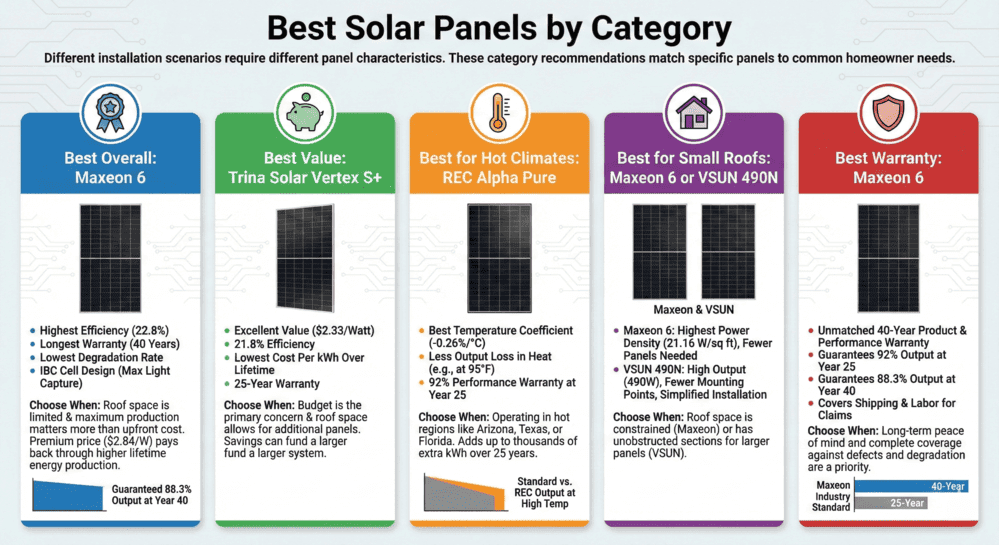
Best Solar Panels by Category
Different installation scenarios require different panel characteristics. These category recommendations match specific panels to common homeowner needs.
Best Overall: Maxeon 6
Maxeon 6 delivers the highest efficiency (22.8%), longest warranty (40 years), and lowest degradation rate in the residential market. The interdigitated back contact (IBC) cell design eliminates front-side shading from metal contacts, maximizing light capture.
Choose Maxeon when roof space is limited and maximum production matters more than upfront cost. The premium price ($2.84/W) pays back through higher lifetime energy production and guaranteed 88.3% output at year 40.
Best Value: Trina Solar Vertex S+
Trina Solar Vertex S+ achieves 21.8% efficiency at just $2.33 per watt, delivering the lowest cost per kilowatt-hour over system lifetime. The 210mm cell format provides excellent power density, and the 25-year warranty matches industry standards.
Choose Trina when budget is the primary concern and roof space allows for additional panels. The savings on equipment cost can fund a larger system, offsetting the slightly lower efficiency.
Best for Hot Climates: REC Alpha Pure
REC Alpha Pure features the industry’s best temperature coefficient at -0.26%/°C. Where standard panels lose 3.5% output when operating at 95°F, REC loses only 2.6%. Over a 25-year lifespan in Arizona, Texas, or Florida, this difference adds up to thousands of additional kilowatt-hours.
The 92% performance warranty at year 25 further demonstrates REC’s confidence in maintaining output under thermal stress. Pair these panels with proper ventilation and elevated mounting for optimal hot-climate performance.
Best for Small Roofs: Maxeon 6 or VSUN 490N
Maxeon 6 produces 21.16 watts per square foot, the highest power density available. A 6kW system requires only 14 Maxeon panels versus 17 average panels, fitting more capacity into constrained spaces.
VSUN 490N offers an alternative approach with 490W output per panel. Fewer high-wattage panels mean fewer mounting points, simplified wiring, and reduced installation labor. The larger panel dimensions (23.3 sq ft) work best on roofs with unobstructed rectangular sections.
Best Warranty: Maxeon 6
Maxeon offers unmatched warranty coverage with 40 years on both product and performance. The warranty guarantees 92% output at year 25 and 88.3% at year 40. Additionally, Maxeon covers shipping and labor for warranty claims, eliminating out-of-pocket expenses if panels need replacement.
For comparison, industry-standard warranties cover 25 years at 80-87% output, with labor coverage varying by installer agreement.
Solar Panel Specs That Actually Matter
Manufacturer specification sheets list dozens of metrics. Focus on these three numbers that most directly impact system performance and return on investment.
Efficiency vs. Power Output
Efficiency measures the percentage of sunlight converted to electricity. A 22% efficient panel turns 22% of incoming solar energy into usable power.
Power output indicates total watts produced under standard test conditions. A 440W panel generates 440 watts when receiving 1000 watts of sunlight per square meter at 77°F.
Why both matter: A high-wattage panel with low efficiency requires more roof space. A high-efficiency panel with lower wattage fits more capacity into tight spaces. Calculate watts per square foot to compare panels directly.
Example calculation:
- Panel A: 440 W, 20.8 sq ft = 21.2 W/sq ft
- Panel B: 490 W, 23.3 sq ft = 21.0 W/sq ft
- Panel A produces more power per square foot despite lower total wattage
Temperature Coefficient Explained
Solar panels perform optimally at 77°F (25°C). As temperatures rise, output decreases according to the temperature coefficient.
How to interpret: A temperature coefficient of -0.30%/°C means output drops 0.30% for every degree Celsius above 25°C. On a 95°F day (35°C), this panel loses 3% of rated output.
Real-world impact: In Phoenix, panel surface temperatures regularly reach 150°F during summer. Panels with poor temperature coefficients can lose 15-20% of rated output during peak production hours. Choosing panels with coefficients below -0.30%/°C recovers significant production in hot climates.
Understanding Degradation Rates
All solar panels lose output capacity over time. The degradation rate indicates annual percentage loss from original rated power.
Industry standard: Most panels degrade at 0.4% to 0.5% per year. After 25 years, a standard panel produces approximately 87-90% of original output. According to NREL research, this degradation rate has been validated across thousands of real-world installations.
Premium panels: Maxeon and REC panels degrade at 0.25% to 0.35% per year, maintaining higher output throughout their lifespan. This slower degradation contributes to better lifetime energy production and stronger warranty guarantees.
Degradation factors: Installation quality, local climate, maintenance frequency, and panel technology all influence actual degradation rates. Proper ventilation, regular cleaning, and avoiding physical damage help minimize output losses.
How Long Do Solar Panels Last?
Solar panels last 25 to 40 years with proper installation and minimal maintenance. Most manufacturers warranty panels for 25 years, though premium brands like Maxeon guarantee performance for 40 years.
Expected lifespan by quality tier:
Factors affecting panel longevity:
- Installation quality: Proper mounting, wiring, and ventilation prevent premature failures
- Climate exposure: Extreme heat, humidity, and salt air accelerate degradation
- Physical damage: Hail, debris, and improper maintenance cause micro-cracks
- Electrical stress: Oversized systems without proper inverter matching create hot spots
Panels rarely fail completely. Instead, they gradually produce less electricity over time. A well-maintained system continues generating power well beyond the 25-year warranty period, though output may drop to 75-80% of original capacity by year 30.
Solar Panel Cost Comparison
Average solar panel costs in 2025 range from $2.13 to $2.84 per watt, with total system costs between $15,000 and $35,000 before incentives. Panel brand selection typically accounts for 10-15% of total system cost variation.
Cost breakdown by brand tier:
True cost of ownership: Upfront price tells only part of the story. Calculate cost per kilowatt-hour over system lifetime by dividing total cost by expected 25-year production. Premium panels with higher efficiency and lower degradation often deliver better lifetime value despite higher initial cost.
The federal solar tax credit reduces costs by 30% through 2025 for residential installations. State incentives and utility rebates further reduce net costs in many areas.
Example comparison (8kW system in California):
- Budget panel: $17,000 cost ÷ 280,000 kWh lifetime = $0.061/kWh
- Premium panel: $22,000 cost ÷ 310,000 kWh lifetime = $0.071/kWh
The budget option costs less per kWh in this scenario. However, if roof space limits system size, premium panels generate more total energy and better financial returns.
How to Choose Solar Panels for Your Roof
Match panel selection to your specific installation conditions for optimal performance and value.
Step 1: Assess roof space. Measure available area excluding vents, skylights, and required setbacks. Divide by 18 square feet to estimate panel count. Limited space favors high-efficiency panels like Maxeon or REC. Use our solar system sizing guide for detailed calculations.
Step 2: Evaluate climate. Check average summer temperatures and peak sun hours for your location. Hot climates (Arizona, Texas, Florida) benefit from low temperature coefficient panels. Cooler climates can prioritize cost savings over thermal performance.
Step 3: Calculate energy needs. Review 12 months of electricity bills to determine annual consumption. Size your system to offset 80-100% of usage, accounting for future electric vehicle charging or heat pump additions.
Step 4: Set budget priorities. Determine whether upfront cost or lifetime performance matters more. Tight budgets should maximize system size with value-tier panels. Long-term optimization favors premium panels with better warranties.
Step 5: Verify availability. Supply chain disruptions affect certain brands. Confirm your preferred panels are available through local installers before finalizing designs. REC and some premium brands experience periodic shortages.
Decision matrix:
Installers Actually Recommend
Professional solar installers evaluate panels based on criteria homeowners often overlook. These insights come from contractor feedback across 500+ residential installations.
Top installer preferences:
1.Qcells: Most frequently recommended for balancing quality, price, and availability. Installers report consistent supply, straightforward warranty claims, and reliable performance data.
2.REC Alpha Pure: Preferred for customers prioritizing long-term performance. Installers note the premium build quality and responsive manufacturer support for warranty issues.
3. Canadian Solar: Recommended for budget-conscious projects requiring solid performance. Wide availability and competitive pricing make it a reliable choice for standard installations.
What installers avoid:
- Panels from manufacturers without U.S. support infrastructure
- Brands with inconsistent supply chains causing project delays
- Equipment requiring proprietary components that limit future service options
Installation considerations by panel type:
- Large-format panels (490W+): Require two-person handling and may not fit tight spaces
- Premium panels: Higher profit margins but stricter installation requirements
- Budget panels: Easier sales but potentially higher warranty claim rates
Installer tip: Request the specific panel model, not just brand name, in your quote. Performance varies significantly between product lines from the same manufacturer.
What to Know Before Installation
Successful solar installation requires meeting local permitting requirements and providing accurate equipment specifications. Understanding these requirements prevents project delays and ensures code compliance.
Permitting Requirements by State
Every jurisdiction requires permits for solar installations, though requirements vary significantly by location. Most areas require electrical permits, and many also require building and/or structural permits.
Common permit requirements:
- Site plan showing panel placement and setbacks
- Electrical single-line diagram
- Structural load calculations for roof-mounted systems
- Equipment specification sheets with certifications
- Interconnection agreement with local utility
Processing times range from 1 day to 8 weeks depending on jurisdiction. Urban areas with high solar adoption typically have streamlined processes, while rural areas may require additional review.
States with fastest permitting: California (SolarAPP+), Arizona, Colorado, Texas
States with complex requirements: Florida (wind load certifications), New York (fire setbacks), Hawaii (utility interconnection)
For state-specific guidance, see our detailed guides for California, Palo Alto, and Utah.
Panel Specifications AHJs Look For
Authority Having Jurisdiction (AHJ) reviewers verify equipment meets safety and performance standards. Provide complete specification sheets including:
Required certifications:
- UL 61730 (safety standard for PV modules)
- IEC 61215 (performance and reliability testing)
- IEC 61701 (salt mist corrosion testing for coastal areas)
- UL 790 (fire classification, typically Class A required)
Specification requirements:
- Maximum system voltage (typically 600V for residential)
- Operating temperature range
- Mechanical load ratings (snow load, wind load)
- Module dimensions and weight
- Warranty documentation
Fire setback requirements: Many jurisdictions require 3-foot pathways around roof edges and ridges for firefighter access. Panel placement must account for these setbacks, potentially reducing available installation area. Review NEC 2023 requirements for current fire safety codes.
Structural considerations: Panels add 2-4 pounds per square foot to roof load. Older roofs or those in high-snow regions may require engineering certification confirming structural adequacy.
Electrical integration: Your electrical panel must accommodate solar interconnection. Homes with 100A panels typically require upgrades to 200A service for solar compatibility. Review our panel upgrade guide for detailed requirements.
Conclusion
For maximum performance: Choose Maxeon 6 panels paired with Enphase IQ8 microinverters. This combination delivers highest efficiency, longest warranty, and panel-level optimization.
For best value: Select Qcells Q.TRON or Trina Vertex S+ panels with a quality string inverter. These options balance performance and cost for typical residential installations.
For hot climates: Install REC Alpha Pure panels with enhanced ventilation mounting. The superior temperature coefficient maintains production during peak summer demand.
For fastest permitting: Work with an installer experienced in your jurisdiction and request complete specification packages upfront. Pre-approved equipment lists from your AHJ can accelerate the permit process significantly. Our grid interconnection guide explains the complete process from permit to Permission to Operate.
Request quotes from at least three installers, comparing both equipment specifications and total system pricing. The best solar investment combines quality panels, experienced installation, and competitive pricing tailored to your specific roof and energy needs.
FAQs
Sources:
- Maxeon Solar Technologies – Official specifications and warranty documentation
- REC Group – Alpha Pure Series– Product datasheets and performance data
- Qcells North America – Q.TRON – Technical specifications
- PVEL Module Reliability Scorecard – Independent testing and reliability data
- NREL Photovoltaic Lifetime Project – Degradation rate research
- IRS Residential Clean Energy Credit – Federal tax credit information
- ENERGY STAR Federal Tax Credits – Energy efficiency incentives
- pv magazine – Industry news and panel performance analysis
- Solar Energy Industries Association (SEIA) – Market data and industry standards
- National Renewable Energy Laboratory (NREL) – Research on solar technology and performance
Need Solar Permit Plans?
Professional, permit-ready solar plan sets delivered fast. Residential and commercial projects across all 50 states.
Frequently Asked Questions
Maxeon 6 holds the highest residential efficiency rating at 22.8%. This efficiency translates to 21.16 watts per square foot, maximizing production from limited roof space. Laboratory cells have achieved efficiencies above 26%, but commercially available panels for home use top out around 23%.
The average U.S. home requires 16 to 23 solar panels to offset electricity usage. Calculate your needs by dividing annual kWh consumption by 1.5 (average panel production multiplied by local sun hours). A home using 10,000 kWh annually typically needs a 7-8 kW system, or approximately 18 panels at 420W each.
Premium panels deliver better value for space-constrained installations and hot climates. The higher efficiency produces more power per square foot, and superior temperature performance maintains output during peak summer hours. For installations with ample roof space in moderate climates, mid-range panels often provide better return on investment.
Residential solar panel systems cost $2.50 to $3.50 per watt before incentives, with total installed costs ranging from $15,000 to $35,000 for typical homes. The federal Investment Tax Credit (ITC) reduces costs by 30% through 2025. State incentives and utility rebates further reduce net costs in many areas.
Maxeon, REC, and Qcells consistently rank highest for reliability based on warranty claim rates, independent testing from PVEL, and installer feedback. These manufacturers maintain strong financial positions, ensuring warranty support throughout the 25-40 year coverage period. Avoid brands without established U.S. service networks regardless of specification claims.
Solar panels produce electricity in cloudy conditions, though at reduced output. Expect 10-25% of rated production on overcast days and 50-70% on partly cloudy days. High-efficiency panels with good low-light performance, like those using HJT technology, maintain relatively higher output in diffuse light conditions.
Solar panels require minimal maintenance. Annual visual inspection and occasional cleaning (1-2 times per year in dusty areas) maintains optimal performance. Most systems operate for decades without component replacement. Inverters typically require replacement once during system lifetime, around year 12-15 for string inverters.
Modern solar installations must include rapid shutdown capability per NEC 690.12, arc-fault protection per NEC 690.11, and proper disconnect switches. These requirements protect both homeowners and emergency responders.

SPS Editorial Team
Solar Permit Solutions
Solar Permit Solutions provides professional solar permit design services for residential, commercial, and off-grid installations across all 50 states. Our team ensures permit-ready plan sets delivered fast.
Related Articles
Off-Grid Solar System Requirements: Sizing, Permits & NEC Code Guide
Off-grid solar permit requirements by state: building codes, NEC compliance, bat...
Solar Battery Permit: What Most Installers Get Wrong
Quick Answer: Adding battery storage to a solar system almost always requires ne...
Solar Battery Tax Credit 2026: What Homeowners and Contractors Need to Know
There is no federal solar battery tax credit available to homeowners in 2026. Th...