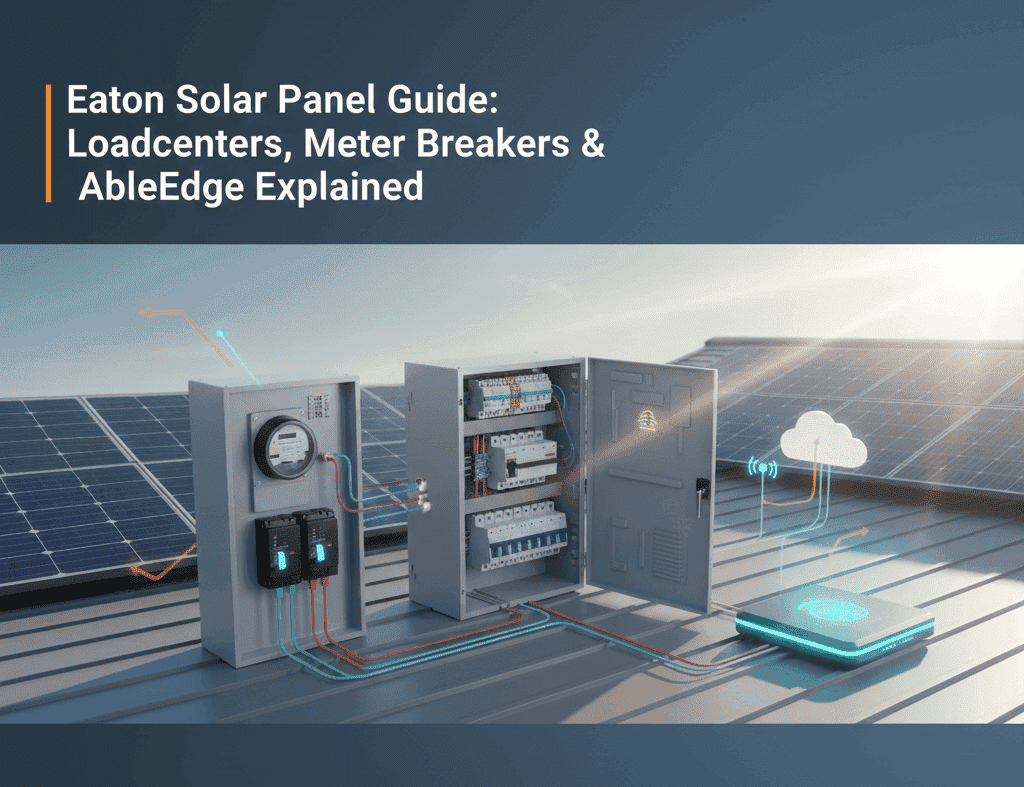
Eaton solar-ready electrical panels are specialized load centers and meter breakers designed for safe, NEC-compliant integration of residential solar photovoltaic (PV) systems and home backup power. Eaton offers three main product categories: Type CH plug-on neutral load centers, Type BR load centers, and the AbleEdge home energy management system launched in September 2024. According to the International Energy Agency’s Renewables 2024 report, global solar capacity continues to grow at unprecedented rates, driving demand for compatible electrical infrastructure.
Standard Eaton solar power centers feature a 225-amp copper bus that accommodates up to 70 amps of solar PV input when paired with a 200-amp main breaker, following the NEC 705.12(D) 120% rule. All models include factory-installed permanent markings required by NEC 690.64(B) for parallel energy source identification, simplifying permit approvals and inspections. Working with a solar permit design company can help navigate the complexities of equipment selection and code compliance.
Key Eaton solar panel types include
- Type CH Load centers (CH32PVPN200, CH42PVPN200, CH60PVPN200): 3/4-inch spaces, plug-on neutral design, 35 kAIC rating, lifetime warranty
- Type BR Load centers (BR2040PV200, BR4242PV200): 1-inch spaces, NEMA 1 and 3R options, AbleEdge compatible, 10-year warranty
- Solar Meter Breakers: Combined meter socket and distribution panel in EUSERC and non-EUSERC configurations
- AbleEdge System: Smart breakers and microgrid interconnect device enabling solar operation during grid outages
The AbleEdge microgrid interconnect device solves a common homeowner concern by allowing solar panels to continue generating power during outages. Unlike standard grid-tied systems that shut down per NEC 690.12 rapid shutdown requirements, AbleEdge creates an isolated home microgrid where solar can recharge batteries and power critical loads indefinitely. This complete guide covers Eaton’s full lineup of solar power centers, load centers, meter breakers, and smart panel technology to help homeowners, installers, and permit designers make informed decisions.

Understanding Solar-Ready Electrical Panels
What Makes an Electrical Panel Solar-Ready?
A solar-ready electrical panel differs from a standard panel in several critical ways that enable safe and code-compliant integration of photovoltaic power. These specialized panels feature factory-installed permanent markings, adequate bus capacity for combined utility and solar loads, and proper breaker positioning that meets NEC requirements for parallel energy sources. The National Renewable Energy Laboratory provides extensive research on solar system integration standards.
Eaton’s solar-ready meter breakers and load centers feature factory-installed permanent markings that help ensure NEC 705 compliance for safety markings on parallel energy sources and their disconnects. The wide variety of load centers and meter breakers are designed for utility power and solar PV power to work together, enabling PV energy to land on the distribution panel through load-side interconnection. Understanding solar permitting best practices helps ensure smooth approval processes.
Load-side interconnection with a solar-ready panel offers significant advantages over line-side utility connections. This approach makes installation quick and easy while reducing complexity and potential points of failure. A copper bus rated up to 225A maximizes the allowable PV input at 70A for standard units with a 200A main disconnect.
Key features of solar-ready panels include:
- Bus rating capacity sufficient to accommodate combined utility and solar input per the 120% rule
- Factory-installed NEC-compliant permanent markings for parallel energy source identification
- The main breaker positioned at the opposite end from the back fed PV breaker location
- Dual power source labeling identifying both utility and solar energy inputs
- Maximum bus, utility, and PV disconnect ratings clearly marked on the panel
NEC Code Requirements for Solar Interconnection Panels
Compliance with the National Electrical Code is mandatory for all solar installations in the United States. Eaton solar power centers comply with NEC (2008) Section 690.64(B) and (2011) Section 705.12(D), which identify the acceptable installation and marking requirements for utility interactive solar inverters. The SolSmart program provides resources for communities looking to streamline solar permitting processes.
NEC 705.12(D) establishes requirements for load-side connections of utility-interactive inverters. This section specifies that the sum of the ratings of all overcurrent devices connected to power production equipment shall not exceed 120% of the busbar or conductor rating. This is commonly known as the “120% rule” and directly impacts panel selection and sizing. For projects that exceed these limits, understanding supply-side connection requirements becomes essential.
NEC 690.64(B) addresses point of connection requirements, mandating that the output of a utility-interactive inverter shall be connected to the premises wiring system in accordance with specific conditions. These conditions include proper conductor sizing, overcurrent protection, and the requirement that connection be made on the line side of the service disconnecting means or load side of the service disconnecting means at a dedicated overcurrent device.
Required NEC-compliant markings on solar-ready panels include:
- Solar power center nameplate on the front door identifying the device as a component of a complete PV electrical system
- Permanent solar marking identifying that terminals on both line and load sides may be energized in the open position
- Location identification of the parallel energy source disconnect (back fed PV breaker)
- Dual power source identification marking noting both normal power and power production source
- Maximum bus, utility, and PV disconnect ratings to prevent busbar overloading

Eaton Solar Power Center Product Types
Eaton Solar-Ready Load centers: Type CH vs. Type BR
Eaton offers two primary load center product lines for solar applications: Type CH and Type BR. Each platform provides distinct advantages depending on installation requirements, with both featuring the essential solar-ready capabilities needed for NEC-compliant PV interconnection.
Type CH Plug-on Neutral Load centers
Eaton’s CH 3/4-inch load centers represent the company’s premium residential platform, featuring the innovative plug-on neutral design that eliminates pigtail wiring requirements for AFCI and GFCI breakers. This design provides significant time and labor savings during installation while delivering a professional finished appearance. Understanding AFCI and GFCI safety code requirements is essential for proper breaker selection.
The Type CH platform features a unique stab design that provides a tight connection to the bus, enhancing electrical performance and long-term reliability. CH load centers are available in various configurations from 32 to 60 spaces, accommodating residential applications from modest homes to large estates with extensive circuit requirements.
Type CH Solar-Ready Load center Models:
- CH32PVPN200: 32 spaces, 32 circuits, 200A main breaker, 225A bus, 70A max PV input, 35 kAIC
- CH42PVPN200: 42 spaces, 42 circuits, 200A main breaker, 225A bus, 70A max PV input, 35 kAIC
- CH60PVPN200: 60 spaces, 120 circuits (requires CHNT breakers), 200A main breaker, 225A bus, 70A max PV input, 35 kAIC
Key Type CH advantages include:
- The plug-on neutral feature eliminates pigtail wiring for time and labor savings
- The unique stab design provides tight, reliable bus connections
- Top or bottom feed capability for installation flexibility
- Straight-in wiring provides additional savings in labor and material
- Limited lifetime warranty on all CH centers and circuit breakers
Type BR Load centers
Eaton’s BR 1-inch load centers provide a versatile platform widely used throughout the residential and light commercial markets. Type BR solar-ready load centers offer excellent value while delivering the full range of solar-ready features needed for NEC-compliant installations. For residential solar permit applications, these panels provide reliable performance at competitive price points.
Type BR load centers are available in both indoor (NEMA 1) and outdoor rainproof (NEMA 3R) configurations, providing flexibility for various installation environments. The BR platform also serves as the foundation for Eaton’s new AbleEdge home energy management system, making it an excellent choice for homeowners planning future smart panel upgrades.
Type BR Solar-Ready Load center Models:
- BR2040PV200: 20 spaces, 40 circuits, 200A main, 225A bus, 70A max PV, 35 kAIC, NEMA 1
- BR2040PV200R: 20 spaces, 40 circuits, 200A main, 225A bus, 70A max PV, 35 kAIC, NEMA 3R rainproof
- BR4242PV200: 42 spaces, 42 circuits, 200A main, 225A bus, 70A max PV, 35 kAIC, NEMA 1
- BR4242PV200R: 42 spaces, 42 circuits, 200A main, 225A bus, 70A max PV, 35 kAIC, NEMA 3R rainproof
All Type BR solar-ready load centers feature copper bussing rated at 225A, enabling a maximum PV input of 70A when paired with a 200A main breaker. Type BR products carry a 10-year warranty, and rainproof (R suffix) models are furnished with hub closure plates.
Choosing Between Type CH and Type BR for Solar Projects
Selecting between Type CH and Type BR load centers depends on several factors, including installation requirements, budget considerations, and future expansion plans. Both platforms deliver equivalent solar-ready functionality with identical bus ratings and PV input capacities.
Choose Type CH when the installation requires extensive AFCI/GFCI protection where plug-on neutral reduces installation time significantly, the project budget accommodates premium equipment, or the homeowner prioritizes the lifetime warranty and premium fit and finish of the CH platform.
Choose Type BR when the installation requires outdoor-rated NEMA 3R enclosures, budget optimization is a priority, or future AbleEdge smart panel upgrades are planned since AbleEdge components are designed specifically for BR load centers and meter breakers. For larger installations, commercial solar permit design services can help navigate equipment selection.
Solar Permit Solutions
Need Solar Permit Plans?
Professional, permit-ready solar plan sets delivered fast. Residential and commercial projects across all 50 states.
Eaton Solar Power Center Meter Breakers
Combination Meter Breaker Units for Solar Installations
Eaton solar power center meter breakers combine the meter socket and distribution section into one enclosure, providing significant savings in labor and material while simplifying installation. These combination units are ideal for new construction projects and service upgrades where a complete electrical service solution is required.
Solar power center meter breakers feature all the factory-installed permanent markings required for NEC compliance, along with the same 225A copper bus capacity found in standalone load centers. This enables a maximum 70A PV input for standard configurations with 200A main breakers.
EUSERC vs. Non-EUSERC Designs
Eaton offers meter breakers in both EUSERC and non-EUSERC configurations to meet regional utility requirements. EUSERC (Electric Utility Service Equipment Requirements Committee) standards apply primarily to Western United States utilities and specify side-by-side construction where the meter socket and main breaker are positioned adjacent to each other.
Non-EUSERC designs use over/under construction, where the meter socket is positioned above or below the distribution section. These configurations are more common in Eastern and Midwestern utility territories. Before selecting a meter breaker, contact your local utility to confirm which design is approved for your service territory. For state-specific guidance, review resources like our California solar permitting guide.
Ring, Ringless, and Lever Bypass Configurations
Eaton solar power center meter breakers are available with ring, ringless, and lever bypass meter base configurations to accommodate different utility metering requirements:
Ring style: Traditional design with a locking ring that secures the meter to the base. Ring-style meters require utility personnel to break the ring seal for meter access.
Ringless style: Features a hinged cover with a utility padlock provision. Ringless designs allow easier meter access while maintaining security through utility-controlled locks.
Lever bypass: Incorporates a bypass mechanism that allows the utility to remove the meter for testing or replacement without interrupting power to the premises. This design is increasingly required by utilities for smart meter deployments.
Popular Eaton Solar Meter Breaker Models
Type CH Meter Breakers (EUSERC):
- CMBE3242PV200BF: 32 spaces, 42 circuits, 200A main, 225A bus, 70A max PV, 22 kAIC, flush mount, underground service
- CMBE4242PV200BS: 42 spaces, 42 circuits, 200A main, 225A bus, 70A max PV, 22 kAIC, surface mount, UG/OH service
- CMBX3242PV200TS: 32 spaces, 42 circuits, 200A main, 225A bus, 70A max PV, 22 kAIC, lever bypass, non-EUSERC
Type BR Meter Breakers:
- MBE1224PV100BTS: 12 spaces, 24 circuits, 100A main, 125A bus, 50A max PV, 10 kAIC, surface mount
- MBE2040PV200BTF: 20 spaces, 40 circuits, 200A main, 225A bus, 70A max PV, 22 kAIC, flush mount
- MBE2040PV200BTS: 20 spaces, 40 circuits, 200A main, 225A bus, 70A max PV, 22 kAIC, surface mount
- MBED3042PV200BF: 30 spaces, 42 circuits, 200A main, 225A bus, 70A max PV, 22 kAIC, 7-inch deep for stucco homes

Eaton AbleEdge Home Energy Management System
Next-Generation Smart Panel Technology for Solar and Storage
In September 2024, Eaton announced the AbleEdge home energy management system, providing homeowners and installers with a comprehensive, quickly installed, and fully integrated solution to simplify a safe energy transition. The AbleEdge system transforms existing and new Eaton load centers and meter breakers into modular smart panels, helping avoid costly main panel upgrades while enabling advanced energy management capabilities. Resources like EnergySage can help homeowners compare solar and storage options.
Eaton’s AbleEdge home energy management system is designed for interoperability with any residential energy storage and solar system in North America through open application programming interfaces (APIs) and multiple communication options for its microgrid interconnect device. This open architecture approach means homeowners are not locked into a single brand or technology, allowing flexibility to build and expand home energy systems as needed.
The residential segment is expected to install 10 gigawatts of storage in the U.S. between 2024 and 2028, according to Wood Mackenzie. Eaton’s “Home as a Grid” approach and AbleEdge technologies simplify the energy transition in homes, providing smart solutions that make it easier to reduce carbon footprint, keep the power on, and support the electric grid.
AbleEdge Smart Breakers
Eaton AbleEdge smart breakers leverage industry-first technology for load management to help extend battery life during grid outages. These next-generation breakers deliver highly effective load management and metering to optimize energy Use at home while helping avoid overloading backup system capacity during power interruptions. Understanding rapid shutdown compliance requirements ensures proper system design.
Smart breakers enable participation in utility demand response programs and virtual power plants, creating potential revenue opportunities for homeowners while supporting grid stability. The technology provides real-time monitoring of individual circuit consumption, enabling informed decisions about energy usage patterns.
AbleEdge Microgrid Interconnect Device
The Eaton AbleEdge microgrid interconnect device enables a seamless transition from grid power to energy storage systems during outages. This device can be retrofitted into existing Eaton meter breakers, making it accessible to homeowners with existing Eaton electrical infrastructure without requiring complete panel replacements.
The microgrid interconnect device supports distributed energy resource (DER) integration, providing the gateway between household electrical systems and battery storage. Multiple communication options ensure compatibility with various storage system brands and models.
AbleEdge Critical Loads and Combiner Box Panels
Eaton AbleEdge critical loads and combiner box panels offer flexible configurations accommodating nearly endless installation and retrofit requirements. These panels allow installers to designate which circuits receive backup power during outages, ensuring essential loads like refrigeration, medical equipment, and lighting remain operational.
The modular approach reduces equipment count and installation time through a complementary and fully integrated suite of solutions that can be added to any Eaton BR loadcenter and meter breaker. This flexibility enables customized backup power solutions tailored to each homeowner’s specific needs and priorities.
Benefits of AbleEdge for Homeowners
The AbleEdge ecosystem delivers multiple advantages for homeowners investing in solar and energy storage:
- Avoid costly main panel upgrades: AbleEdge transforms existing Eaton infrastructure into smart panels without full replacement.
- Interoperability: Open APIs ensure compatibility with any residential solar and storage system in North America.
- Extended battery life: Smart load management optimizes battery usage during outages.
- Utility program participation: Enable participation in demand response and virtual power plant programs.
- Seamless backup transitions: Automatic switching between grid and battery power during outages.
- Future-proof investment: Modular design allows incremental expansion of capabilities.
How Eaton Panels Connect to Solar Systems During Power Outages
Understanding Solar System Behavior During Grid Outages
One of the most common questions homeowners ask is whether their solar panels will continue producing power during a grid outage. The answer depends entirely on the type of solar system installed and the electrical equipment used. Understanding how Eaton panels integrate with solar systems during outages is essential for homeowners who want reliable backup power when the grid goes down.
Why Standard Grid-Tied Solar Systems Shut Down During Outages
Standard grid-tied solar systems are required by electrical safety codes to automatically shut down when the utility grid loses power. This safety requirement exists primarily to protect utility workers who may be repairing power lines during an outage. The 2023 NEC rapid shutdown requirements provide detailed specifications for these safety mechanisms.
The National Electrical Code (NEC) mandates this automatic disconnection through anti-islanding protection requirements. NEC 690.12 establishes rapid shutdown requirements that force grid-tied inverters to cease operation within seconds of detecting a loss of grid power. This means that even on a sunny day with solar panels producing at full capacity, a standard grid-tied system will not provide power to your home during an outage.
Grid-tied inverters constantly monitor the utility grid voltage and frequency. When these parameters fall outside acceptable ranges, indicating a grid failure, the inverter immediately stops converting DC power from the solar panels to AC power for the home. This rapid shutdown typically occurs within 2 seconds of grid power loss.
Eaton AbleEdge: Enabling Solar Power During Outages
Eaton’s AbleEdge home energy management system solves the grid outage problem by providing a pathway for solar energy to continue powering your home even when the utility grid is down. The system accomplishes this through intelligent integration of battery storage, automatic transfer switching, and smart load management.
The Role of the Microgrid Interconnect Device
The Eaton AbleEdge microgrid interconnect device is the critical component that enables seamless transition from grid power to backup power during outages. This device serves as the gateway between your home’s electrical system, the utility grid, your solar system, and battery storage.
When the microgrid interconnect device detects a grid outage, it automatically performs several critical functions within milliseconds. First, it disconnects your home from the utility grid to prevent backfeeding power to utility lines and to comply with NEC anti-islanding requirements. Second, it establishes an isolated electrical island within your home that can safely operate independent of the grid. Third, it activates battery storage to provide immediate backup power to designated circuits.
Once the home is safely islanded from the grid, the solar inverter can synchronize with the microgrid interconnect device rather than the utility grid. This allows the solar panels to resume generating power, which flows to your home’s electrical loads and recharges the battery storage system. The result is a self-sustaining power system that can operate indefinitely during extended outages, as long as sufficient sunlight is available to recharge the batteries.
System Architecture for Backup Power
Understanding the physical connection architecture helps illustrate how Eaton panels integrate with solar systems during outages. In a typical AbleEdge installation, the system components connect in a specific sequence that enables both grid-tied operation and backup power functionality. For detailed guidance on proper conductor sizing and wiring requirements, consult with a qualified professional.
The backup power system architecture includes these key connection points:
- Utility Service Entrance: The utility power enters through the meter base and connects to the Eaton meter breaker or main load center.
- Microgrid Interconnect Device: Installed between the utility service and the main distribution panel, this device monitors grid status and controls the transfer between grid power and backup power.
- Battery Storage System: Connected to the microgrid interconnect device, batteries provide instant backup power and store excess solar energy for use during outages or nighttime hours.
- Solar Inverter Connection: The solar inverter connects to the electrical system through a dedicated back fed breaker in the Eaton solar-ready panel, positioned per NEC requirements.
- Critical Loads Panel: The AbleEdge critical loads panel segregates essential circuits that receive backup power from non-essential circuits that remain off during outages.
- Smart Breakers: AbleEdge smart breakers monitor and control individual circuits, enabling intelligent load management during backup power operation.
Automatic Transfer Sequence During Grid Outages
When a grid outage occurs, the Eaton AbleEdge system executes an automatic transfer sequence that transitions your home to backup power without any manual intervention required. This sequence happens within milliseconds, often so quickly that sensitive electronics experience no interruption.
The automatic transfer sequence proceeds as follows:
- Grid Failure Detection: The microgrid interconnect device continuously monitors utility voltage and frequency. When grid power is lost or falls outside acceptable parameters, the device immediately detects the outage.
- Grid Disconnection: The transfer switch within the microgrid interconnect device opens, electrically isolating your home from the utility grid. This satisfies NEC anti-islanding requirements and protects utility workers.
- Battery Activation: The battery storage system immediately begins supplying power to the critical loads panel, providing uninterrupted power to essential circuits.
- Microgrid Formation: The system establishes a stable electrical microgrid within your home, with the battery inverter providing the voltage and frequency reference that was previously provided by the utility grid.
- Solar Inverter Synchronization: Once the microgrid is stable, compatible solar inverters can synchronize with the home microgrid and resume generating power. This solar power supplements the battery, extending backup duration.
- Load Management Activation: AbleEdge smart breakers begin actively managing loads to optimize battery life and prevent system overload. Non-essential loads may be automatically shed to preserve power for critical circuits.
Smart Load Management During Outages
One of the most valuable features of the Eaton AbleEdge system is its intelligent load management capability during backup power operation. Unlike simple transfer switch systems that either power all circuits or none, AbleEdge smart breakers provide granular control over which loads receive power and when.
During an outage, the smart breakers continuously monitor total power consumption and available battery capacity. If consumption approaches the battery’s output limit, the system can automatically shed lower-priority loads to prevent overload and maintain power to critical circuits. For example, if the air conditioning cycles on while other loads are running, the system might temporarily disable the electric water heater to stay within capacity limits.
This intelligent load management significantly extends battery life during extended outages. Rather than depleting the battery by attempting to power all loads simultaneously, the system optimizes usage to keep essential circuits running as long as possible. Homeowners can prioritize which circuits matter most, such as refrigeration, medical equipment, lighting, and internet connectivity, while allowing less critical loads to remain off until grid power returns.
Technical Specifications Comparison
Eaton Solar Panel Specifications at a Glance
The following table provides a comprehensive comparison of popular Eaton solar-ready load centers and meter breakers, enabling quick identification of the appropriate product for specific project requirements. Understanding how long permit approvals take can help with project planning.

Understanding the 120% Rule and Bus Sizing
The 120% rule is fundamental to understanding solar panel selection and sizing. Per NEC 705.12(D), the sum of the ratings of overcurrent devices supplying power to a busbar or conductor shall not exceed 120% of the rating of the busbar or conductor.
Formula: Main Breaker Rating + PV Breaker Rating must be less than or equal to Bus Rating x 120%
Example calculation: For a panel with a 225A bus rating: 225A x 1.20 = 270A maximum combined overcurrent protection. With a 200A main breaker, this leaves 70A available for the PV backfed breaker (200A + 70A = 270A).
This calculation explains why Eaton’s standard solar-ready panels with a 225A bus and a 200A main breaker accommodate a maximum 70A PV input. For installations requiring larger PV systems, options include panels with larger bus ratings, line-side interconnection, or supply-side connections that bypass the 120% rule limitation.
Preparing for Solar Panel Installation with Eaton Equipment
Load-Side vs. Line-Side Interconnection
Load-side interconnection, where the solar inverter connects to the electrical panel through a dedicated backfed breaker, is the most common method for residential solar installations. Eaton’s solar-ready panels are specifically designed to simplify load-side connections, with factory-installed markings and properly positioned main breakers ensuring code compliance.
Line-side or supply-side interconnection connects the solar system between the utility meter and the main service disconnect. This approach bypasses the 120% rule limitation, enabling larger PV systems on panels with limited bus capacity. However, line-side connections require additional equipment, including a separate disconnect and often utility-specific approval processes.
Use load-side interconnection when the PV system size fits within the 120% rule for the existing or planned panel, the installation uses a solar-ready panel designed for this connection type, or simplicity and cost-effectiveness are priorities.
Consider line-side interconnection when the PV system exceeds the 120% rule capacity of available panels, the existing panel cannot be replaced, or the utility provides favorable terms for supply-side connections.
Main Breaker Positioning Requirements
NEC requirements specify that for load-side connections, the main breaker must be located at the opposite end of the panel from the backfed PV breaker. This ensures that any fault current flows through the shortest possible path on the busbar, minimizing the risk of busbar overloading.
Eaton’s solar-ready centers and meter breakers come with the 200A main breaker factory-installed and located at the end of the distribution panel, ensuring compliance with this NEC requirement. The backfed PV breaker installs at the opposite end, maintaining proper current flow distribution across the busbar. Working with a NABCEP-certified installer ensures proper installation techniques.
Surface Mount vs. Flush Mount Selection
Eaton offers solar-ready panels in both surface mount and flush mount configurations to accommodate various installation environments:
Surface mount: The panel box extends from the mounting surface. Surface mount panels are easier to install and provide better access for wiring. They are standard for outdoor installations and garages.
Flush mount: The panel box is recessed into the wall with only the trim ring and cover visible. Flush mount provides a cleaner appearance and is common for indoor installations in finished spaces.
Semi-flush mount (7-inch deep): Eaton offers 7-inch deep designs specifically for stucco home installations where standard flush mount panels would interfere with exterior wall construction.
Utility Coordination and Approval
Prior to installation, contact your local utility to confirm approval of the selected panel and meter base configuration. Utilities have specific requirements for meter bases, including ring vs. ringless designs, bypass provisions, and EUSERC compliance that vary by service territory. For Texas installations, review our Texas solar permit requirements guide for state-specific guidance.
The utility interconnection application process typically requires documentation of the panel specifications, including bus rating, main breaker size, and maximum PV input capacity. Having this information readily available from the panel specifications expedites the approval process.
Navigating Permits for Eaton Solar Panel Installations
Solar installations require electrical permits in virtually all US jurisdictions. The permitting process verifies that the proposed system design meets local building codes, NEC requirements, and utility interconnection standards. Proper panel selection significantly impacts permit approval timelines. Review our comprehensive guide on everything you need to know about solar permit services for detailed information.
Eaton’s factory-installed permanent markings simplify the permit review process by clearly documenting the panel’s solar-ready capabilities. Inspectors can quickly verify that the bus rating, PV input capacity, and marking requirements meet NEC specifications without requiring detailed calculations or additional documentation. The NC solar tips resource provides state-specific guidance for North Carolina installations.
Common inspection checkpoints for solar-ready panels include:
- Verification that the solar power center nameplate is visible on the panel door
- Confirmation that permanent solar markings identify energized terminal warnings
- Verification of parallel energy source disconnect location marking
- Confirmation that dual power source identification is present
- Verification that maximum ratings are marked and not exceeded
- Confirmation of proper main breaker and PV breaker positioning
Future-Proofing Your Electrical System
Planning for EV Charging and Energy Storage Integration
As home electrification accelerates, electrical panels must accommodate not only solar systems but also electric vehicle chargers, battery storage, and other high-demand loads. Selecting panels with adequate space and capacity for future expansion protects homeowners from costly upgrades down the road. The REN21 Global Status Report tracks global renewable energy adoption trends.
EV charging circuits typically require 40A to 60A dedicated breakers for Level 2 charging equipment. When sizing a panel for solar installation, consider reserving space for at least one EV charging circuit even if electric vehicle purchase is not immediately planned. The larger Eaton panels with 42 or 60 spaces provide ample room for current and future circuit requirements.
Battery storage integration adds another dimension to panel planning. Systems with whole-home backup require careful load analysis and potentially critical load panels to manage which circuits receive backup power. Eaton’s AbleEdge ecosystem provides a clear upgrade path for homeowners who want to add storage capabilities to existing BR loadcenter installations. The EPA provides guidance on end-of-life solar panel management for long-term planning.
Key future-proofing considerations:
- Select panels with 20% to 30% more spaces than current circuit count to accommodate future loads
- Consider BR platform panels for AbleEdge smart panel upgrade compatibility
- Evaluate larger bus ratings if future solar expansion is anticipated
- Plan for dedicated EV charging circuit space even before purchasing an electric vehicle
- Take advantage of available federal solar tax credits before incentive levels decrease
Conclusion
Selecting the right electrical panel for solar interconnection and home backup power is a critical decision that impacts system performance, code compliance, installation efficiency, and future expandability. Eaton’s comprehensive lineup of solar power centers, load centers, meter breakers, and the innovative AbleEdge home energy management system provides solutions for virtually any residential application. The The Union of Concerned Scientists provides valuable resources on renewable energy benefits and adoption.
From the plug-on neutral convenience of Type CH load centers to the versatile Type BR platform that serves as the foundation for smart panel upgrades, Eaton equipment delivers the reliability and code compliance essential for successful solar installations. Factory-installed permanent markings ensure NEC compliance while simplifying the permit and inspection process.
The AbleEdge ecosystem represents the future of home energy management, enabling seamless integration of solar, storage, and grid services without requiring complete panel replacements. With the microgrid interconnect device, homeowners can finally use their solar panels during grid outages, transforming their homes into resilient energy systems that maintain power when the grid fails.
For expert assistance with solar permit design, engineering stamps, and interconnection applications across all 50 states, contact Solar Permit Solutions. Our team specializes in navigating the permitting requirements for all major equipment manufacturers, ensuring your solar project achieves approval efficiently and cost-effectively. Explore our solar permit blog resources for additional guidance.
FAQs
What is the difference between Eaton Type CH and Type BR load centers?
Type CH load centers use 3/4-inch breaker spaces and feature the plug-on neutral design that eliminates pigtail wiring for AFCI/GFCI breakers. They carry a limited lifetime warranty. Type BR load centers use 1-inch breaker spaces, are available in outdoor NEMA 3R configurations, carry a 10-year warranty, and are compatible with Eaton’s AbleEdge smart panel upgrades.
What is EUSERC, and why does it matter for meter breakers?
EUSERC (Electric Utility Service Equipment Requirements Committee) establishes standards primarily used by Western US utilities. EUSERC-compliant meter breakers use side-by-side construction with the meter socket adjacent to the main breaker. Non-EUSERC designs use over/under construction. Contact your local utility to determine which configuration is required in your service territory before selecting a meter breaker.
Need Solar Permit Plans?
Professional, permit-ready solar plan sets delivered fast. Residential and commercial projects across all 50 states.
Frequently Asked Questions
An Eaton solar power center is an electrical panel that combines both utility power and solar photovoltaic (PV) power into one enclosure. These panels feature factory-installed permanent markings for NEC compliance and are designed specifically for load-side solar interconnection with copper bus ratings up to 225A and maximum PV input of 70A for standard configurations.
Type CH loadcenters use 3/4-inch breaker spaces and feature the plug-on neutral design that eliminates pigtail wiring for AFCI/GFCI breakers. They carry a limited lifetime warranty. Type BR loadcenters use 1-inch breaker spaces, are available in outdoor NEMA 3R configurations, carry a 10-year warranty, and are compatible with Eaton's AbleEdge smart panel upgrades.
With a 225A bus and 200A main breaker, you can add up to 70A of solar PV input per the NEC 120% rule. The calculation is: 225A x 1.20 = 270A maximum. With a 200A main breaker, this leaves 70A available for the backfed PV breaker (200A + 70A = 270A).
Eaton AbleEdge is a home energy management ecosystem launched in September 2024 that includes smart breakers for load management, a microgrid interconnect device for seamless grid-to-battery transitions, and critical load panels. It transforms existing Eaton BR loadcenters into smart panels without requiring full replacements and is interoperable with any residential solar and storage system in North America.
Standard grid-tied solar systems automatically shut down during outages per NEC safety requirements to protect utility workers. However, with Eaton's AbleEdge system including a microgrid interconnect device and battery storage, your solar panels can continue generating power during outages. The system automatically isolates your home from the grid and creates a local microgrid that allows solar power to flow to your home and recharge batteries.
When the microgrid interconnect device detects a grid outage, it automatically disconnects your home from the utility grid, activates battery backup power, and establishes an isolated microgrid within your home. Once stable, compatible solar inverters can synchronize with this home microgrid and resume generating power, which supplements the battery and can provide potentially indefinite backup during sunny conditions.
Yes, Eaton solar-ready loadcenters and meter breakers work with any utility-interactive inverter that meets NEC requirements. The AbleEdge home energy management system is specifically designed for interoperability with any residential energy storage and solar system in North America through open APIs.
The primary applicable codes are NEC 705.12(D) for load-side interconnection requirements and the 120% rule, NEC 690.64(B) for point of connection and marking requirements, NEC 690.12 for rapid shutdown requirements, and NEC 705 generally for safety markings on parallel energy sources. Eaton solar-ready panels comply with these requirements through factory-installed permanent markings.
Options depend on your current panel. If you have an existing Eaton BR loadcenter or meter breaker, you may be able to retrofit AbleEdge components for smart panel capabilities including backup power. For panels that are not solar-ready, replacement with a solar-ready model is typically required to ensure proper bus capacity and NEC-compliant markings.
EUSERC (Electric Utility Service Equipment Requirements Committee) establishes standards primarily used by Western US utilities. EUSERC-compliant meter breakers use side-by-side construction with the meter socket adjacent to the main breaker. Non-EUSERC designs use over/under construction. Contact your local utility to determine which configuration is required in your service territory before selecting a meter breaker.

SPS Editorial Team
Solar Permit Solutions
Solar Permit Solutions provides professional solar permit design services for residential, commercial, and off-grid installations across all 50 states. Our team ensures permit-ready plan sets delivered fast.
Related Articles
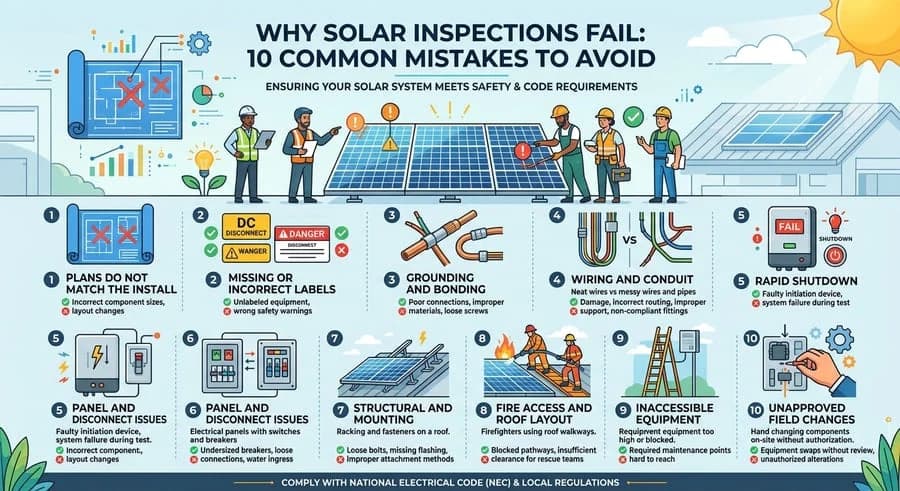
Why Solar Inspections Fail: 10 Common Mistakes to Avoid
Discover the 9 critical reasons solar inspections fail and how to avoid costly m...

Solar Grounding And Bonding: How To Pass Inspection Every Time
Learn how to pass solar grounding and bonding inspections every time. Avoid comm...
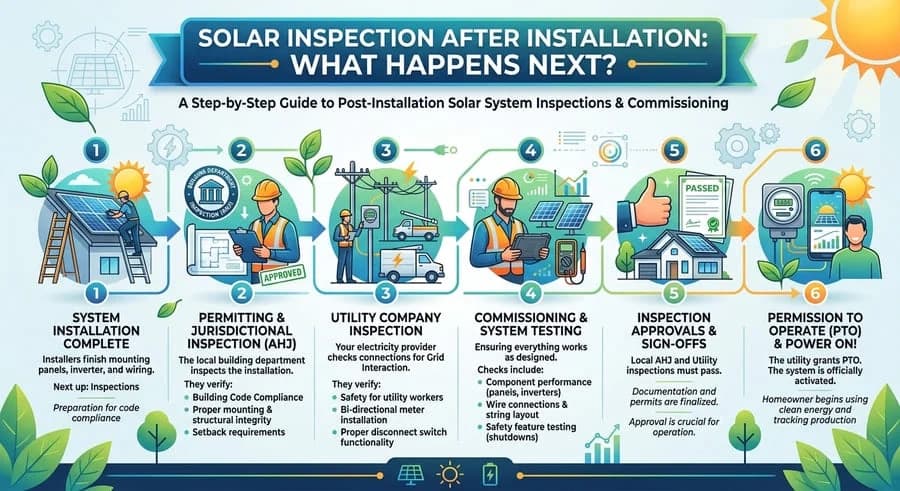
Solar Inspection After Installation: What Happens Next?
Learn how to pass your solar inspection by following essential tips for obtainin...