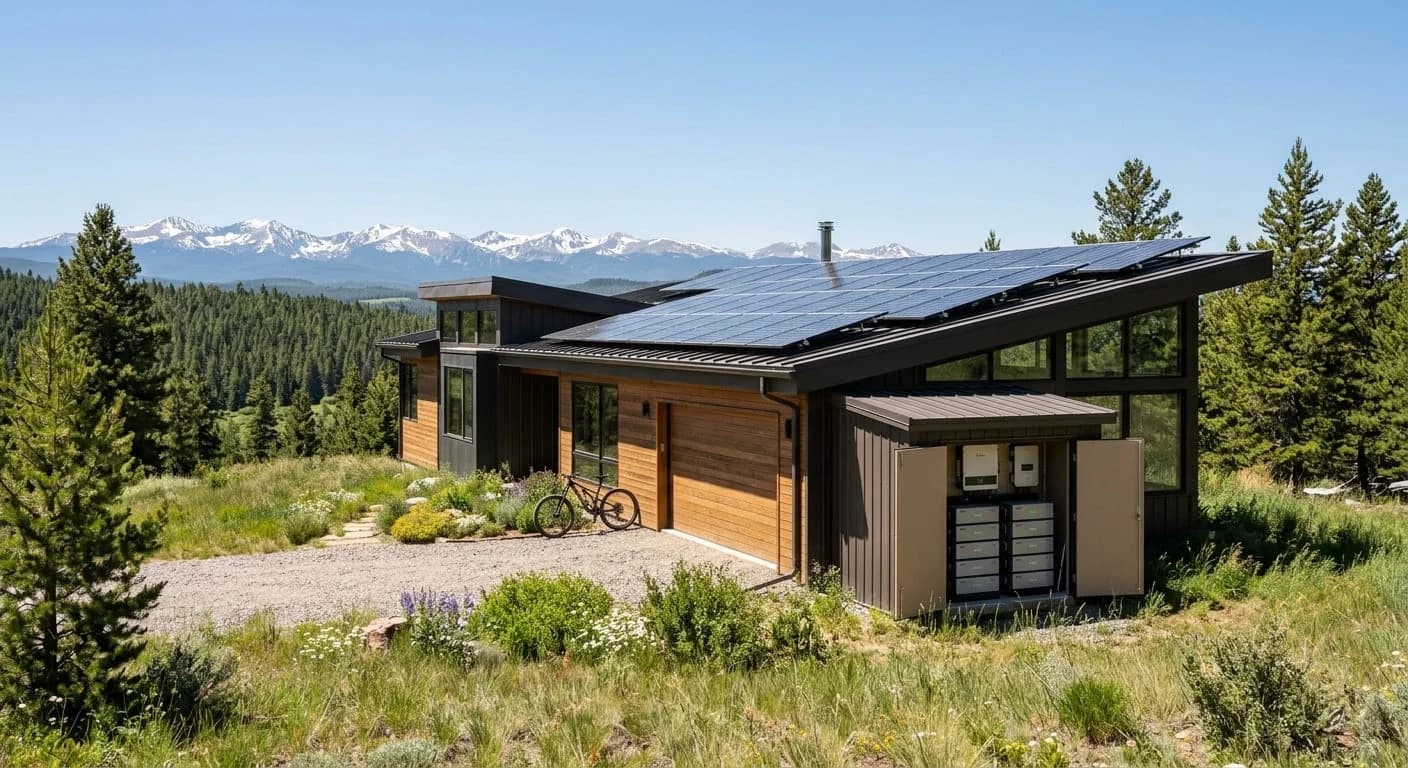
Most off-grid homes need about 8 to 16 solar panels rated at 400 watts, depending on daily electricity use. A home using 10 kWh per day needs roughly 8 panels, and one using 20 kWh needs about 16, assuming four peak sun hours and an 80% performance factor. Winter sunlight and battery recovery can raise those numbers.
Panel count is only one part of the design. A reliable off-grid system also needs batteries sized for cloudy weather, an inverter that can start your largest loads, and a permit-ready plan set for your local authority having jurisdiction (AHJ). This guide shows the sizing formula, worked examples for common household loads, and the winter and battery adjustments that most quick estimates skip.
Off-Grid Solar Panel Sizing: Quick Reference
| Sizing step | What to determine | Example used in this guide |
|---|---|---|
| 1. Daily electricity use | Add up your actual kWh per day | 10 kWh per day |
| 2. Peak sun hours | Use location data for your lowest-production season | 4 hours (3 hours for a winter check) |
| 3. Performance factor | Allow for inverter, wiring, heat, dirt, and shading losses | 80% |
| 4. Array size | Daily kWh ÷ (peak sun hours × performance factor) | 3.13 kW |
| 5. Panel count | Array watts ÷ panel watts, rounded up | 8 panels at 400 W |
| 6. Battery bank | Daily battery kWh × backup days ÷ usable depth of discharge | 12.5 kWh for one day at 80% |
| 7. Permits | Confirm building and electrical permit rules with your AHJ | Required in most jurisdictions |
How Many Solar Panels Do You Need to Run Off the Grid?
The number of panels depends primarily on how much electricity you use each day and how much energy your panels can produce under local conditions. A small cabin with a few essential appliances needs a relatively small array. A full-time household running air conditioning, an electric water heater, and a refrigerator generally needs a much larger one.
The table below gives illustrative estimates using 400-watt panels and an 80% overall performance factor. It shows two sunlight cases, because the design that works in summer may fall short in winter.
| Daily electricity use | Array size at 4 peak sun hours | Panels at 4 sun hours | Panels at 3 sun hours |
|---|---|---|---|
| 5 kWh | 1.56 kW | 4 panels | 6 panels |
| 10 kWh | 3.13 kW | 8 panels | 11 panels |
| 15 kWh | 4.69 kW | 12 panels | 16 panels |
| 20 kWh | 6.25 kW | 16 panels | 21 panels |
| 30 kWh | 9.38 kW | 24 panels | 32 panels |
These figures are preliminary estimates, not universal system recommendations. Actual requirements change with location, seasonal sunlight, shading, equipment efficiency, battery charging losses, and the amount of backup power you want. For a quick grid-tied estimate by state, try the SolarPermitSolutions solar panel calculator, then treat an off-grid design as a larger version of that number.
How many solar panels do you need for a small cabin?
A small cabin using approximately 3 to 5 kWh per day might need around 3 to 4 of the 400-watt panels in the example conditions above. That could support LED lighting, phone charging, a laptop, and an efficient refrigerator, depending on actual consumption.
If the cabin uses electric heating, an electric water heater, or air conditioning, the energy requirement can rise significantly. A cabin’s floor area alone is not enough to determine its solar needs.
How many solar panels do you need for a typical off-grid home?
A home consuming 10 to 20 kWh per day might need approximately 8 to 16 of the 400-watt panels under the four-sun-hour assumption. Homes with electric vehicles, electric cooking, large air-conditioning systems, swimming pools, or electric resistance heating can require considerably more capacity.
The most reliable starting point is your actual daily energy use, not a general estimate based on bedrooms or square footage.
How to Calculate the Number of Solar Panels You Need
You can estimate your panel requirements with two short formulas. Round the final result up to the next whole panel.
Solar array size (kW) = Daily electricity use (kWh) ÷ (Peak sun hours × System performance factor)
Number of panels = Solar array size (kW) × 1,000 ÷ Panel wattage (W)
Step 1: Calculate your daily electricity consumption
If you have utility service today, review your bills. Divide the monthly kilowatt-hour usage by the number of days in the billing period. For example, 450 kWh over 30 days equals 15 kWh per day.
If you are building a new home, cabin, or remote property, prepare an appliance list. The U.S. Department of Energy explains how to estimate appliance energy use: multiply the wattage by the hours of daily use, then divide by 1,000. For a refrigerator, it suggests dividing the plugged-in time by three, because the compressor cycles on and off.
| Appliance or load | Illustrative daily energy use |
|---|---|
| Refrigerator | 1.2 kWh |
| LED lighting | 0.4 kWh |
| Laptop and electronics | 0.6 kWh |
| Television and entertainment | 0.5 kWh |
| Water pump | 0.8 kWh |
| Other small appliances | 1.0 kWh |
| Total | 4.5 kWh per day |
These are examples, not guaranteed consumption figures. Actual usage depends on appliance efficiency and how often equipment runs. Pay particular attention to heating, cooling, water heating, cooking, and well pumps, which can account for a large share of daily use.
Also distinguish energy from power. Daily consumption (kWh) determines how much your array must produce. Simultaneous appliance demand (kW) helps determine the inverter capacity you need.
Step 2: Determine your peak sun hours.
Peak sun hours are the equivalent number of hours per day when sunlight averages 1,000 watts per square meter. They are not the same as daylight hours. A location with eight hours of daylight does not receive eight peak sun hours.
Available sunlight varies by location, season, array tilt and orientation, and shading. A desert property and a cloudy northern property can have very different production potential. For a preliminary estimate, four peak sun hours is a common assumption, but replace it with location-specific data before sizing a year-round system.
The PVWatts calculator from the National Laboratory of the Rockies estimates solar production for a specific address, and the National Solar Radiation Database publishes the underlying solar resource data. Both are useful for preliminary analysis, but an off-grid design must also consider battery charging, seasonal reliability, and what happens during prolonged low production.
Step 3: Account for system losses
Panels rarely deliver their full rated output as usable electricity. Real-world production is reduced by inverter conversion, wiring and connection losses, high panel temperatures, dirt and snow, and shading.
PVWatts uses a default total loss of about 14% for a typical system, built from categories such as soiling, shading, wiring, connections, and mismatch, which the lab describes in its PVWatts system design documentation. This guide uses a more conservative 80% performance factor, the same factor used in the SolarPermitSolutions solar panel calculator and our off-grid requirements guide, so the numbers stay consistent across our content.
Treat 80% as an illustrative assumption, not a universal standard. For example, a 4 kW array receiving four peak sun hours would produce an estimated 4 × 4 × 0.80 = 12.8 kWh per day. Battery charging and discharging losses are not part of this factor, so include them in the battery sizing step using the selected battery’s specifications.
Step 4: Calculate the required solar array size.
Suppose your household uses 10 kWh per day, you assume four peak sun hours, and your performance factor is 80%. The array size is 10 ÷ (4 × 0.80) = 3.13 kW.
Step 5: Convert array capacity into panel count
With 400-watt panels, 3.13 kW × 1,000 ÷ 400 W = 7.8 panels. Round up to 8 panels, which gives a nominal array capacity of 3.2 kW.
This is a starting point, not proof that the system can carry every load year-round. You still need to verify seasonal production, battery capacity, inverter requirements, and recovery after cloudy weather.
Solar Permit Solutions
Need Solar Permit Plans?
Professional, permit-ready solar plan sets delivered fast. Residential and commercial projects across all 50 states.
Example: How Many 400-Watt Panels Does a 15 kWh Home Need?
Consider a household that uses 15 kWh per day, with four peak sun hours and an 80% performance factor.
- Array size: 15 ÷ (4 × 0.80) = 4.69 kW
- Panel count: 4,690 W ÷ 400 W = 11.7 panels, rounded up to 12 panels
- Nominal array capacity: 12 × 400 W = 4.8 kW
This illustrates the sizing method. It does not establish that 13 panels will reliably power the home through winter or extended cloudy weather. If the design period receives only three peak sun hours, the same load calls for 15 ÷ (3 × 0.80) = 6.25 kW, or 16 panels.
The lesson is simple: the number of panels depends not just on how much electricity you use but on how much usable energy each panel can produce when you need it.
Why Off-Grid Solar Systems Must Account for Winter Sunlight
An array that covers a household in summer may struggle in winter. Shorter days, lower sun angles, persistent clouds, and snow reduce production, and an off-grid home has no utility grid to cover the shortfall.
Peak sun hours versus daylight hours
Use solar resource data rather than counting hours between sunrise and sunset. A design based on annual-average sunlight can underestimate the panels needed in the lowest-production months.
How cloudy weather affects solar production
Panels still generate electricity under clouds, but output can drop significantly. One cloudy day is manageable if the batteries are well charged. Several low-production days in a row are harder, because the system must serve the household and refill the batteries at the same time.
Why the lowest-production month matters
If you plan to live off-grid year-round, size it for the least favorable season. You may need a larger array, more battery storage, a backup generator, or a combination. Adding panels increases potential production, while adding batteries increases stored energy. Neither alone guarantees power through every weather pattern. Many off-grid owners accept running a backup generator during the darkest weeks instead of oversizing the array, because the extra panels needed for worst-case winter weather add substantial cost for production you only need part of the year.
How Much Battery Storage Do You Need for an Off-Grid Solar System?
Panels generate electricity only when the sun is available. Batteries store energy for nighttime and for periods when production falls short. The National Renewable Energy Laboratory, now the National Laboratory of the Rockies, describes how solar-plus-storage shifts output into evening and night hours.
Battery capacity is calculated separately from panel count because it answers a different question: how much energy must be available when the panels are not producing enough?
Calculate your required battery capacity
Required nominal battery capacity (kWh) = Daily energy supplied by the battery × Backup days ÷ Usable depth of discharge
Suppose the battery must supply 10 kWh per day, you want one day of backup, and the battery allows 80% of its nominal capacity to be used. Then 10 × 1 ÷ 0.80 = 12.5 kWh of nominal capacity. For two days of backup, 10 × 2 ÷ 0.80 = 25 kWh.
This simplified calculation excludes conversion losses, temperature limits, aging, and reserve capacity. Include those using the selected battery’s specifications. Chemistry also changes usable depth of discharge, and our solar battery selection guide compares the main battery types.
How many days of backup should you plan for?
The right number depends on your climate, how critical your loads are, whether you have a generator, and how much risk of running short you can accept. A remote home with no other power source needs a different design from a seasonal cabin where occasional generator use is fine. More storage does not create more electricity. The array must still meet daily loads and restore the battery.
Why battery recovery matters
After several cloudy days, the system may need to power the home and recharge a depleted battery together. A design that only matches average daily consumption may not recover quickly enough. Evaluate both the energy for household loads and the extra production needed to restore the battery.
Some owners begin with panels and add storage later. If that is your plan, our guide on how to add a battery to an existing solar system explains AC and DC coupling and why the original design matters.
What Else Do You Need to Run a Home Off-Grid?
Panels and batteries are essential, but a complete system includes other equipment that must work together. Our complete off-grid solar guide covers each component, installation, and maintenance in more depth.
Inverter capacity
The inverter converts DC electricity from the batteries and array into AC power for household appliances. Size it for the loads that may run at the same time. Pumps and compressors can draw much more power when starting than when running, so a system with plenty of daily production can still fail to start a large appliance if the inverter is undersized.
Charge controller and battery compatibility
In systems with a separate controller, the charge controller regulates the flow of electricity from the array to the battery. It must match the array’s electrical characteristics and the battery system. Our comparison of MPPT vs PWM solar charge controllers explains the efficiency and cost trade-offs. Some inverter-chargers integrate solar charge control, so the equipment arrangement varies by design.
Grounding, backup power, and energy conservation
Grounding and bonding are among the items inspectors check, and our guide to solar grounding and bonding covers how to pass that part of the inspection. Some off-grid systems also add a generator for long low-production stretches.
Reducing consumption lowers the array and battery you need. Efficient appliances, insulation, careful heating and cooling, and shifting flexible loads to sunny hours all improve resilience.
Do Off-Grid Solar Systems Need Permits?
In most jurisdictions, yes. An off-grid system skips the utility interconnection process because it never connects to the grid, but mounting panels and wiring a battery and inverter are still building and electrical work. Local governments set their own rules and fees, as the U.S. Department of Energy notes in its overview of rooftop solar permitting and inspection.
Your electrical design is reviewed against the edition of the National Electrical Code (NFPA 70) that your AHJ has adopted. Article 690 covers the PV array, Article 706 covers energy storage, and Article 710 covers stand-alone systems.
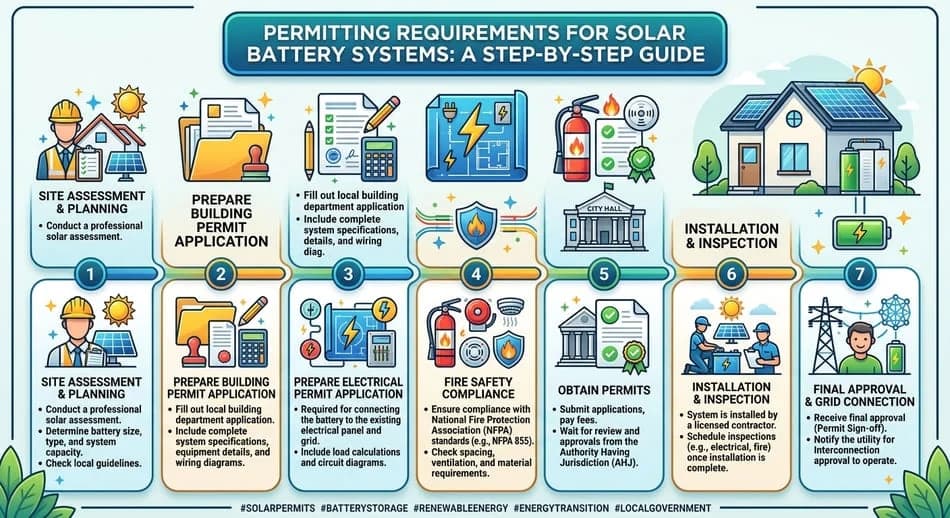
Panel count feeds directly into the permit drawings. It sets the array footprint, the roof or foundation loading, and the string and charge controller configuration, so size the system before you design the plans. Battery storage adds its own review, which our solar battery permit requirements guide explains, and indoor battery locations may trigger fire-safety requirements under NFPA 855.
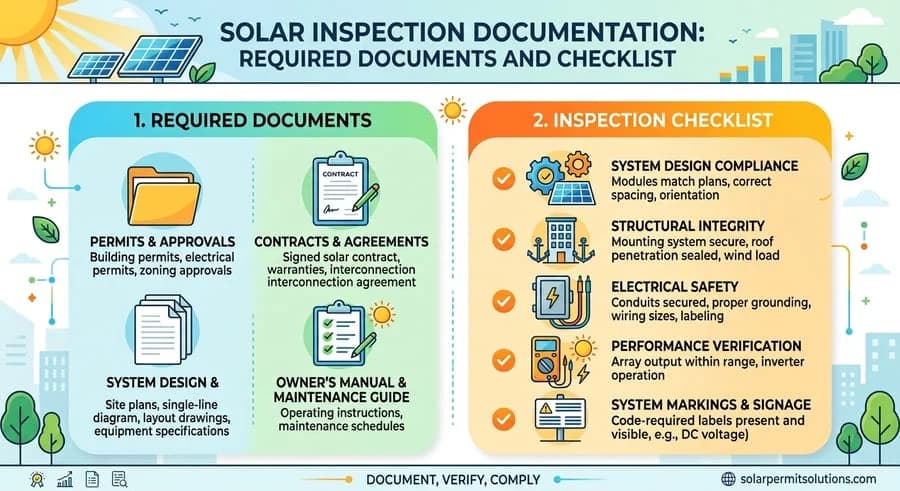
For permit requirements by state, code articles, and component details, read our off-grid solar system requirements guide. To prepare for the final walkthrough, see our guide to solar inspection documentation. If you plan to build it yourself, our DIY solar installation guide covers permits, plans, and engineering.
What About Tax Credits for Off-Grid Solar?
The federal 30% Residential Clean Energy Credit is no longer available for homeowner-purchased systems. The IRS states that the credit does not apply to property placed in service after December 31, 2025, which includes solar panels and battery storage. Do not subtract an assumed 30% when budgeting.
Our solar battery tax credit 2026 guide explains what remains, including commercial credits for third-party-owned systems. State, utility, and local incentives may still exist, and the DSIRE database is a good place to check them by address.
Final Thoughts: Size Your Off-Grid Solar System for Your Actual Needs
The number of panels you need depends on daily electricity consumption, panel wattage, available sunlight, and system losses. Battery storage, inverter capacity, and seasonal weather decide whether the complete system can meet your needs reliably.
Start by calculating your daily energy use, estimate the solar resource for your location, and apply a consistent performance assumption. Then check the lowest-production season, size the battery, and confirm permit requirements before you buy equipment. Do not rely on panel count alone.
Need permit-ready plans for your off-grid project? Solar Permit Solutions prepares PE-stamped plan sets for residential solar design and off-grid solar system design projects across all 50 states. Explore our full list of services or submit your project to discuss what documentation you need.
These estimates are preliminary and use illustrative assumptions. Final equipment selection and electrical design should be completed by qualified professionals, and permitting, utility, and incentive requirements vary and can change, so verify current requirements with the applicable authority.
Frequently Asked Questions
Need Solar Permit Plans?
Professional, permit-ready solar plan sets delivered fast. Residential and commercial projects across all 50 states.
Frequently Asked Questions
Four 400-watt panels provide a nominal array capacity of 1.6 kW. Under the illustrative assumptions of four peak sun hours and an 80% performance factor, they would produce approximately 5.1 kWh per day. That may support a small, energy-efficient cabin or a limited set of essential loads. It is unlikely to meet the needs of many full-time households without additional energy sources or substantially lower consumption.
A small cabin using around 3 to 5 kWh daily might need approximately 3 to 4 of the 400-watt panels under the example conditions in this article. The actual number depends on appliances, sunlight, seasonal use, and battery requirements. A cabin used mainly in summer may have different sizing needs from one occupied year-round.
Square footage alone cannot determine the correct panel count. Two homes of the same size can have very different electricity consumption because of insulation, heating and cooling systems, appliances, and occupant behavior. Start with daily electricity use and local solar resource data, then calculate the array size and verify battery and inverter requirements. A 2,000-square-foot home with high electric heating and cooling loads may need substantially more capacity than an efficient home of the same size.
It is possible to use solar power without batteries in certain arrangements, but a conventional standalone off-grid home generally needs storage or another source of electricity to operate when solar generation is insufficient. Without batteries or backup generation, a standalone system cannot reliably provide solar-generated electricity at night or during extended periods of poor sunlight.
Often, yes. Shorter days, lower sun angles, clouds, and snow can reduce solar production during winter. The amount of additional capacity needed depends on location, array orientation, energy demand, and the desired level of reliability. Use seasonal solar resource estimates rather than applying the same annual-average production figure to every month.
There is no universal number. A home using 10 kWh daily may need around 8 of the 400-watt panels in the illustrative four-peak-sun-hour calculation, while a home using 20 kWh daily may need around 16. At three peak sun hours those figures rise to about 11 and 21. A fully off-grid design also needs suitable battery storage, an appropriately sized inverter, and a plan for extended periods of low solar production.
In most jurisdictions, yes. Off-grid systems skip utility interconnection, but mounting panels and wiring batteries and inverters are still building and electrical work, so local permit and inspection requirements generally apply. Confirm the requirements, including whether a PE stamp is needed, with the local authority having jurisdiction before you buy equipment.
Not for a homeowner who buys the system. The IRS states that the 30% Residential Clean Energy Credit is not available for property placed in service after December 31, 2025. State, utility, and local incentives may still apply, so check your address before you budget.

SPS Editorial Team
Solar Permit Solutions
Solar Permit Solutions provides professional solar permit design services for residential, commercial, and off-grid installations across all 50 states. Our team ensures permit-ready plan sets delivered fast.
Related Articles
Solar Battery Permit Requirements: What You Need to Know
A solar battery usually needs local approval and a utility review before it can ...
How To Add A Battery To Your Existing Solar System
Adding a battery to your solar system costs $10,000-$20,000. Save with 30% feder...
Solar Inspection Documentation: Required Documents and Checklist
Learn about solar inspection documentation, including permit requirements, NEC c...