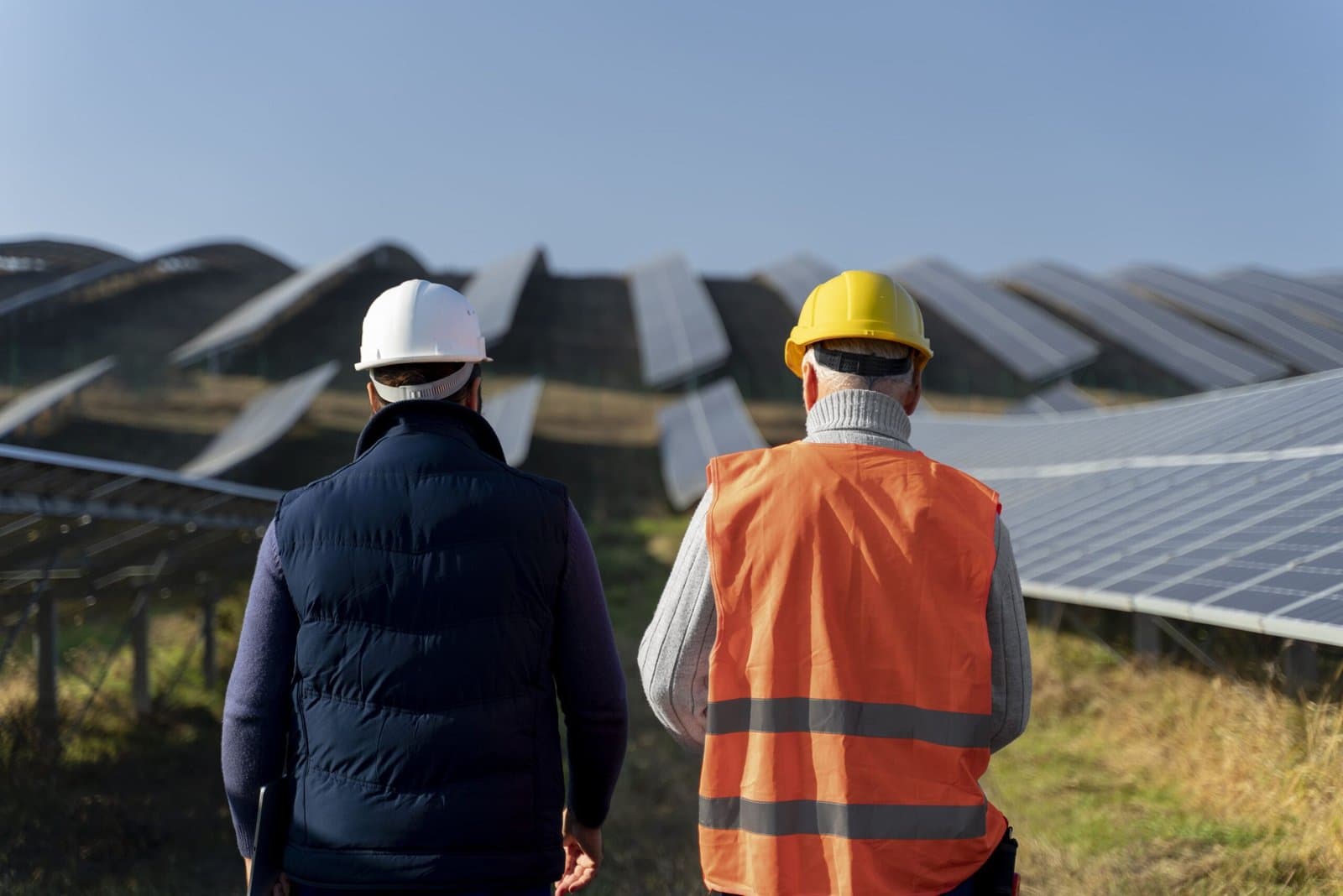
Solar interconnection equipment requirements include UL 1741 SA/SB-compliant inverters, lockable disconnect switches, revenue-grade metering systems, grounding and bonding equipment, overcurrent and voltage protection devices, and surge arresters. Grid-connected solar systems must meet utility standards and National Electrical Code requirements to ensure safe parallel operation with the electrical grid.
System size and voltage level determine specific equipment configurations. Secondary voltage connections (up to 600V) require lockable AC disconnect switches within 10 feet of the interconnection meter, while primary voltage connections need lockable switching equipment with visible breaks. Systems 3 MW and larger require SCADA monitoring of connection status, real power output, reactive power output, and voltage at the point of connection. All distributed energy resource installations must provide effective grounding that matches utility system standards and include protection relaying for three-phase interconnections.
Understanding Basic Equipment Compliance Standards
Solar generator applicants must meet all requirements outlined in their utility’s interconnection procedures. Small generators, net metering installations, and community solar program participants each follow specific equipment guidelines established by their local utility and electrical codes.
Distributed energy resources and related customer equipment must comply with standards designated by the interconnecting utility and local electrical and building codes. The following sections detail specific equipment requirements for grid-connected solar systems.
UL 1741 Compliance and Smart Inverter Functionality
Inverters must be UL 1741-tested and compliant for utility interconnection approval. Most jurisdictions now require UL 1741 Supplement A (SA) or Supplement B (SB) certification, which includes advanced grid support functions aligned with IEEE 1547-2018 standards. Non-compliant inverters will not receive consideration for grid connection.
UL 1741 SA certification verifies smart inverter capabilities including voltage and frequency ride-through, volt-watt control, and frequency-watt response. UL 1741 SB adds interoperability requirements through communication protocols such as IEEE 2030.5, SunSpec Modbus, or DNP3. Many states transitioned to requiring SB certification starting in 2023.
Any material modifications to the inverter’s standard settings require documentation with the interconnection application materials. Common inverter modifications that require disclosure include static or dynamic power factor adjustments, use of smart inverter functionality, and permanent curtailment of the maximum inverter output compared to its AC nameplate capacity provided by the manufacturer.
Utilities provide direction to applicants on Supervisory Control and Data Acquisition (SCADA) requirements for their DER on an individual project basis.
Electrical Safety Through Proper Grounding and Bonding
Grounding and bonding serve critical functions for safety and electrical reliability. System owners remain responsible for ensuring that their DER’s electrical wiring and service equipment are grounded and bonded in accordance with applicable National Electrical Code requirements.
The DER must provide the same level of effective grounding as the utility system to avoid adverse impacts on grid operations. Maintaining effective grounding protects equipment belonging to both the utility and its customers. Utility system grounding provides a path of least resistance for potentially damaging electrical current following a surge or fault.
Most utilities require solidly grounded facilities and use wye-wye transformers to achieve this condition. Applicants can have a wye or delta connection on their side of the point of delivery, but must connect to the utility with a grounded wye connection.
Utilities follow specific engineering service requirements that include guidance on customer-owned transformers beyond the point of delivery when applicable.
Solar Permit Solutions
Skip the Permit Headaches
We design plan sets that pass inspection the first time. Code-compliant, PE-stamped, accepted by AHJs nationwide.
Lockable Switching and System Isolation Hardware
For secondary voltage connections of parallel operations, a lockable AC disconnect switch is required. This switch must be positioned within 10 feet of the interconnection meter unless an alternative location receives utility approval.
Primary voltage connections require lockable switching equipment such as a disconnect switch, breaker, or recloser with a visible break to isolate the DER from the utility system.
Overcurrent, Voltage, and Frequency Protection Systems
System owners bear responsibility for protecting their DER equipment. Primary voltage interconnections require overcurrent protection to isolate the utility from disturbances originating on the DER side.
Proposed three-phase DER interconnections must include overvoltage and undervoltage relaying on each phase. Overfrequency and underfrequency protection must be included on at least one phase. Three-phase systems must be gang operated if any single phase of the protection devices detects a power quality violation.
Installations using relays incapable of sending or receiving Mirrored Bits can utilize an ancillary device to translate Mirrored Bits to the relay. This device features hard-wired inputs and outputs as well as a fiber connection for the Mirrored Bits. System owners should verify fiber type requirements with their utility.
Managing Voltage Transients and Overvoltage Events
Voltage surges and transients represent temporary overvoltages of various levels, durations, frequencies, and repetition rates. Such occurrences can overheat arresters and cause equipment failure.
When voltage surges and transients resulting from the proposed DER cannot be mitigated through other means, installation of additional surge arresters or surge arresters with higher maximum continuous operating voltage ratings may become necessary.
When Systems Operate In Parallel With the Grid
When a DER generates electricity for a duration of 100 milliseconds or more while connected to the utility system, the DER operates in parallel operation mode. Utility interconnection procedures provide detailed information about parallel operation requirements.
Dual Metering for Temporary Remote Disconnect Capability
Interconnection to feeders with limited capacity for new DERs may require installation of an additional utility meter base to accommodate a second, non-revenue utility meter. The second utility meter allows for temporary remote disconnection of the DER from the utility system during times of high DER generation and low customer energy load on the feeder.
Utilities perform temporary disconnection without notice to system owners during times when disconnection is deemed appropriate. System owners bear responsibility for the cost of the additional utility meter base.
Utilities may require a two-meter solution based on feeder capacity to avoid significant interconnection costs for system upgrades or new facilities needed to accommodate new DER installations.
Revenue-Grade Metering and Data Acquisition Standards
System owners and utilities must have unrestricted access to metering and data acquisition equipment to conduct routine business or respond to emergencies. Metering requirements vary based on interconnection service voltages and system configuration.
Drawing Package Submissions for Large Service Connections
Utilities establish interconnection and equipment requirements for relocated, rewired, and new services. Single-phase services over 320 A or three-phase services over 200 A typically require submission of a drawing package for utility review.
The package must contain a site plan, electrical one-line diagram, electrical room layout if applicable, working clearances, and manufacturer drawings with relevant equipment standards references. System owners must receive confirmation that equipment meets utility requirements from the utility’s meter engineering department prior to installation.
Switchboard Specifications for Primary Voltage Services
System owners must consult with utilities regarding services greater than 600 V prior to construction. Switchboards must meet utility engineering service requirements for service voltages of 12.47 kV. Equipment requirements for service voltage of 34.5 kV require direct utility consultation.
System owners must consult utilities for specifications on instrument transformers, the meter test switch, and secondary wiring of instrument transformers prior to ordering the meter enclosure. Enclosure drawings with a site plan and electrical room detail must receive utility approval prior to installation.
Current and Potential Transformer Installation Guidelines
Utilities specify and purchase all revenue metering instrument transformers including current transformers (CTs) and potential transformers (PTs). Utilities provide the instrument transformers to system owners for applicable switchboard and primary services for installation by the system owner.
Utilities install the test switch and all secondary meter wiring. All instrument transformers must meet IEEE C57.13-2016 revenue metering requirements and will only be used for utility revenue metering devices.
Coordination Requirements for Large-Scale Installations
All commercial, industrial, and large residential electricity customers must coordinate their service requirements with their utility. System owners must provide factory-produced submittal drawings of metering equipment before purchase and installation.
Single residential services over 320-amp continuous and all three-phase residential services qualify as large residential services requiring enhanced coordination. Structural engineering calculations and conduit selection must also meet applicable standards for safe installation.
Real-Time Monitoring and Data Collection Systems
Utilities install appropriate revenue-grade metering at interconnection points. Additional behind-the-meter telemetry may be required at utility discretion to distinguish between net and gross electricity consumption at customer premises for operational or planning purposes.
Utilities require monitoring of connection status, real power output, reactive power output, and voltage at the point of connection for interconnections of small generator DER with capacity of 3 MW and larger.
Remote Meter Base Design for SCADA Integration
For SCADA-connected DERs, metering configurations follow standard utility schematics representing general wall-mounted, remote meter base designs. Individual site requirements may alter the design, and system owners must coordinate with utilities on any design changes. For off-grid applications, different equipment configurations apply. Additional resources and technical guidance are available on our blog.
Special Considerations for Network System Connections
When a DER serves as a source of electric power for greater than 100 ms while connected to the utility system, the DER operates in parallel operations mode. Interconnection to a secondary network system for parallel operations faces limitations due to utility system risks related to cycling network protectors and potential islanding of customers.
Although common rules exist for general network systems, additional interconnection rules apply when addressing grid or spot networks.
Area Network Capacity Thresholds and Restrictions
For interconnection to a secondary grid network, also called an area network, utilities can accommodate new or modified DERs up to an aggregate DER capacity not exceeding the lesser of 5% of the associated network system’s peak load, or 50 kilowatts (kW).
When either of these thresholds are met, no additional DER can be added to the network system. No additional provisions exist for connecting to secondary grid networks beyond these capacity limitations.
Network Protector Coordination and IEEE 1547 Compliance
For interconnection to a spot network, utilities can accommodate new or modified DERs if aggregate DER capacity does not exceed the lesser of 5% of the spot network’s peak load or 50 kW. When either threshold is met, no additional DER can be added to the network system.
Additional rules per IEEE 1547-2018 include:
Network protectors shall not be used to separate, switch, perform breaker failure backup, or isolate a network or network primary feeder to which the DER is connected from the remainder of the spot network.
The DER shall not cause operation or prevent reclosing of any network protectors on the spot network. This coordination shall be accomplished without requiring any changes to prevailing network protector clearing time practices.
Connection of the DER to the spot network is only allowed if the network bus is already energized by more than 50% of the installed network protectors.
The DER output shall not cause any cycling of network protectors.
The network equipment loading and fault interrupting capacity shall not be exceeded with the addition or modification of the DER.
DER installations on a spot network using an automatic transfer scheme in which load is transferred between the DER and utility in a momentary make-before-break (closed transition) operation shall meet the above requirements regardless of the duration of paralleling.
Conclusion
Successfully navigating solar interconnection equipment requirements requires careful attention to technical specifications, utility standards, and safety protocols. From UL 1741 SA/SB-compliant inverters to properly configured metering systems, each component plays a vital role in ensuring safe and reliable grid connection.
System owners who invest time in understanding these requirements upfront can avoid costly delays and equipment modifications during the approval process. Working closely with utility engineering departments from the earliest stages of project planning helps identify voltage-specific requirements, metering configurations, and any site-specific considerations that may impact equipment selection.
The complexity of interconnection equipment varies significantly based on system size, voltage level, and connection type. Small residential installations face relatively straightforward requirements, while large commercial systems and primary voltage connections demand more sophisticated protection devices, instrumentation, and coordination procedures.
Proper grounding, adequate protection systems, and compliant switching equipment form the foundation of any successful interconnection. These safety-critical elements protect both the distributed energy resource and the utility grid from faults, surges, and operational disturbances. Meeting these standards demonstrates commitment to electrical safety and system reliability for all grid users.
FAQs
Any modifications to the inverter’s standard settings, including power factor adjustments or smart inverter functionality, must be documented in the interconnection application materials. These standards ensure inverters can safely disconnect from the grid during faults, provide voltage and frequency ride-through during disturbances, and maintain proper grid support functions during normal operation.
For SCADA-connected systems, metering configurations follow standard utility schematics representing wall-mounted, remote meter base designs. Individual site requirements may alter specific design elements, requiring coordination with utility engineering departments throughout the planning process.
System owners can have wye or delta connections on their side of the point of delivery but must connect to the utility with a grounded wye connection. All electrical wiring and service equipment must be grounded and bonded according to NEC requirements to ensure safety and electrical reliability.
For secondary grid networks, utilities can accommodate distributed energy resources up to an aggregate capacity not exceeding the lesser of 5% of the network system’s peak load or 50 kilowatts. Spot networks have similar capacity limitations plus additional coordination requirements per IEEE 1547-2018 standards to prevent network protector cycling and ensure proper system operation.
The second meter allows utilities to temporarily disconnect the system during times of high generation and low load without notice to the system owner. This approach helps avoid significant interconnection costs for system upgrades while managing feeder capacity constraints.
For professional assistance with solar design and interconnection requirements, contact our team of experts.
Skip the Permit Headaches
We design plan sets that pass inspection the first time. Code-compliant, PE-stamped, accepted by AHJs nationwide.
Frequently Asked Questions
All grid-connected solar inverters must be UL 1741-tested and compliant. Most jurisdictions now require UL 1741 Supplement A (SA) or Supplement B (SB) certification, which provide advanced grid support capabilities aligned with IEEE 1547-2018 standards. Utilities will not approve non-compliant inverters for interconnection. Any modifications to the inverter's standard settings, including power factor adjustments or smart inverter functionality, must be documented in the interconnection application materials. These standards ensure inverters can safely disconnect from the grid during faults, provide voltage and frequency ride-through during disturbances, and maintain proper grid support functions during normal operation.
For secondary voltage connections of parallel operations, a lockable AC disconnect switch must be positioned within 10 feet of the interconnection meter unless the utility approves an alternative location. This proximity requirement ensures utility personnel can quickly and safely isolate the distributed energy resource during maintenance or emergency situations. Primary voltage connections have different requirements involving lockable switching equipment with visible breaks.
Utilities typically require monitoring of connection status, real power output, reactive power output, and voltage at the point of connection for small generator distributed energy resources with capacity of 3 MW and larger. For SCADA-connected systems, metering configurations follow standard utility schematics representing wall-mounted, remote meter base designs. Individual site requirements may alter specific design elements, requiring coordination with utility engineering departments throughout the planning process.
Solar systems must provide the same level of effective grounding as the utility system to avoid adverse impacts on grid operations. Most utilities require solidly grounded facilities and use wye-wye transformers to achieve this condition. System owners can have wye or delta connections on their side of the point of delivery but must connect to the utility with a grounded wye connection. All electrical wiring and service equipment must be grounded and bonded according to NEC requirements to ensure safety and electrical reliability.
Interconnection to secondary network systems for parallel operations faces limitations due to utility system risks related to cycling network protectors and potential islanding of customers. For secondary grid networks, utilities can accommodate distributed energy resources up to an aggregate capacity not exceeding the lesser of 5% of the network system's peak load or 50 kilowatts. Spot networks have similar capacity limitations plus additional coordination requirements per IEEE 1547-2018 standards to prevent network protector cycling and ensure proper system operation.
A two-meter solution involves installing an additional utility meter base to accommodate a second, non-revenue utility meter for temporary remote disconnection capability. Utilities may require this configuration when interconnecting to feeders with limited capacity for new distributed energy resources. The second meter allows utilities to temporarily disconnect the system during times of high generation and low load without notice to the system owner. This approach helps avoid significant interconnection costs for system upgrades while managing feeder capacity constraints.

SPS Editorial Team
Solar Permit Solutions
Solar Permit Solutions provides professional solar permit design services for residential, commercial, and off-grid installations across all 50 states. Our team ensures permit-ready plan sets delivered fast.
Related Articles
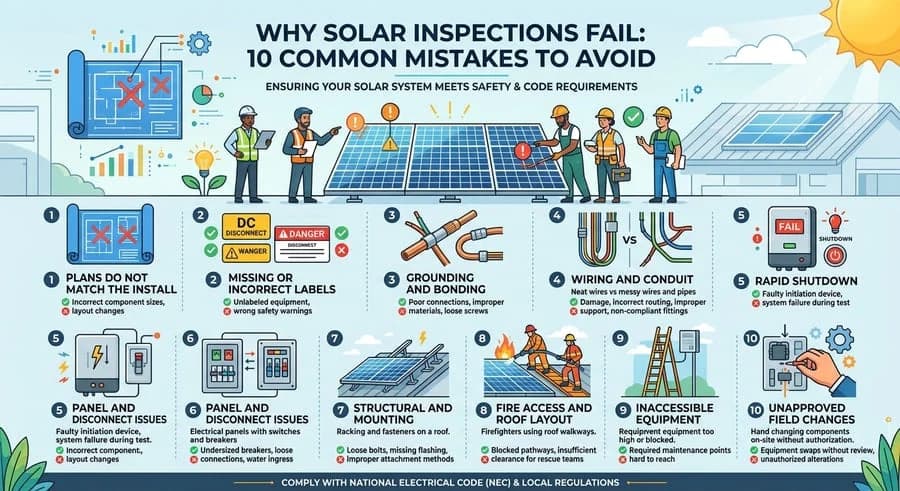
Why Solar Inspections Fail: 10 Common Mistakes to Avoid
Discover the 9 critical reasons solar inspections fail and how to avoid costly m...
Solar Grounding And Bonding: How To Pass Inspection Every Time
Learn how to pass solar grounding and bonding inspections every time. Avoid comm...
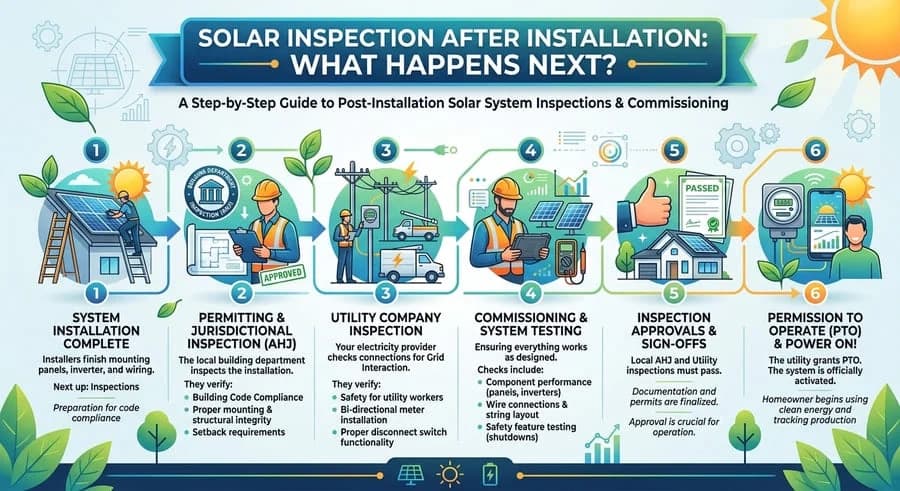
Solar Inspection After Installation: What Happens Next?
Learn how to pass your solar inspection by following essential tips for obtainin...