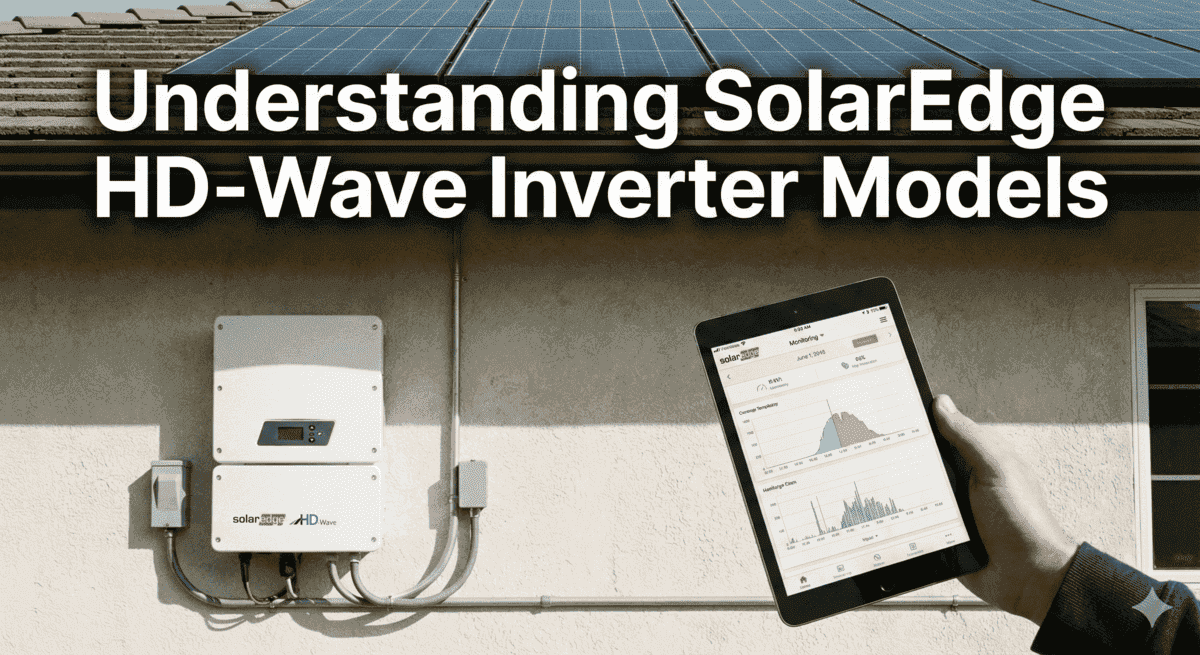
SolarEdge HD-Wave inverters are single-phase, grid-tied inverters for residential solar installations in North America, available in seven models ranging from 3,000W to 11,400W output capacity. These inverters meet NEC 2017/2014 rapid shutdown requirements through integrated power optimizer technology that automatically reduces DC voltage to below 80V within array boundaries upon AC disconnect. All models are UL 1741 SA and IEEE 1547 certified with built-in arc fault protection (AFCI) compliant with NEC Article 690.11, eliminating the need for external arc fault devices.
Key specifications for solar permit plan sets must include maximum DC input power (4,650W to 17,650W depending on model), maximum input voltage (480 Vdc limit), nominal DC voltage range (380-400 Vdc), maximum input current (8.5A to 30.5A by model), AC output ratings (240V or 208V configurations), and NEMA 4X outdoor rating for weather protection. String voltage calculations must demonstrate that open-circuit voltage at the coldest expected temperature stays below 480 Vdc maximum.
Installation requires AC breaker sizing at 125% of continuous output current per NEC requirements, equipment grounding conductor sized per NEC Article 250 Table 250.122, and wire gauges of AWG 6-14 for both DC and AC connections with 1-inch maximum conduit. The transformer-less design operates from -25°C to +60°C (-13°F to +140°F) with optional -40°C models available for extreme cold climates. Natural convection cooling eliminates fan maintenance while requiring 12-inch clearances above and below the unit.
For permitting, documentation must include manufacturer datasheets showing UL 1741 SA certification, one-line electrical diagrams with string voltage calculations, rapid shutdown compliance notes, wire sizing calculations with 125% continuous current factors, and monitoring system specifications. California installations require Rule 21 certification (included), while all jurisdictions need IEEE 1547 grid interconnection compliance. The integrated safety switch can serve as the AC disconnect where codes permit, though some jurisdictions require separate lockable disconnects. Module-level monitoring is built-in through the power optimizer system, satisfying jurisdictions requiring granular performance tracking.

Understanding SolarEdge HD-Wave Inverter Models
Model Selection for Your Solar System
The SolarEdge HD-Wave inverter lineup offers seven models designed to match various residential system sizes, from smaller 3kW installations to larger 11.4kW arrays. The complete model range includes SE3000H-US through SE11400H-US, with rated outputs from 3,000W to 11,400W at 240V configurations.
When sizing your inverter, consider your total array DC power output. A common rule of thumb is to size the inverter between 75% and 115% of your total DC array capacity. For example, if you’re installing a 6 kW DC solar array, the SE5000H or SE6000H would be appropriate choices. Most jurisdictions require that your inverter nameplate rating doesn’t exceed the actual continuous AC power output capability, so proper residential solar design documentation in your plan sets is critical.
The choice between 240V and 208V models depends on your service panel voltage. Most residential installations use 240V single-phase service, while some multi-family buildings, townhomes, and commercial properties may have 208V service.
Why HD-Wave Technology Matters for Permits
SolarEdge’s HD-Wave technology represents significant advancements that directly impact permit approval and code compliance. The HD-Wave inverters include built-in arc fault circuit interrupter (AFCI) protection, which is mandatory under NEC 2014 and 2017 Article 690.11. This integrated protection eliminates the need for external arc fault detection devices and simplifies your system design.
Equally important is the integrated rapid shutdown capability meeting NEC 2014 and 2017 Article 690.12 requirements. Upon loss of AC grid connection or manual shutdown, the SolarEdge system automatically reduces DC voltage at the array level through its power optimizers. This critical safety feature protects first responders and simplifies your rapid shutdown documentation in permit applications.
The transformer-less, ungrounded design of HD-Wave inverters offers several code compliance benefits. Without a transformer, these inverters are lighter, smaller, and more efficient. However, the ungrounded design does require proper documentation in your plan sets, particularly regarding grounding electrode conductor sizing and equipment grounding requirements.
Key Specifications AHJs Look For
When Authority Having Jurisdiction (AHJ) reviewers examine your solar permit application, they focus on specific inverter certifications and compliance standards. Every SolarEdge HD-Wave inverter carries UL 1741 SA certification, which is the gold standard for grid-connected inverters in North America.
IEEE 1547 compliance is another critical specification. This standard governs how distributed energy resources like solar systems connect to the utility grid. All HD-Wave models meet IEEE 1547 requirements for voltage and frequency trip settings, anti-islanding protection, and power quality.
For California installations, Rule 21 certification is mandatory. This CPUC requirement mandates specific grid support capabilities, voltage and frequency ride-through, ramp rate controls, and communication capabilities. All SolarEdge HD-Wave inverters are Rule 21 certified.
Critical Information for Solar Plan Sets
Electrical Specifications Required in Plan Sets
Accurate electrical specifications in your plan sets are non-negotiable for permit approval. Missing or incorrect inverter data is among the most common reasons for plan set rejections.
Input (DC Side) Specifications:
Maximum DC power ratings vary by model and voltage configuration. For 240V applications, these range from 4,650W (SE3000H) up to 17,650W (SE11400H). The nominal DC input voltage for all HD-Wave models is 380-400 VDC. Maximum input voltage is 480 Vdc across all models. This is a hard limit that must never be exceeded, even under cold temperatures. open-circuit conditions. Your plan sets should include string voltage calculations showing that even at the coldest expected temperature, your strings will not exceed 480 Vdc.
Output (AC Side) Specifications:
AC output specifications must be coordinated with your main service panel specifications and utility interconnection requirements. Rated AC power output varies by model from 3,000W to 11,400W at 240V. Maximum continuous output current varies by model and voltage. Per NEC requirements, your overcurrent protection device (breaker) must be sized at 125% of this continuous current.
Safety Features to Highlight in Permit Documents
Modern solar installations must meet extensive safety requirements. The SolarEdge HD-Wave inverters include multiple integrated safety features that should be explicitly called out in your plan sets.
Automatic rapid shutdown upon grid disconnect is perhaps the most critical safety feature for permit approval. When the inverter detects loss of AC grid power, it immediately signals all connected power optimizers to cease operation. Within seconds, DC voltage at the array level drops below safe thresholds as defined in NEC 2017 Article 690.12.
Anti-islanding protection is mandatory for all grid-connected solar systems and prevents the inverter from continuing to energize utility lines during a grid outage. HD-Wave inverters use multiple detection methods, including voltage, frequency, and impedance monitoring, to detect grid disconnection within milliseconds. Your plan sets should note “Anti-islanding protection compliant with IEEE 1547 and UL 1741″ in your safety features section.
Installation Location Requirements
The NEMA 4X rating allows both outdoor and indoor installation. Operating temperature range is -25°C to +60°C (-13°F to +140°F) for standard models, with an optional -40°C version available for extreme cold climates. Natural convection cooling eliminates fan maintenance but requires adequate clearance for air circulation. Your plan sets should include a mounting detail showing minimum clearances: typically 12 inches above and below the unit and 6 inches on each side.

Solar Permit Solutions
DIY Solar? We Handle the Permits.
You install the panels — we design the permit-ready plan set your building department requires. Fast, affordable, all 50 states.
Installation Guide
Pre-Installation Planning
Successful solar installations begin with thorough planning. Assemble all necessary tools, including wire strippers, screwdrivers, a drill with appropriate bits, a level, a tape measure, and a multimeter capable of measuring DC voltage up to 600V. Grounding equipment is critical for safety and code compliance. You’ll need copper grounding electrode conductors sized per NEC Article 250.
Walk your installation site before beginning work and verify several critical factors. Identify the optimal inverter location as close as possible to your main service panel to minimize AC wire runs. Check ambient temperature conditions at your proposed installation location and ensure proper ventilation for natural convection cooling.
Mounting and Wiring
Mount the inverter at a convenient height, typically with the bottom edge 4-5 feet above the finished floor or grade. For wood frame walls, align mounting holes with wall studs for maximum strength. For masonry walls, use expansion anchors or sleeve anchors rated for the weight plus a safety factor of at least 4x.
Wire sizing must be based on maximum current ratings with appropriate safety factors. For DC wiring from your array to the inverter, calculate the maximum current from your string configuration, then multiply by 1.25 per NEC continuous current requirements. Most SolarEdge residential installations use AWG 10 for strings up to 15A or AWG 8 for strings up to 20A after applying adjustment factors.
AC Side Connection
Breaker sizing must account for continuous current requirements. NEC Article 705.12 requires that the inverter’s output overcurrent protection device (breaker) be rated at least 125% of the inverter’s maximum continuous output current. For example, if your SE7600H outputs 32A maximum continuous current at 240V, your breaker must be rated at least 40A.
The load-side connection is typically used for residential solar installations under 10kW. NEC Article 705.12(D)(2) requires that the sum of the solar breaker rating plus the main breaker rating not exceed 120% of the panel’s bus rating.
Communication and Commissioning
SolarEdge inverters support multiple communication methods: RS485 wired connection, Ethernet installation, ZigBee wireless (optional), or cellular gateway (optional). With all wiring complete and monitoring connected, follow the proper powering-up sequence. First, turn on the AC disconnect to energize the inverter with grid power. Once the inverter shows “ready” status, close the DC disconnect to allow DC power to flow from the solar array.

Common Permit Issues and Solutions
Rapid Shutdown Compliance
SolarEdge HD-Wave inverters automatically meet NEC 2017 and 2014 rapid shutdown requirements through the integrated power optimizer system. Documenting rapid shutdown in your plan sets requires clear explanation. Include a note in your electrical one-line diagram stating: “Rapid shutdown compliant with NEC 2017 Article 690.12. The SolarEdge power optimizer system automatically reduces DC voltage to <80V within array boundary and <30V outside the array boundary upon loss of AC power or manual shutdown."
String Sizing and Configuration
Improper string sizing is one of the most common reasons for plan set rejections. String voltage calculations must account for temperature effects. Module open-circuit voltage increases as temperature decreases. Calculate the worst-case cold temperature Voc and verify it stays below 480 Vdc. Understanding different inverter types can help with proper system design.
Grounding and Bonding Requirements
Equipment grounding conductor sizing follows NEC Article 250 requirements. For circuits protected by breakers up to 60A, the minimum equipment grounding conductor is #10 copper or #8 aluminum. Your inverter’s equipment grounding terminal connects via the equipment grounding conductor to the grounding bus in your service panel.
Regional Permit Considerations
California-Specific Requirements
California has some of the most comprehensive solar regulations in the United States. Rule 21 compliance is mandatory for all grid-connected solar systems in California. All SolarEdge HD-Wave inverters are Rule 21 certified. Title 24 considerations affect new construction and major renovation projects. Submit your interconnection application early in the permit process.
Florida Solar Permit Requirements
Wind load calculations and mounting are critical in Florida due to hurricane risks. Your plan sets must include detailed wind load calculations showing that your racking system can withstand the design wind speeds for your location. Building department-specific requirements vary significantly across Florida’s 67 counties and hundreds of municipalities.
Cold Climate and High-Altitude Installations
The -40°C cold weather inverter option is essential for installations in extremely cold climates. Standard HD-Wave inverters are rated for operation down to -25°C (-13°F). Temperature derating above 60°C is required when ambient temperatures exceed the inverter’s rated operating range. At high altitudes above 2,000 meters, reduced air density decreases cooling effectiveness, requiring power derating.
Troubleshooting and Maintenance
Common Installation Issues
Voltage reading errors often stem from measurement problems rather than actual system faults. Always verify your meter settings and probe connections before concluding there’s a system problem. Communication connection problems can prevent monitoring system operation even when power production is working fine. Check that communication cables are properly connected and meet specifications.
Maintenance Requirements
SolarEdge HD-Wave inverters are designed for minimal maintenance. The HD-Wave design has no cooling fans to clean, lubricate, or replace. However, ensure that ventilation openings remain clear of dust, debris, leaves, or nests. A quick visual inspection every 6-12 months is sufficient for most installations. Firmware update procedures keep your inverter operating with the latest features and bug fixes.
Warranty Documentation
Most SolarEdge HD-Wave inverters include a standard 12-year warranty covering defects in materials and workmanship. Extended warranty options up to 25 years are available for purchase. Proper documentation for warranty claims should include proof of purchase, installation date documentation, the inverter serial number, and a description of the problem, including any fault codes.
Conclusion
Successfully installing and permitting a SolarEdge HD-Wave inverter requires attention to detail, but the process is straightforward when you understand the requirements. Critical specifications for permit plan sets include all electrical ratings, safety certifications (UL 1741 SA, IEEE 1547, Rule 21), integrated safety features, and monitoring capabilities.
Professional permit design services like Solar Permit Solutions can significantly streamline the permitting process, especially for complex installations or challenging jurisdictions. NABCEP certification demonstrates professional competence and can enhance your credibility with customers and inspectors.
Get professional help with permit plan sets if you’re uncertain about any aspect of the design or if your local jurisdiction has complex requirements. If you’re comparing options, understanding string inverters vs. microinverters can help clarify the best choice for your installation.
FAQs
DIY Solar? We Handle the Permits.
You install the panels — we design the permit-ready plan set your building department requires. Fast, affordable, all 50 states.
Frequently Asked Questions
Size your inverter based on your total array DC power output, typically choosing a model rated between 75% and 115% of your array capacity. For example, if you're installing 6,000W of solar panels, consider the SE5000H (5,000W) or SE6000H (6,000W) models. The optimal ratio depends on factors like shading, orientation, and local climate.
Yes, all SolarEdge HD-Wave inverters have NEMA 4X ratings suitable for outdoor installation in most climates. The standard models operate in temperatures from -25°C to +60°C (-13°F to +140°F). For extremely cold climates experiencing sustained temperatures below -25°C, specify the cold-weather version rated to -40°C (-40°F).
Your plan sets must include the model number, rated AC output power and voltage, maximum DC input power and voltage, maximum continuous AC output current, certifications including UL 1741 SA, IEEE 1547, and Rule 21 (for California), NEMA 4X outdoor rating, integrated safety features, physical dimensions and weight, and monitoring communication method.
Yes, SolarEdge HD-Wave inverters with power optimizers fully comply with NEC 2017 Article 690.12 rapid shutdown requirements. Upon loss of AC power or activation of the AC disconnect, the inverter immediately signals all connected power optimizers to cease operation, reducing DC voltage within the array boundary to less than 80V and outside the array boundary to below 30V.
SolarEdge HD-Wave inverters include built-in monitoring capabilities. To access monitoring data, you need a communication connection from the inverter to SolarEdge's cloud-based monitoring platform. Connection options include Ethernet, RS485 with Ethernet converter, ZigBee wireless (optional gateway device), or cellular (optional gateway device). Once connected, you access monitoring through SolarEdge's free web portal or smartphone app.
SPS Editorial Team
Solar Permit Solutions
Solar Permit Solutions provides professional solar permit design services for residential, commercial, and off-grid installations across all 50 states. Our team ensures permit-ready plan sets delivered fast.
Related Articles
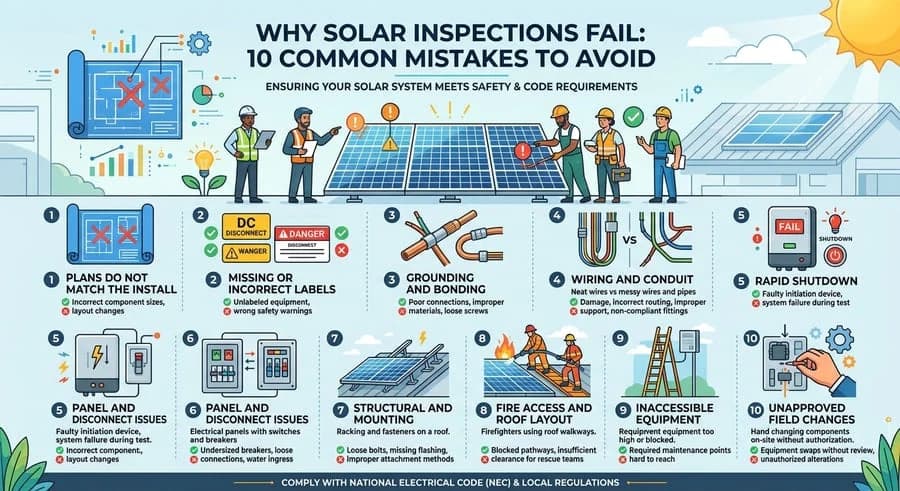
Why Solar Inspections Fail: 10 Common Mistakes to Avoid
Discover the 9 critical reasons solar inspections fail and how to avoid costly m...
Solar Grounding And Bonding: How To Pass Inspection Every Time
Learn how to pass solar grounding and bonding inspections every time. Avoid comm...
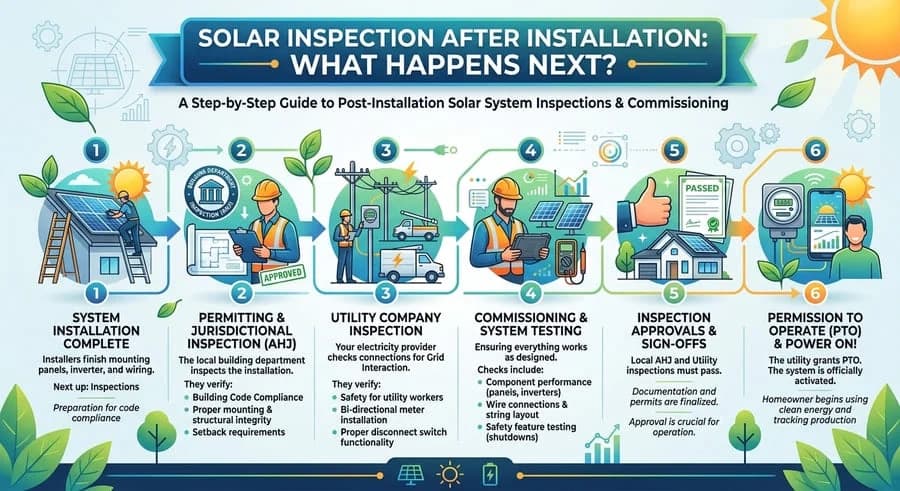
Solar Inspection After Installation: What Happens Next?
Learn how to pass your solar inspection by following essential tips for obtainin...