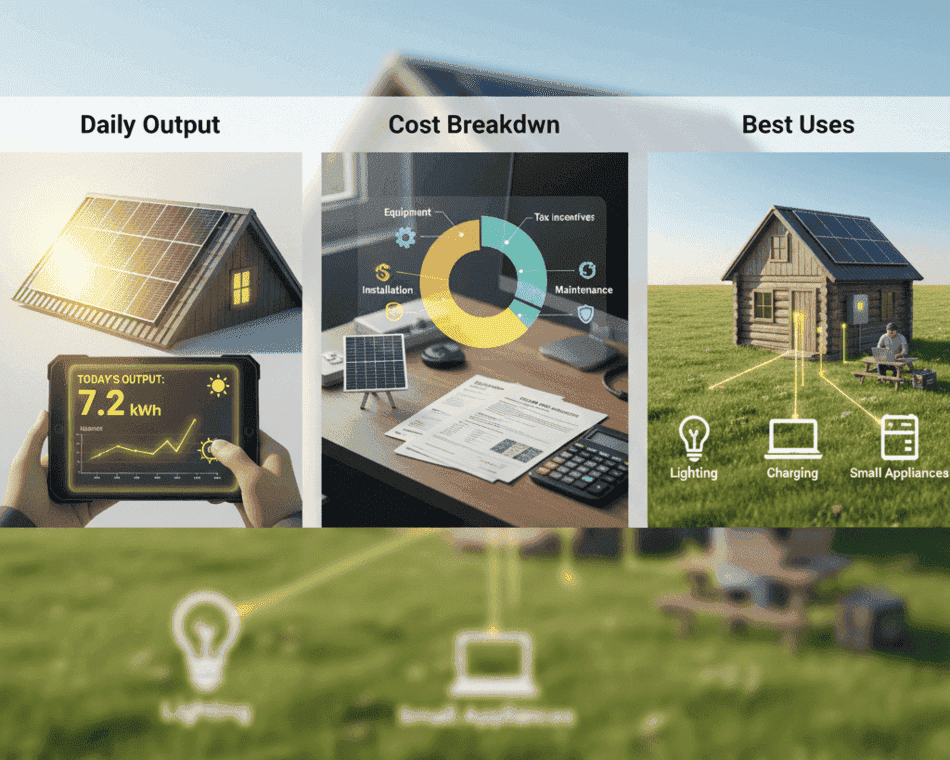
A 1kW solar panel system generates 4 to 5 kWh of electricity daily, costs between $1,800 and $5,800 depending on battery inclusion, and requires 3 to 4 standard 300-watt panels. This entry-level solar setup delivers an 8- to 15-year payback period and powers essential household devices, including LED lighting, laptops, small refrigerators, and phone chargers. With proper maintenance, expect your 1kW system to produce clean energy for 25 to 30 years while reducing monthly utility bills by $15 to $50 depending on local electricity rates.
What You Need to Know About a 1kW Solar System
A 1kW solar system delivers 1,000 watts of power by capturing sunlight through solar panels. When you install this setup, you get four essential components working together:
- Solar panels convert sunlight directly into electrical energy.
- An inverter transforms that electricity into AC power your home appliances can use.
- A charge controller regulates the flow of electricity into your batteries and protects them from damage.
- Batteries hold your generated energy so you can use it after sunset or during outages.
Understanding how these components interact helps you make informed decisions about solar system design and equipment selection. According to NREL solar research, photovoltaic technology continues improving efficiency while costs decrease annually.
How Much Power Does a 1kW Solar System Produce?
Expect your 1kW solar system to generate the following output in most locations:
- Daily production: 4 to 5 kWh
- Monthly production: 120 to 150 kWh
- Annual production: 1,400 to 1,800 kWh
These figures represent averages across the United States. Your actual output depends on geographic location, panel orientation, shading, and weather patterns. The IEA Renewables 2024 report confirms that solar energy remains the fastest-growing renewable source globally, making small residential systems increasingly viable.
How Many Batteries Should You Pair With a 1kW Solar System?
Your 1kW system generates approximately 4 to 5 kWh daily, so you need battery storage capacity that matches this output. Most residential batteries provide around 2 kWh of storage each, meaning you should plan on installing 2 to 3 batteries to cover a full day of energy use. Add extra batteries for backup power during overcast weather or emergencies. Battery systems must comply with NEC arc-fault protection requirements to ensure safe operation.
Solar Permit Solutions
Affordable Solar Permit Plans
Don't let permit costs slow your project. Professional plan sets at competitive prices — all 50 states, fast turnaround.
How Many Solar Panels Do You Need for a 1kW System?
Standard solar panels produce approximately 300 watts each. To reach 1,000 watts of total capacity, install 3 to 4 panels. If you live in a region with limited sunlight, plan for 5 to 6 panels instead. Panel type and efficiency ratings directly impact your system’s performance. The EnergySage marketplace provides comparison tools for evaluating panel efficiency ratings and pricing.
What Appliances Can a 1kW Solar System Power?
A 1kW system handles smaller devices effectively, though you cannot run everything simultaneously. Use this system to power the following:
- LED or CFL lighting throughout your home
- Laptops and desktop computers
- Televisions under 100 watts
- Wi-Fi routers and modems
- Compact refrigerators or mini-fridges
- Phone and device chargers
- Ceiling or standing fans
- Coffee makers or blenders (not simultaneously)
Keep in mind that operating all these appliances at once drains your system’s capacity rapidly. A 1kW system works best when you stagger your usage throughout the day, allowing batteries to recharge between heavy loads. This setup performs best for moderate, everyday electricity needs rather than high-demand applications like air conditioning or electric heating.
What Does a 1kW Solar System Installation Cost?
Your total investment depends on the components you select and local installation rates. Review these estimated costs for U.S. installations:
- Solar panels: $500 to $1,000
- Inverter: $200 to $500
- Charge controller: $100 to $300
- Batteries (optional): $1,000 to $2,000
- Installation labor: $1,000 to $2,000
Budget between $2,800 and $5,800 for a complete 1kW solar system with batteries. Skip the batteries, and your costs drop to $1,800 to $3,000. Working with NABCEP-certified professionals ensures quality installation and code compliance.

1kW Solar System ROI and Payback Period
Calculate your return on investment before committing to a 1kW solar system. A typical 1kW system produces approximately 1,400 to 1,800 kWh annually. Multiply your production by your local electricity rate (average U.S. rate: $0.17 to $0.18 per kWh) for expected annual savings of $238 to $324 per year. A $3,000 system with $280 annual savings breaks even in approximately 10 to 11 years. State and local incentives can reduce that timeline to 8 to 9 years.
Factors That Accelerate Your ROI:
- Higher local electricity rates increase your savings faster.
- State tax credits, SRECs, and local rebates reduce upfront costs significantly. Check the IRS Residential Clean Energy Credit page for current federal incentive details.
- Net metering programs credit you for excess power sent to the grid.
Most 1kW systems pay for themselves within 8 to 15 years. Since solar panels last 25 to 30 years, expect 10 to 20 years of free electricity after reaching your break-even point. States like New York offer 25% state tax credits up to $5,000. Check the Union of Concerned Scientists renewable energy resources for state-specific incentive information.
State-by-State Power Output Variations
Your geographic location directly impacts how much electricity your 1kW solar system generates. Understanding solar permit timeline by state also helps you plan your installation schedule.
Even states with lower sunlight hours benefit from solar. Higher electricity rates in northeastern states often offset reduced production, maintaining competitive payback periods. Review the NC DEQ residential solar tips for state-specific guidance on optimizing your installation.
1kW Portable Solar System: Fixed vs. Mobile Setup Options
A conventional 1kW solar system functions best as a permanent installation. The complete system involves heavy panels, an inverter, a battery bank, and complex wiring, making relocation difficult and impractical. Three to four standard panels weigh 50 to 80 pounds total, and properly connected systems involve conduit, junction boxes, and safety disconnects that require professional disassembly.
For users who prioritize mobility, manufacturers offer portable solar kits, including foldable panel kits that collapse into carrying cases, briefcase-style panels with built-in stands, flexible panels that mount on curved RV or boat surfaces, and all-in-one solar generators combining panels, batteries, and inverters. These portable solutions move easily between locations but typically produce less than 1 kW of output. Combining multiple portable units can approach 1 kW capacity for larger power needs.
Choosing Between Fixed and Portable:
A 1kW mobile setup works well for RV travel, keeping batteries charged during extended trips away from shore power and eliminating generator noise and fuel costs at campsites. Mobile installations still require attention to solar panel safety codes when connecting to shore power or permanent electrical systems. The REN21 Global Status Report shows residential solar adoption accelerating worldwide, making both fixed and portable options increasingly cost-effective.
Is a 1kW Solar System Worth Your Investment?
A 1kW system makes sense when you want to offset a portion of your electricity bill without major investment, have limited roof space or budget constraints, need backup power for essential devices during outages, plan to expand the system gradually over time, or live in a sunny region where small systems produce meaningful output.
Consider a larger system when your monthly electricity consumption exceeds 500 kWh, you want to eliminate your electricity bill entirely, you plan to add electric vehicles or heat pumps in the future, your roof has ample unshaded space for additional panels, or local incentives favor larger installations with better per-watt pricing.
System Expansion Options:
Most 1kW systems expand easily to 2kW or larger. Budget an additional $1,500 to $3,000 for expansion, including extra panels, upgraded inverter capacity if needed, and installation labor. Expanding an existing system typically costs less per watt than building a new larger system from scratch because you can reuse existing infrastructure like mounting hardware, wiring, and inverters (if properly sized initially).
Permit and Installation Requirements
Before installing your 1kW solar system, understand the permit requirements that apply to your location. Review everything you need to know about solar permit services before starting your project.
Do You Need a Permit?
Most municipalities require permits for any grid-tied solar installation, regardless of size. Some areas exempt small systems under specific wattage thresholds (often 1 kW or less). Off-grid systems may face fewer requirements but still need electrical permits in many locations. HOA regulations may impose additional restrictions on panel placement and visibility. Contact your local building department to confirm exact requirements. The SolSmart solar permitting resource provides guidance on streamlined permitting processes across participating jurisdictions.
Typical Permit Process:
- Submit application with system specifications and site plans
- Pay permit fees ranging from $100 to $500
- Schedule inspections at required stages
- Obtain approval and permission to operate from your utility
Understanding the solar permit process in California or Texas solar permit requirements helps if you live in these major solar markets.
NEC Code Compliance Requirements:
Your installation must meet National Electrical Code (NEC) standards, including rapid shutdown requirements for rooftop systems to protect emergency responders. Learn more about 2025 rapid shutdown compliance and review the 2023 NEC changes to rapid shutdown requirements. Additional requirements include proper grounding of all components, correct wire sizing based on amperage and voltage, appropriate overcurrent protection per NEC 690.16 fuse servicing requirements, and clear labeling on all disconnects and electrical boxes.
Grid-tied systems require utility approval before operation. Processing times range from two weeks to several months depending on your utility provider. Learn what happens if you install solar without a permit to understand the risks of noncompliant installations.
Maintenance and Lifespan Deep Dive
Proper maintenance extends your 1kW solar system’s productive life and maximizes energy output over decades of operation.
Component Lifespans:
Solar panels degrade approximately 0.5% per year, meaning they still produce 85% to 90% of their original output after 25 years. Clean panels early morning or evening when cool, using soft water and a soft brush. Avoid pressure washers that can damage panel surfaces. In dusty climates, clean every 2 to 3 months; areas with regular rainfall need cleaning only every 6 months.
Annual System Inspection Checklist:
- Check all electrical connections for corrosion or looseness
- Inspect wiring for damage from weather, pests, or UV exposure
- Verify mounting hardware remains secure and rust-free
- Test system output against expected production levels
- Review inverter error logs for recurring issues
Following solar permitting best practices during installation makes ongoing maintenance easier and ensures your system passes future inspections. Call a professional when output drops significantly below expected levels, inverters display error codes repeatedly, or visible damage appears on equipment.
When your system components reach end of life, proper disposal matters. The EPA solar panel regulations provide guidance on recycling and disposal requirements for photovoltaic equipment.
Conclusion
A 1kW solar system provides an accessible entry point into renewable energy for homeowners with modest electricity needs or limited budgets. This compact setup generates meaningful savings while reducing your carbon footprint and providing backup power capability during grid outages.
Before purchasing, assess your energy consumption patterns, available installation space, local incentives, and long-term goals. Calculate your expected payback period based on local electricity rates and available tax credits or rebates. A 1kW system works best as a supplemental power source or starting point for gradual expansion rather than a whole-home solution.
Work with qualified installers who understand local permit requirements and NEC code compliance. Professional installation protects your investment and ensures your system passes required inspections. Review how to pass your solar inspection to prepare for the final approval process and avoid common mistakes that cause delays.
Whether you choose a fixed rooftop installation, ground-mounted array, or portable camping setup, a 1kW solar system delivers clean, renewable energy that pays for itself over time. With proper maintenance and care, your investment will generate free electricity for 15 to 20 years after reaching the break-even point. Explore more solar installation guides on the Solar Permit Solutions blog.
FAQs
Affordable Solar Permit Plans
Don't let permit costs slow your project. Professional plan sets at competitive prices — all 50 states, fast turnaround.
Frequently Asked Questions
A properly maintained 1kW solar system lasts 25 to 30 years. Solar panels degrade approximately 0.5% per year. Inverters require replacement every 10 to 15 years (string inverters) or 20 to 25 years (microinverters). Batteries need replacement every 3 to 15 years depending on type.
A 1kW system cannot power an entire house but effectively supplements your electricity usage. The average U.S. home consumes 877 kWh monthly, while a 1kW system produces only 120 to 150 kWh per month. Use this system to offset specific loads like lighting and small appliances.
Most jurisdictions require permits for grid-tied solar installations regardless of size. Some areas exempt small off-grid systems. Contact your local building department to confirm requirements before purchasing equipment.
Lithium iron phosphate (LiFePO4) batteries offer the best performance, lasting 10 to 15 years with minimal maintenance. While more expensive upfront than lead-acid alternatives, lithium batteries provide deeper discharge cycles and longer lifespan.
A 1kW system using standard 300-watt panels requires approximately 60 to 80 square feet of unshaded roof space. Higher efficiency panels reduce space requirements. Factor in spacing between panels and setback requirements from roof edges.

SPS Editorial Team
Solar Permit Solutions
Solar Permit Solutions provides professional solar permit design services for residential, commercial, and off-grid installations across all 50 states. Our team ensures permit-ready plan sets delivered fast.
Related Articles
Why Solar Inspections Fail: 10 Common Mistakes to Avoid
Discover the 9 critical reasons solar inspections fail and how to avoid costly m...
Solar Grounding And Bonding: How To Pass Inspection Every Time
Learn how to pass solar grounding and bonding inspections every time. Avoid comm...
Solar Inspection After Installation: What Happens Next?
Learn how to pass your solar inspection by following essential tips for obtainin...