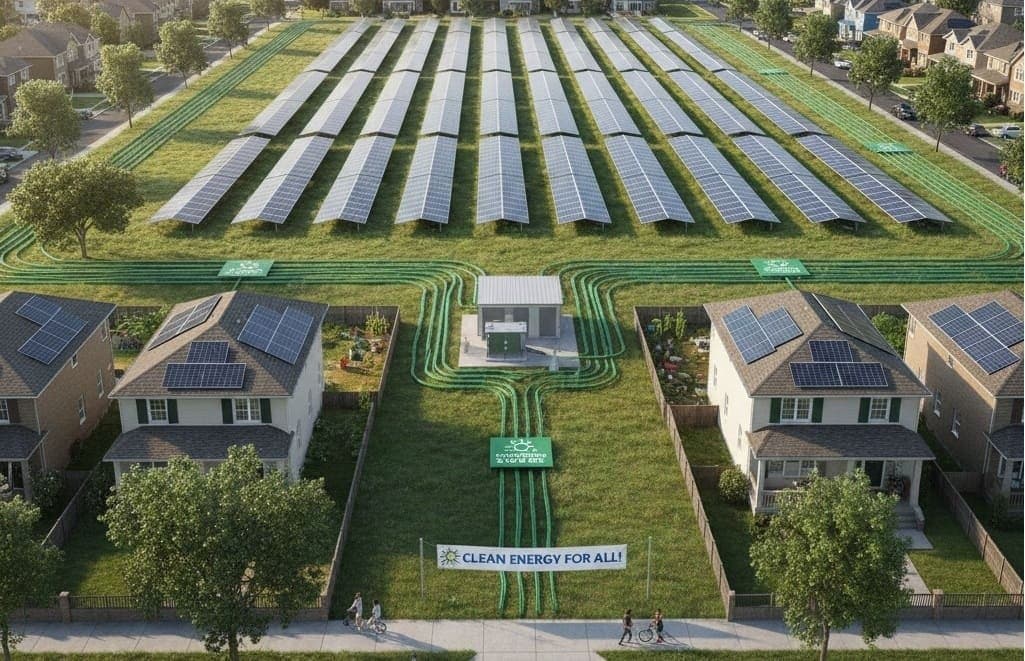
Community solar allows homeowners, renters, and businesses to benefit from solar energy without installing panels on their property. Subscribers receive credits on their electricity bills for their share of energy produced at a local solar farm. Most participants save 5% to 20% on annual electricity costs with no upfront investment or maintenance responsibilities.
Key Takeaways:
• Community solar subscribers typically save 5% to 20% on electricity bills
• No rooftop installation, upfront costs, or maintenance required
• Available in 41 states plus Washington, D.C.
• Subscribers cannot claim federal solar tax credits
• Ideal for renters, condo owners, and properties unsuitable for rooftop solar
What Is Community Solar?
Community solar, also known as shared solar or solar gardens, connects multiple customers to a single off-site solar installation. According to SolSmart permitting resources, these programs allow individuals, businesses, and nonprofits to purchase or subscribe to a portion of the solar array’s energy output without navigating complex local approval processes.
The solar farm generates electricity that feeds into the local utility grid. Subscribers receive bill credits based on their allocated share of the energy produced. This structure makes solar energy accessible to people who cannot install panels on their own property. For those new to solar, our beginner’s guide to solar explains the fundamentals of how solar power works.
Community solar differs from traditional residential solar design because the panels are located at a central facility rather than on individual rooftops. The REN21 Global Status Report confirms that community solar capacity has grown substantially worldwide, with projects now operating across most U.S. states.
How Community Solar Works
Community solar operates through a straightforward process. A developer builds a solar farm, typically on unused agricultural land, brownfields, or other suitable locations. Local utility customers then subscribe to receive a portion of the electricity generated. Understanding grid connection processes help explain how these large-scale projects deliver power to subscribers.
The subscription process involves signing up with a community solar provider and selecting an allocation size based on energy needs. The solar farm produces electricity during daylight hours, and that power flows into the utility grid. Subscribers receive credits on their monthly utility bills reflecting their share of production. The NREL solar research provides extensive data on community solar performance and subscriber outcomes.
Most programs use virtual net metering to calculate bill credits. This billing mechanism allows the solar energy generated at the community solar site to offset electricity consumption at the subscriber’s location. The utility handles the credit calculations and applies them to each monthly statement. Subscribers may wonder about meter changes, though community solar typically requires no equipment modifications at the subscriber’s property.

Benefits of Community Solar
Lower Electricity Costs
The primary benefit of community solar is reduced electricity expenses. Subscribers typically save between 5% and 20% on their annual utility bills. These savings come from purchasing solar energy at rates lower than standard utility prices.
For a household spending $150 monthly on electricity, a 10% savings translates to $180 annually. Over a typical subscription period, these savings accumulate significantly. EnergySage offers comparison tools to help subscribers evaluate community solar options against their current utility rates.
No Installation Required
Community solar eliminates the need for rooftop equipment, structural assessments, and installation crews. Traditional solar installations involve detailed engineering work, inspections, and coordination with local authorities. Many homeowners face permit design mistakes that delay their projects. Community solar subscribers skip this entire process.
Properties with shading issues, older roofs, or unsuitable orientations face significant challenges with rooftop solar. Community solar provides these property owners access to clean energy without the complications of on-site systems. The IEA Renewables 2024 report highlights how community solar expands renewable energy access to previously underserved populations.
Ideal for Renters and Condo Owners
Renters and condo owners typically cannot install solar panels due to property ownership restrictions. Some properties also face HOA regulation challenges that prevent rooftop installations. Community solar programs accept subscribers regardless of property ownership status. The only requirement is having an electricity account with a participating utility.
Many community solar contracts include portability provisions. Subscribers who move within the same utility territory can often transfer their subscription to a new address. Some programs allow subscribers to assign their contract to another customer if they relocate outside the service area.
No Maintenance Responsibilities
The community solar developer handles all equipment maintenance, monitoring, and repairs. Subscribers receive their energy credits without worrying about panel cleaning, inverter replacements, or system troubleshooting. Understanding solar equipment specifications becomes unnecessary for community solar participants.
Rooftop solar owners must budget for ongoing maintenance and potential repairs. They also need to understand electrical fundamentals for their systems. Community solar subscribers avoid these technical considerations entirely.
Flexible Contract Terms
Modern community solar programs offer increasingly flexible subscription options. Many providers have moved away from long-term commitments, now offering month-to-month or annual contracts with minimal cancellation penalties.
This flexibility allows subscribers to test community solar with limited risk. If circumstances change or a better option emerges, exiting the program involves minimal financial impact. The NC DEQ solar tips provide state-specific guidance on evaluating community solar contracts.
Environmental Benefits
Community solar directly supports clean energy generation and reduces reliance on fossil fuels. The Union of Concerned Scientists recognizes community solar as an effective pathway for expanding renewable energy access while reducing greenhouse gas emissions.
Subscribers contribute to their local community’s renewable energy goals without modifying their property. This environmental impact represents a meaningful way to address climate concerns through everyday energy choices.

Solar Permit Solutions
Need Solar Permit Plans?
Professional, permit-ready solar plan sets delivered fast. Residential and commercial projects across all 50 states.
Disadvantages of Community Solar
No Tax Incentives or Rebates
Community solar subscribers using the subscription model cannot claim the federal Investment Tax Credit (ITC) or most state incentives. The IRS clean energy credit currently offers 30% of system costs as a tax credit, but this benefit applies only to system owners.
Some community solar programs offer ownership models where subscribers purchase a share of the solar array. These arrangements may qualify for tax credits, though they require careful evaluation. Property owners should also understand how tax credit denials occur to avoid common mistakes when claiming solar incentives.
Land Use and Environmental Concerns
Large-scale community solar projects require significant land area. Some developments clear previously undeveloped land, potentially affecting local ecosystems and wildlife habitats. Responsible developers address these concerns by selecting previously disturbed sites.
Brownfields, landfills, and existing agricultural land offer suitable locations without additional environmental impact. Many modern projects incorporate agrivoltaics, allowing continued agricultural use beneath and around the solar panels. The EPA solar panel regulations also addresses end-of-life panel management to minimize long-term environmental impact.
Limited Geographic Availability
Community solar programs exist in 41 states and Washington, D.C., but availability varies significantly by location. Some states have robust markets with multiple project options, while others have limited or no community solar infrastructure.
State legislation determines whether utilities must offer virtual net metering and how community solar projects can operate. For states without enabling policies, rooftop installations remain the primary option. Understanding solar permit regulations helps property owners navigate the approval process for on-site systems.
Lower Savings Compared to Rooftop Solar
While community solar provides consistent savings, the percentage reduction typically falls below what rooftop solar owners achieve. Homeowners with owned solar systems eliminate most or all of their electricity costs and may generate surplus energy.
Community solar subscribers continue paying for a portion of their electricity at standard rates. The savings represent a discount rather than elimination of energy costs. Those interested in maximizing savings might explore DIY solar guides for rooftop installation alternatives.
Waitlists and Capacity Limitations
Popular community solar projects often reach subscription capacity quickly. Interested customers may need to join waitlists until new projects come online or existing subscribers cancel their contracts.
Project development timelines extend from initial planning through permitting and construction. Property owners wondering about permit approval timelines should note that community-scale installations face even longer approval processes than residential projects.
Community Solar vs. Rooftop Solar
Choosing between community solar and rooftop installation depends on individual circumstances. Both options reduce electricity costs and support clean energy, but they suit different situations.
Rooftop solar makes sense for property owners with suitable roofs, adequate sun exposure, and the ability to invest in equipment. The upfront cost is higher, but long-term savings exceed community solar, especially when combined with available tax credits. Working with NABCEP certified professionals ensures quality installation and proper system design.
Community solar works better for renters, condo owners, and property owners with roof limitations. The subscription model eliminates upfront costs and installation hassles while still providing meaningful savings and environmental benefits. Those considering rooftop systems should also understand unpermitted installation risks before proceeding.
Factors to Consider
• Property ownership: Renters benefit most from community solar flexibility
• Roof condition: Older roofs or complex designs favor community solar
• Available incentives: Tax credit eligibility shifts the balance toward ownership
• Investment timeline: Rooftop solar requires longer commitment for maximum returns
• Local availability: Some areas lack community solar options entirely
Community Solar Availability by State
Community solar markets vary dramatically across states. Legislative frameworks, utility cooperation, and developer activity determine local availability. For areas like the Pacific Northwest, services such as Spokane permit design help property owners pursue rooftop installations where community solar options remain limited.
Leading Community Solar States
• Florida: Over 2,000 MW of community solar capacity
• New York: Strong legislative support with multiple active programs
• Massachusetts: Early adopter with mature community solar market
• Minnesota: Pioneer in community solar enabling legislation
• Illinois: Growing market with low-income program requirements
How to Choose a Community Solar Program
Selecting the right community solar program requires evaluating several factors. Not all programs offer identical terms, savings rates, or contract flexibility. Those wanting to learn more about solar options can explore essential solar books for comprehensive background knowledge.
Evaluation Criteria
• Guaranteed savings rate: Compare the discount percentage across available programs
• Contract length: Shorter terms provide more flexibility but may offer smaller discounts
• Cancellation terms: Review fees and notice requirements for early termination
• Transferability: Confirm options if relocating within or outside the service area
• Developer reputation: Research the company’s track record and customer reviews
• Project location: Evaluate land use practices and environmental impact
Request detailed contract documents before signing. Reputable providers explain all terms clearly and answer questions about billing, credit calculations, and program duration.
Conclusion
Community solar provides a legitimate path to solar energy benefits for people who cannot or prefer not to install rooftop panels. The savings are real, the environmental impact is meaningful, and the commitment level is manageable.
The program works best for renters, condo owners, and property owners with roof limitations. Property owners with suitable roofs and tax credit eligibility should compare community solar against rooftop installation, as ownership typically delivers greater long-term returns.
For those considering rooftop solar, Solar Permit Solutions provides comprehensive residential solar design services to streamline the installation process across all 50 states.
FAQS
Need Solar Permit Plans?
Professional, permit-ready solar plan sets delivered fast. Residential and commercial projects across all 50 states.
Frequently Asked Questions
Community solar delivers value for subscribers who cannot install rooftop panels. The 5% to 20% savings on electricity bills accumulate over time with no upfront investment. For renters and property owners with unsuitable roofs, community solar offers the only practical path to solar energy benefits.
Savings vary by program, location, and utility rates. Most subscribers save between 5% and 20% on their electricity bills. A household with $1,800 in annual electricity costs could save $90 to $360 per year through community solar subscriptions.
Yes. Community solar programs accept any customer with an electricity account at a participating utility. Property ownership is not required. Renters represent a significant portion of community solar subscribers nationwide.
Moving within the same utility territory typically allows subscription transfer to the new address. Relocating outside the service area may require contract cancellation or assignment to another subscriber. Review specific terms before signing any community solar agreement.
Some programs perform soft credit checks as part of enrollment. Many providers have relaxed these requirements to expand access. Low-income focused programs often have no credit requirements and may offer enhanced savings rates.
Contract terms range from month-to-month arrangements to 20-year commitments. Most current programs offer terms between one and five years with reasonable cancellation provisions. Shorter contracts provide flexibility while longer terms may include better savings rates.

SPS Editorial Team
Solar Permit Solutions
Solar Permit Solutions provides professional solar permit design services for residential, commercial, and off-grid installations across all 50 states. Our team ensures permit-ready plan sets delivered fast.
Related Articles
Why Solar Inspections Fail: 10 Common Mistakes to Avoid
Discover the 9 critical reasons solar inspections fail and how to avoid costly m...
Solar Grounding And Bonding: How To Pass Inspection Every Time
Learn how to pass solar grounding and bonding inspections every time. Avoid comm...
Solar Inspection After Installation: What Happens Next?
Learn how to pass your solar inspection by following essential tips for obtainin...