
Choosing the best community solar program requires comparing three critical factors: guaranteed discount percentages (typically 5% to 20%), contract terms including cancellation fees, and provider reputation verified through customer reviews. Community solar programs vary significantly between states and utilities, with fixed discount models offering more predictable savings than rate-based structures that fluctuate with utility price changes.
Not all community solar projects deliver equal value to subscribers. Programs differ substantially in discount structures, fee schedules, and consumer protections across jurisdictions and providers. Subscribers qualifying for multiple community solar options should evaluate eligibility requirements, compare savings calculations, assess provider reliability, and review contract fine print before enrollment. Thorough comparison ensures selection of programs aligned with consumption patterns, financial goals, and long-term energy strategies.
Key Takeaways
- Community solar projects must operate within your utility service territory and provide sufficient capacity to match annual electricity consumption requirements.
- Most community solar programs offer fixed discounts on bill credits, with the best programs providing the highest guaranteed savings percentages.
- Review all contract terms carefully before enrollment. Some community solar programs include fees for subscription activation, late payment penalties, or early termination charges.

What Is Community Solar?
Community solar provides access to solar energy benefits without rooftop panel installation or upfront capital investment. This model serves renters, condominium owners, and property owners unable to install traditional rooftop solar systems due to structural, financial, or regulatory constraints.
How Community Solar Works:
Large-scale solar arrays, commonly located alongside highways, on closed landfills, or on dedicated solar farm sites, generate substantial quantities of solar electricity. These installations feed generated power directly into local utility grids, reducing carbon footprints and decreasing reliance on fossil fuel generation sources.
Residents and businesses within cooperating utility service territories can subscribe to community solar farms for bill credit allocation. Each subscriber receives a proportional share of the solar farm based on historical electricity consumption patterns. Subscribers pay monthly for their allocated share of generated electricity at rates discounted below standard utility prices, typically averaging 10% below retail rates.
Monthly credits apply toward electric bills equivalent to the energy each community solar share generates, directly reducing amounts owed to utility companies for grid-supplied electricity. Community solar subscribers typically achieve 5% to 20% savings on annual electricity costs while supporting renewable energy deployment according to the National Renewable Energy Laboratory.
First, Ensure The Offer Meets Basic Requirements
Community solar projects must align with electricity consumption needs, physical location restrictions, and project timeline expectations before subscription consideration.
Location: Community Solar Farm Must Operate Within Utility Territory
Community solar participation requires projects connected to the subscriber’s utility provider. This geographic restriction significantly narrows available options for most consumers. When multiple solar farms operate within a utility’s service area, subscribers can select projects based on proximity preferences and local impact considerations.
Community solar farms located near subscriber properties provide clean energy to specific grid sections and create local employment opportunities. Many subscribers prefer supporting projects in their immediate neighborhoods rather than farms located in distant service territories. This preference reflects community solar’s direct regional economic and environmental benefits as outlined in residential and community solar guidelines.
Share Size: Matching Solar Energy Production To Consumption
Optimal community solar subscriptions closely match actual electricity consumption patterns. Projects must maintain sufficient available capacity to properly size individual subscriber shares. Several factors influence appropriate share sizing decisions.
Current Annual Electricity Demand
Historical electricity usage data, accessible through utility account portals, establishes baseline consumption for share sizing calculations. Community solar companies typically rely on 12 months of consumption history to determine appropriate share allocations.
Future Annual Electricity Demand
Anticipated changes in electricity consumption require consideration during share sizing. Subscribers planning major electrification projects, such as heat pump installations or electric vehicle purchases, should request larger share allocations to accommodate increased future demand.
Share Capacity Versus Output
Share capacity represents the allocated system size, while output reflects actual electricity generation. Solar panel production varies seasonally, generating higher output during summer months and reduced generation during winter. Monthly variations balance annually, maintaining projected savings of 5% to 20% on total electricity costs.
Project Timeline: Solar Farm Activation Schedule
Community solar companies frequently enroll subscribers before solar farm construction completion. Projects in development stages require extended timelines before generating electricity and providing bill credits. Project activation dates provide estimates for when subscribers begin receiving community solar savings and bill credit applications.
Subscribers joining projects still under construction should anticipate waiting periods before receiving community solar credits. Timeline transparency during enrollment helps subscribers set appropriate expectations for savings realization and credit application schedules, similar to traditional solar permitting processes.

Compare Discount Models And Provider Reputation
After eliminating community solar programs that fail to meet basic eligibility requirements, subscribers should evaluate projected savings structures and provider reputations among remaining options.
Savings Timeline And Discount Structure
Community solar savings timing depends directly on program structure and discount model implementation. Programs utilize two primary approaches to subscriber discounts and rate calculations.
Some programs base discounts on current utility electricity rates with built-in escalators for gradual rate increases. These programs promise eventual savings as inflation drives utility rates higher over time. Other programs offer fixed percentage discounts on all solar energy purchases, typically 10% below utility rates. Fixed discount models provide greater certainty and predictability throughout subscription periods.
Community Solar Company Reputation Assessment
Reliable community solar companies maintain responsive customer service channels and consistent communication standards. Subscribers require assurance that providers will address service issues and billing questions with the same responsiveness demonstrated during initial enrollment periods.
Customer service quality assessment during signup processes presents challenges, but most community solar companies maintain online review platforms featuring feedback from past and current subscribers. These reviews provide valuable insights into provider reputation, billing accuracy, credit application consistency, and problem resolution effectiveness. Platforms like EnergySage offer comprehensive provider comparisons and verified customer reviews.
Solar Permit Solutions
Affordable Solar Permit Plans
Don't let permit costs slow your project. Professional plan sets at competitive prices — all 50 states, fast turnaround.
Understanding Community Solar Discount Models
Community solar programs deliver value primarily through electric bill savings, but discount structures vary significantly between providers. Two main discount models dominate the market, each offering distinct advantages and predictability levels.
Fixed Discount On Bill Credits
This model provides subscribers with set percentage discounts on electricity bills, typically ranging from 5% to 20%. Calculation remains straightforward: if a subscriber receives a fixed 10% discount and their community solar share produces $100 worth of electricity, the subscriber pays $90 for those credits. This model offers maximum predictability for long-term savings calculations.
Discount On Electricity Rates
Rate-based discount models lock subscribers into set prices per kilowatt-hour (kWh) with the community solar company. Community solar rates generally remain below utility retail rates, creating savings opportunities. Actual savings depend on utility rate fluctuations relative to the fixed community solar price per kWh. This model provides less predictability than fixed discount on bill credits programs due to variable utility rate changes.
Review Contract Fine Print For Hidden Costs
Subscribers with multiple qualifying community solar offers should examine contract details for provisions that reduce program benefits, including late payment penalties and cancellation fees, much like reviewing solar equipment specifications for traditional installations.
Additional Fee Assessment
Most community solar subscriptions exclude upfront enrollment fees, but contract verification remains important. Some programs include administrative fees, connection charges, or other costs that reduce net savings.
Late Payment Penalties
State-level consumer protections typically cover late utility bill payments, but these protections may not extend to community solar subscriptions. Contract terms should clearly specify late payment consequences, penalty fees, and grace period provisions in compliance with local solar regulations.
Subscription Cancellation Terms
Many community solar providers permit subscription termination at any time but may require minimum advance notice periods or assess cancellation fees. Early exit penalties vary significantly between providers, ranging from no fees to substantial charges based on remaining contract length.
Subscription Portability Options
Most community solar programs allow subscription transfers at no additional cost when subscribers relocate within the same utility service territory. Programs may restrict or prohibit transfers for moves outside the utility service area. Subscribers anticipating potential relocation should verify portability terms before enrollment.
Conclusion
Choosing the optimal community solar program demands careful assessment of eligibility requirements, discount structures, provider reputation, and contract terms. Subscribers who invest time comparing available options position themselves to maximize annual electricity savings while supporting global renewable energy growth.
Successful community solar participation begins with verifying basic eligibility criteria, including utility territory alignment, appropriate share sizing, and acceptable project timelines. Subscribers should then evaluate discount models, prioritizing fixed percentage discounts for predictable long-term savings over rate-based structures with variable outcomes.
Provider reputation assessment through online reviews and customer service responsiveness indicators helps identify reliable companies committed to transparent billing and responsive problem resolution. Contract fine print review remains essential for uncovering hidden fees, late payment penalties, cancellation charges, and subscription portability restrictions that impact overall program value.
Community solar programs offering guaranteed savings percentages, minimal fees, flexible cancellation terms, and subscription portability within utility territories deliver the best subscriber value. Thorough evaluation and comparison of all available options ensures subscribers select programs aligned with consumption patterns, financial goals, and long-term energy strategies as detailed in the Global Status Report on renewable energy adoption.
FAQs
Community solar serves renters, condominium owners, and homeowners with unsuitable roofs due to shading, structural limitations, or unfavorable orientation. Subscriptions require no upfront costs, no property modifications, and no maintenance responsibilities while delivering 5% to 20% annual savings. Homeowners with excellent roof conditions and sufficient capital for system purchases should prioritize rooftop installations for maximum savings. Those interested in DIY solar installation can explore self-installation options with guidance from essential solar energy books. Renters and property owners facing installation barriers benefit most from community solar subscriptions.
State-specific regulations often establish capacity limits for community solar projects. Some states cap individual projects at two megawatts, while others permit installations up to 20 megawatts for utility-scale community solar programs. Project size directly impacts subscriber availability, with larger farms accommodating more participants and offering greater flexibility for share sizing adjustments. Understanding electrical fundamentals helps subscribers better comprehend system capacity and output calculations.
Share reduction requests receive similar consideration when subscribers reduce consumption through energy efficiency improvements or household size decreases. Providers generally process adjustment requests within 30 to 60 days, with changes reflected in subsequent billing cycles. Some programs limit adjustment frequency to once or twice annually, while others permit quarterly modifications. Subscribers should review share adjustment policies during enrollment and maintain communication with providers when consumption patterns change significantly.
State regulations often establish maximum subscription limits for commercial participants, commonly capping individual business shares at 40% of total project capacity to maintain diverse subscriber bases. Businesses with demand charges on utility bills should verify that community solar credits apply to both energy charges and demand charges before enrollment. Some programs restrict credit application to energy consumption only, limiting savings potential for large commercial consumers. Commercial entities should work with NABCEP-certified professionals to compare multiple community solar offers and identify programs with favorable commercial terms, appropriate capacity availability, and compatible billing structures.
Subscribers receive two separate bills: one from the utility company for grid electricity consumption and another from the community solar provider for their share of solar production. The utility bill includes credits for community solar generation, reducing the total amount owed for that billing period. Understanding metering requirements helps clarify how these credits appear on utility statements. Subscribers then pay the community solar company for their share at the discounted rate, typically 10% below utility rates for fixed discount programs.
Net savings appear as the difference between utility bill credits and community solar subscription costs. For example, if a subscriber’s share generates $100 in utility bill credits and the community solar company charges $90 for that same production under a 10% discount structure, the subscriber realizes $10 in net monthly savings. Credits exceeding monthly electricity consumption typically roll over to subsequent billing periods, though rollover policies vary by utility and state regulation. Subscribers should understand these billing mechanics before enrollment, particularly if they previously experienced issues with solar tax credit claims or other federal solar incentives. Solar Permit Solutions offers professional permit design services for those transitioning from community solar to residential installations, and helps property owners avoid common permit denial mistakes while understanding permit requirements. Additionally, HOA regulations and end-of-life solar panel management considerations may influence long-term solar decisions.
Affordable Solar Permit Plans
Don't let permit costs slow your project. Professional plan sets at competitive prices — all 50 states, fast turnaround.
Frequently Asked Questions
The decision between community solar subscriptions and rooftop solar installations depends on property ownership status, roof suitability, financial capacity, and long-term savings goals. Rooftop solar typically generates greater lifetime savings, often reducing electricity costs by 70% to 100% over 25-year system lifespans. However, rooftop installations require substantial upfront investments ranging from $15,000 to $30,000 before incentives, suitable roof conditions, and property ownership. Community solar serves renters, condominium owners, and homeowners with unsuitable roofs due to shading, structural limitations, or unfavorable orientation. Subscriptions require no upfront costs, no property modifications, and no maintenance responsibilities while delivering 5% to 20% annual savings.
Community solar farms typically range from one to five megawatts (MW) in capacity, though project sizes vary based on state regulations, utility requirements, and available land. A one-megawatt solar farm occupies approximately four to five acres and serves 150 to 200 residential subscribers. Larger projects reaching five megawatts can serve 750 to 1,000 residential customers or smaller numbers of commercial subscribers with higher consumption. State-specific regulations often establish capacity limits for community solar projects. Some states cap individual projects at two megawatts, while others permit installations up to 20 megawatts for utility-scale community solar programs.
Most community solar programs allow share size adjustments to accommodate changing electricity consumption patterns, though policies vary significantly between providers. Subscribers experiencing consumption increases due to home additions, electric vehicle purchases, or heating system electrification can typically request larger share allocations subject to project capacity availability. Share reduction requests receive similar consideration when subscribers reduce consumption through energy efficiency improvements or household size decreases. Providers generally process adjustment requests within 30 to 60 days, with changes reflected in subsequent billing cycles.
Commercial businesses, nonprofits, municipalities, and other organizations qualify for community solar subscriptions in most state programs. Business subscriptions follow similar structures to residential programs but accommodate higher consumption volumes through larger share allocations. Commercial subscribers typically receive the same discount percentages as residential participants, generating substantial savings on higher electricity bills. State regulations often establish maximum subscription limits for commercial participants, commonly capping individual business shares at 40% of total project capacity to maintain diverse subscriber bases.
Community solar billing operates through a dual-credit system involving both the community solar provider and the electric utility. Each month, the community solar farm generates electricity based on weather conditions and system performance. The utility company measures total production and calculates credits for each subscriber based on their share percentage. Subscribers receive two separate bills: one from the utility company for grid electricity consumption and another from the community solar provider for their share of solar production. The utility bill includes credits for community solar generation, reducing the total amount owed for that billing period. Net savings appear as the difference between utility bill credits and community solar subscription costs.

SPS Editorial Team
Solar Permit Solutions
Solar Permit Solutions provides professional solar permit design services for residential, commercial, and off-grid installations across all 50 states. Our team ensures permit-ready plan sets delivered fast.
Related Articles
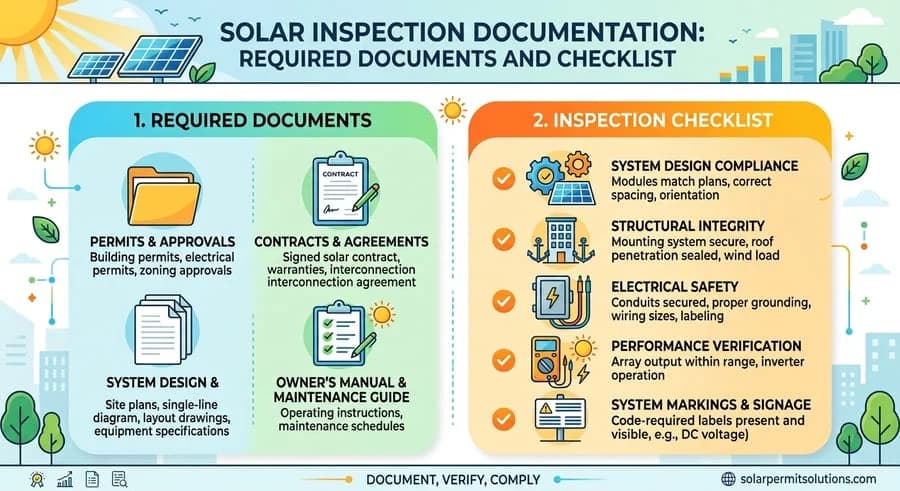
Solar Inspection Documentation: Required Documents and Checklist
Learn about solar inspection documentation, including permit requirements, NEC c...
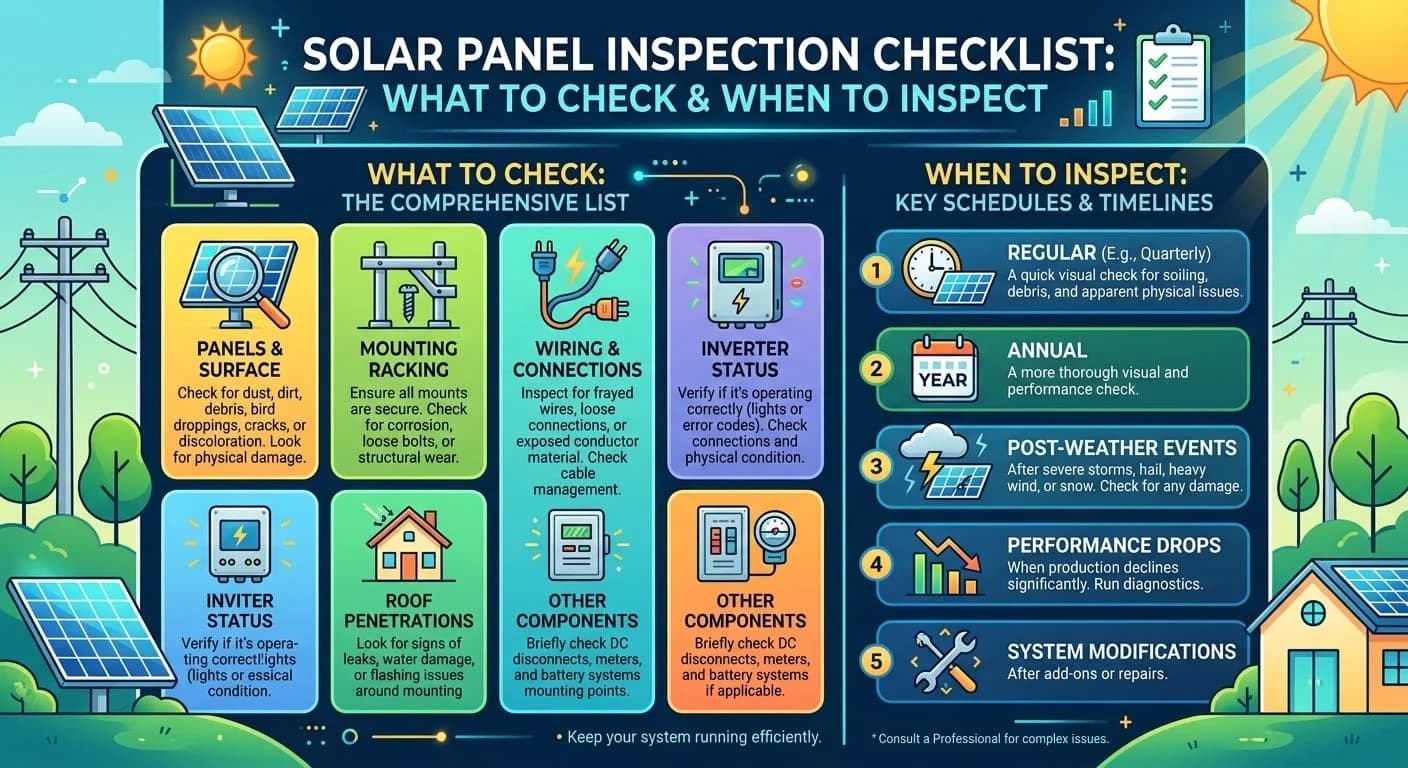
Solar Panel Inspection Checklist: What To Check & When To Inspect
Solar panel inspection guide: Learn what to check, when to inspect (annually + e...
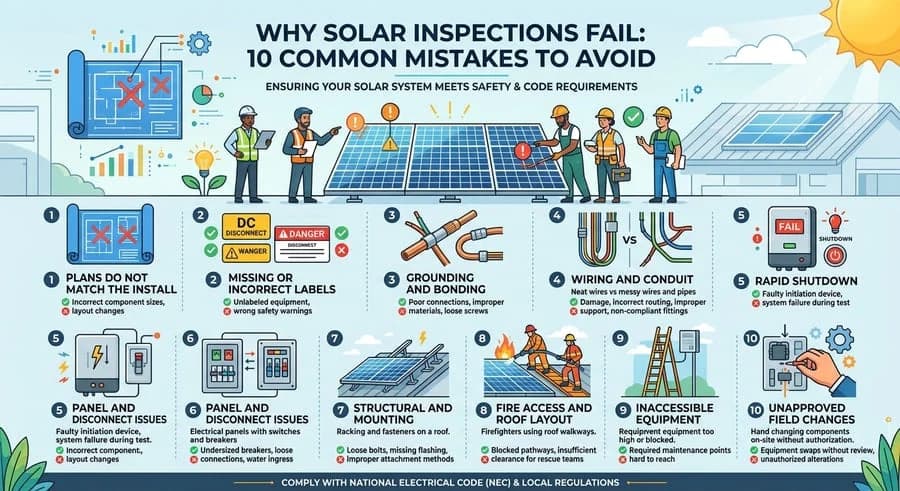
Why Solar Inspections Fail: 10 Common Mistakes to Avoid
Discover the 9 critical reasons solar inspections fail and how to avoid costly m...