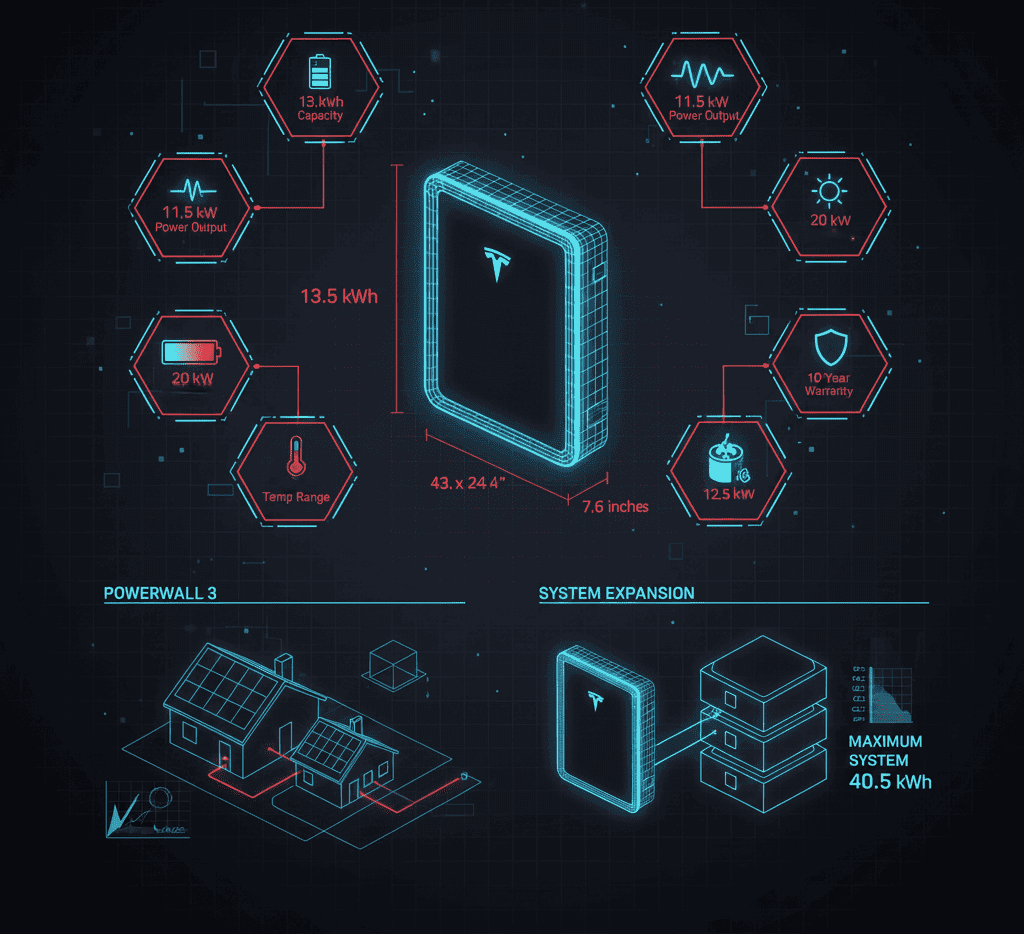
The Tesla Powerwall 3 is a 13.5 kWh lithium iron phosphate (LFP) home battery system with 11.5 kW continuous power output, priced at $13,500 to $16,800 installed (approximately $9,500 to $11,800 after the 30% federal tax credit). Released in September 2023, it delivers 130% more power than the Powerwall 2 and includes an integrated solar inverter with 6 MPPTs supporting up to 20 kW of solar input.
A single Powerwall 3 can power essential home appliances for 12 to 24 hours during an outage or indefinitely when paired with solar panels. The system features 185 LRA load start capability (enough to start most AC units), 97.5% solar-to-grid efficiency, and seamless backup transition in a fraction of a second. Tesla backs the Powerwall 3 with a 10-year warranty guaranteeing 70% capacity retention.
Installation requires Gateway 3, Backup Switch, or Backup Gateway 2 for grid integration, with systems limited to 200A service and 120/240V split-phase electrical configurations. The Powerwall 3 holds UL 9540 and UL 9540A certifications, UL 1741, and IEEE 1547 certifications, meeting all NEC code requirements for residential energy storage systems.

A Brief History of the Tesla Powerwall Series
Tesla’s journey into home energy storage began in 2012 when the company started experimenting with battery packs at select industrial customer locations. In November 2013, Tesla announced plans to build Giga Nevada, a massive lithium-ion battery factory. On April 30, 2015, the company officially unveiled the Powerwall on Tesla’s official website, applying its electric vehicle battery expertise to residential energy storage.
Powerwall 1 (2015)
The original Powerwall launched with a 6.4 kWh capacity and 3.3 kW power output. It utilized nickel-manganese-cobalt (NMC) battery chemistry with liquid cooling technology. Priced at $3,000 at launch, the system required a DC-to-DC converter and worked with existing solar inverters. Production was limited, but it established Tesla as a serious player in home energy storage.
Powerwall 2 (2017)
Mass production began at Giga Nevada in early 2017, introducing a significant upgrade. The Powerwall 2 doubled storage capacity to 13.5 kWh while incorporating Tesla’s own DC-to-AC inverter design. This AC-coupled approach allowed homeowners with existing solar systems to add storage without replacing their inverters. The 2170 cell format and improved thermal management made it suitable for both indoor and outdoor installation.
Powerwall+ (2021)
Announced in May 2021 (US only), the Powerwall+ combined the Powerwall 2 battery, Tesla Backup Gateway, and Tesla Solar Inverter into a streamlined package. This integration simplified installation and increased on-grid power output from 5 kW to 5.8 kW (7.6 kW peak). By May 2021, Tesla had installed 200,000 Powerwalls globally, selling 100,000 units in a single year. Learn more about everything you need to know about solar permit services for battery storage installations.
Powerwall 3 (2023-2024)
Released in September 2023 with widespread availability in early 2024, the Powerwall 3 represents Tesla’s most significant advancement. It integrates solar and battery into a single device with 11.5 kW continuous power output (a 130% increase over Powerwall 2), 6 MPPTs supporting up to 20 kW of solar input, and a streamlined design for faster installation. In 2025, Tesla built and installed its one-millionth Powerwall unit.
Powerwall 3 System Overview
Detailed Technical Specifications
Solar Input Specifications
Physical Specifications
Scalability & Expansion
The Powerwall 3 system supports up to 4 Powerwall 3 units and up to 3 Expansion units per Powerwall 3 (maximum 7 total units). Each expansion unit adds 13.5 kWh of storage capacity at $5,900 each, without a separate inverter. Expansion units are slimmer (168 mm depth vs 193 mm) and can be stacked behind a Powerwall 3 for floor-mounted configurations. The expansion harness installation takes approximately 22 minutes.

Solar Permit Solutions
Affordable Solar Permit Plans
Don't let permit costs slow your project. Professional plan sets at competitive prices — all 50 states, fast turnaround.
Site Requirements and Pre-Installation Guidance
Electrical System Requirements
Powerwall 3 must be installed with Gateway 3, Backup Gateway 2, or Backup Switch to enable grid integration. All installations must comply with NEC Article 706 for energy storage systems (ANSI/NFPA 70) or the Canadian Electrical Code CSA C22.1. Understanding solar engineering requirements for permits is essential for proper system design. Key electrical requirements include 120/240V single/split-phase service only, a maximum 200A service rating with a Form 2S meter socket (when using Backup Switch), and a 60A overcurrent protection device (default) for each Powerwall 3 unit. The system is rated for 10 kA fault current (22 kA with a J-class fuse upstream, 25 kA with Gateway 3 and an Eaton CSR/BWH main breaker).
Physical Location Requirements
Powerwall 3 requires specific clearances for installation, cabling, and airflow. Minimum clearances include 36 inches in front (per NEC 110.26 working space requirements), 1 inch minimum above for exhaust venting, and 6 inches between side-by-side units. When installed indoors, the unit must be in a space with an ambient temperature between -20°C and 50°C with adequate ventilation. Outdoor installations benefit from IP67 weather resistance but should avoid direct sunlight exposure when possible to optimize battery longevity. The solar permit timeline varies by state, so homeowners should plan accordingly.
Gateway Options Comparison
Certifications and Compliance
Proper certification documentation is critical for permit approval. Before beginning your project, review solar permitting requirements in California or your state’s specific guidelines. Homeowners in the Lone Star State should consult the Texas solar permit guide for local AHJ requirements.
Powerwall 3 Certifications
These certifications ensure compliance with NEC requirements for energy storage systems and PV Rapid Shutdown using Tesla Mid-Circuit Interrupters.
Perfect Pairing with Solar Systems
DC-Coupled Integration
Powerwall 3’s integrated solar inverter accepts direct DC input from solar panels through 6 independent MPPTs, eliminating the need for a separate string inverter. This DC-coupled configuration achieves 97.5% solar-to-grid efficiency and simplifies installation by reducing component count. The system supports up to 20 kW of solar input with voltage range of 60-550V DC. String sizing must comply with NEC requirements, and Mid-Circuit Interrupters (MCIs) are mandatory for all PV connections to meet rapid shutdown requirements per NEC Article 690. For homeowners pursuing off-grid solar system design, the Powerwall 3 offers exceptional flexibility.
AC-Coupled Configuration
Powerwall 3 can also operate in AC-coupled mode with existing Tesla Solar Inverters or third-party inverters for homeowners who already have solar installations. In this configuration, the Powerwall 3 charges from AC power (solar or grid) and provides backup power independently. Note that third-party MLPE solutions (such as optimizers) are not compatible with Powerwall 3’s DC inputs. The system achieves 89% round-trip efficiency when cycling through the battery.
Intelligent Energy Management
The Tesla app provides comprehensive control over energy flow, including Self-Powered mode (maximize solar self-consumption), Time-Based Control (optimize for TOU rates), Backup-only mode, and Storm Watch (automatic charging before severe weather). The app displays real-time energy flow, historical data, and estimated savings. Virtual Power Plant (VPP) programs allow Powerwall owners to earn income by supporting grid stability during peak demand events. In 2024, Tesla paid out $9.9 million to VPP participants. To maximize savings, check the DSIRE database for state-specific battery incentive programs.
Cost and Return on Investment
2025 Pricing Overview
Note: Prices vary by region, with coastal markets (California, New York) typically running $1,000-$1,500 higher than markets in Texas or Arizona. The per-kWh cost of approximately $1,140 makes Powerwall 3 one of the most affordable home battery solutions available. Understanding how long solar permits take can help you plan your installation timeline effectively.
Available Incentives
The 30% Federal Investment Tax Credit (ITC) applies to homeowner-owned battery storage systems installed by December 31, 2025. For systems installed through leases or power purchase agreements (PPAs), the credit remains available through 2032. The DOE solar tax credit resources provide detailed guidance on eligibility. According to ENERGY STAR’s federal tax credit guide, battery storage technology must have a capacity of at least 3 kWh to qualify. State incentives vary significantly: California offers multiple programs, including SGIP, while states like Kentucky have no additional incentives. Many utilities offer rebates or special time-of-use rates that improve battery economics. Sales tax exemptions for solar batteries may apply when purchased through local installers in certain states.
Payback Period Analysis
Payback periods typically range from 5 to 12 years depending on electricity rates, TOU spread, and usage patterns. Key factors affecting ROI include high peak-to-off-peak rate differentials (areas with a $0.30+/kWh spread see faster payback), net metering policies in your utility territory, frequency of power outages (backup value), and participation in Virtual Power Plant programs. At the national average rate of $0.14/kWh and 10 kWh daily usage, annual savings approximate $511, yielding an 11-12 year payback after tax credits. High-rate areas like California (PG&E peak rates of $0.52+/kWh) can achieve 4-6 year payback. The NREL energy storage research provides additional data on battery economics and performance projections.
Conclusion
The Tesla Powerwall 3 represents the most significant evolution in Tesla’s home energy storage lineup, offering 130% more power output than its predecessor while maintaining the same 13.5 kWh capacity. Its integrated solar inverter with 6 MPPTs, 185 LRA load start capability, and comprehensive certifications make it suitable for whole-home backup in most residential applications. With Tesla reaching 1 million Powerwall installations in 2025 and the federal tax credit reducing costs by 30%, homeowners have never had a better opportunity to achieve energy independence while supporting grid stability through Virtual Power Plant participation.
For homeowners navigating the permitting process, understanding solar permitting best practices can significantly reduce approval timelines. Whether you need help with residential solar permit design or commercial solar design services, professional assistance ensures compliance with all AHJ requirements.
Before scheduling your installation, review tips on how to pass your solar inspection to avoid common mistakes. If you’re unsure whether permits are required in your area, our guide on solar permit requirements in the US provides a comprehensive overview. Modern solar permit design tools can also streamline the documentation process.
For professional permitting assistance and design support, contact Solar Permit Solutions.
FAQs
Affordable Solar Permit Plans
Don't let permit costs slow your project. Professional plan sets at competitive prices — all 50 states, fast turnaround.
Frequently Asked Questions
A single Tesla Powerwall 3 with its 13.5 kWh capacity can power essential home appliances for 12 to 24 hours during a power outage, depending on energy consumption. Running only critical loads like a refrigerator (200W), lights (100W), and WiFi router (10W) can extend backup to over 40 hours. When paired with solar panels, the Powerwall 3 can provide indefinite backup power by recharging during daylight hours. For whole-home backup including air conditioning, most homeowners need 2 to 3 Powerwall units. The system's 11.5 kW continuous output and 185 LRA motor start capability allow it to run high-demand appliances that previous Powerwall models could not support.
A Tesla Powerwall 3 costs $13,500 to $16,800 fully installed before incentives, with equipment pricing around $9,250 to $11,900 and installation labor ranging from $3,000 to $8,000. After applying the 30% federal Investment Tax Credit (ITC), the net cost drops to approximately $9,450 to $11,760. Expansion units cost $5,900 each and add 13.5 kWh of storage capacity without requiring a separate inverter. Prices vary by region, with coastal markets like California and New York typically running $1,000 to $1,500 higher than Texas or Arizona. At roughly $1,140 per kWh of storage, the Powerwall 3 ranks among the most affordable home battery solutions available.
Most homeowners need 1 to 2 Tesla Powerwall 3 units for essential backup power, while whole-home backup typically requires 2 to 3 units depending on energy consumption and home size. A single Powerwall 3 (13.5 kWh) can back up basic loads like refrigerators, lights, WiFi, and phone charging for 12 to 24 hours. Adding a second unit enables backup for air conditioning and 240V appliances. For homes over 2,500 square feet with above-average consumption, consider 3 Powerwall units for comprehensive whole-home backup. The rule of thumb is one Powerwall for every 7 kW of solar panel capacity if maximizing self-consumption. You can install up to 4 Powerwall 3 units with up to 3 expansion packs each, providing a maximum of 54 kWh storage capacity per system.
The Tesla Powerwall 3 delivers 11.5 kW continuous power output compared to just 5 kW for Powerwall 2, representing a 130% increase that enables whole-home backup from a single unit. Both models store 13.5 kWh of energy, but Powerwall 3 integrates a solar inverter with 6 MPPTs (supporting 20 kW solar input), eliminating the need for a separate string inverter. Powerwall 3 uses safer lithium iron phosphate (LFP) battery chemistry versus Powerwall 2's nickel manganese cobalt (NMC) cells. The newer model features 185 LRA load start capability (vs. limited surge capacity in Powerwall 2), enabling startup of large AC units and well pumps. Powerwall 3 also introduced expansion units ($5,900 each) for more affordable capacity scaling, while Powerwall 2 required purchasing full additional units.
The Tesla Powerwall 3 is worth it for homeowners seeking reliable backup power, energy bill savings through time-of-use rate arbitrage, or increased solar self-consumption. With the 30% federal tax credit reducing costs to approximately $10,000, payback periods range from 5 to 12 years depending on local electricity rates and usage patterns. Homeowners in high-rate areas like California (where peak rates exceed $0.50/kWh) can achieve 4 to 6 year payback. Beyond financial returns, the Powerwall 3 provides insurance value against power outages, protects against rising utility rates, and can generate passive income through Virtual Power Plant (VPP) programs. Tesla paid out $9.9 million to VPP participants in 2024. The integrated solar inverter saves $2,000 to $3,000 in additional equipment costs compared to AC-coupled battery systems.

SPS Editorial Team
Solar Permit Solutions
Solar Permit Solutions provides professional solar permit design services for residential, commercial, and off-grid installations across all 50 states. Our team ensures permit-ready plan sets delivered fast.
Related Articles
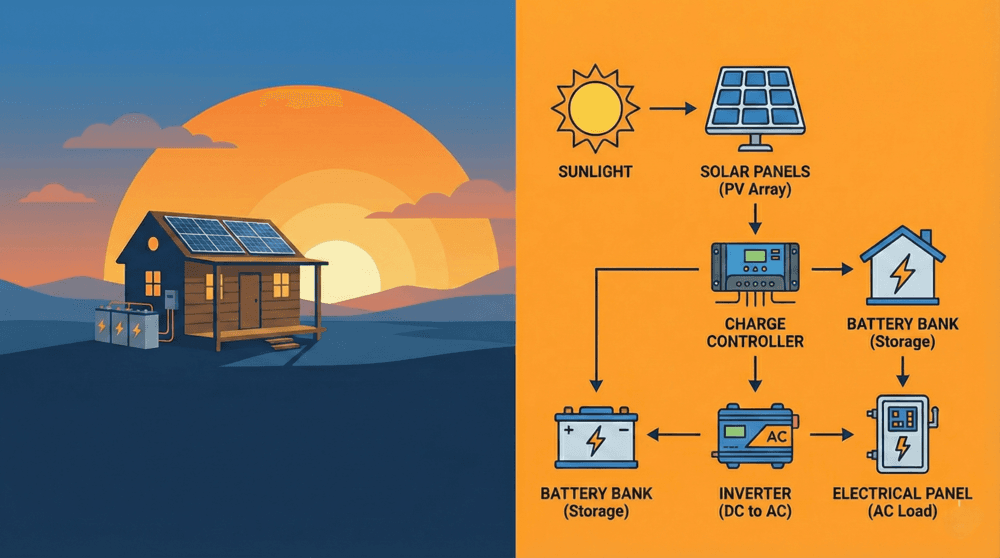
Off-Grid Solar System Requirements: Sizing, Permits & NEC Code Guide
Off-grid solar permit requirements by state: building codes, NEC compliance, bat...
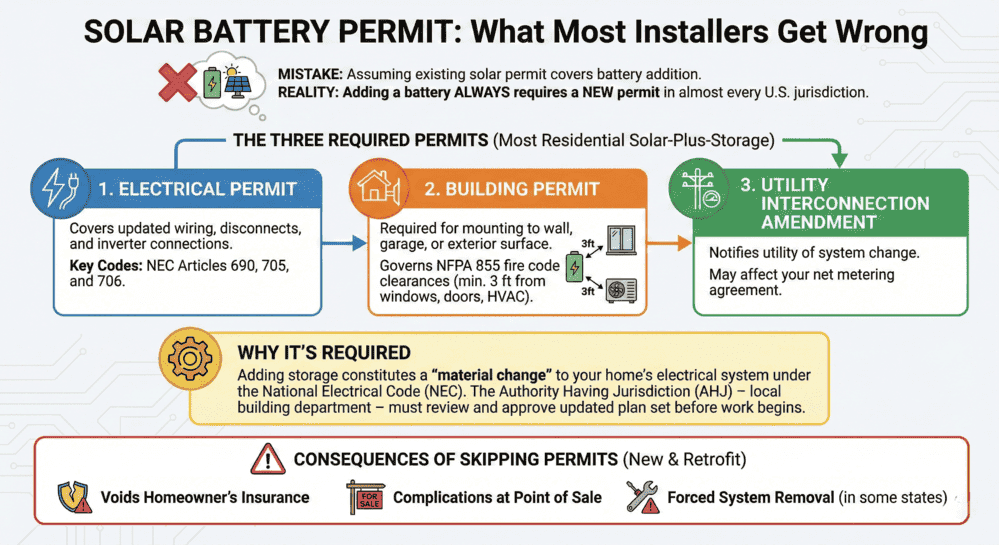
Solar Battery Permit: What Most Installers Get Wrong
Quick Answer: Adding battery storage to a solar system almost always requires ne...
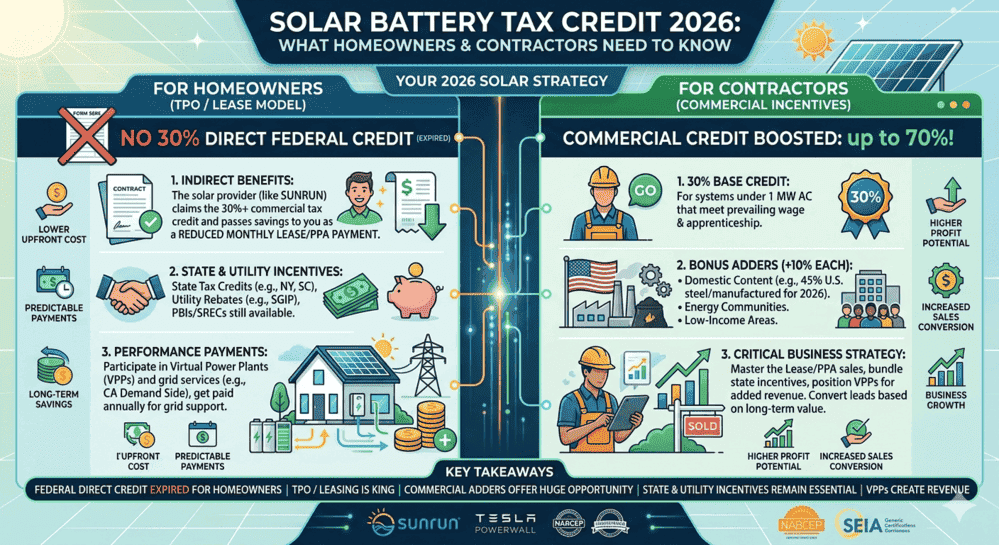
Solar Battery Tax Credit 2026: What Homeowners and Contractors Need to Know
There is no federal solar battery tax credit available to homeowners in 2026. Th...