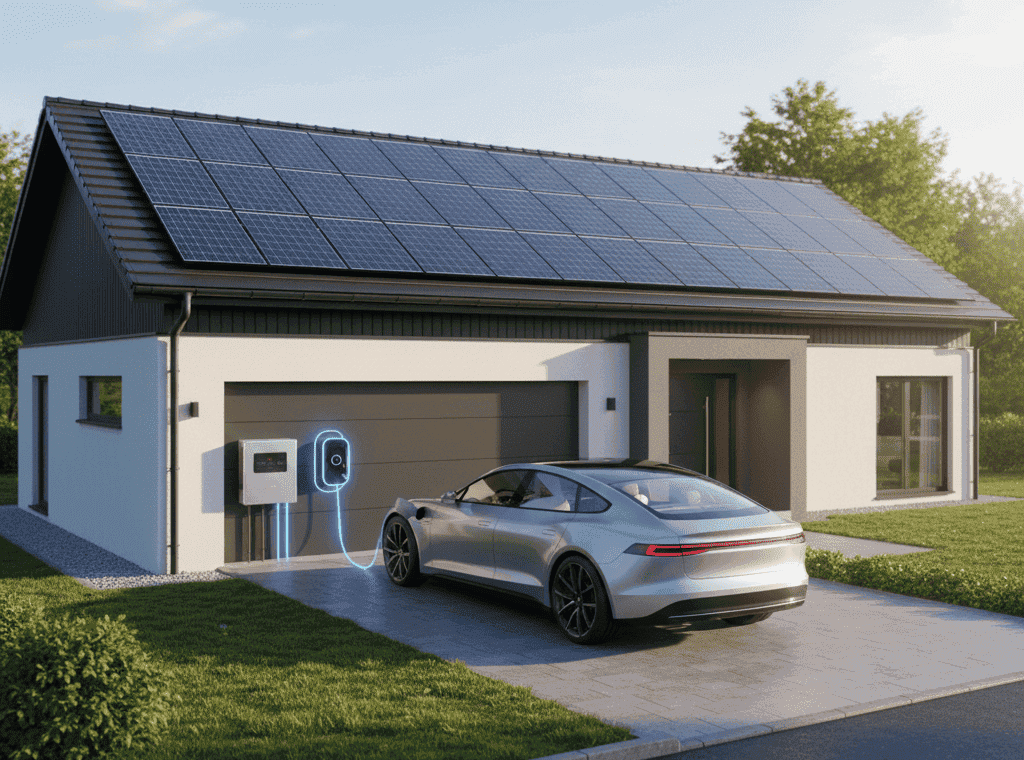
Solar EV charging allows homeowners to power their electric vehicles using electricity generated by rooftop solar panels, effectively eliminating fuel costs. A typical household needs 10 to 12 kW of solar capacity (24 to 28 panels) to charge an EV regularly, approximately 50% more than a standard home solar installation. With smart EV chargers, you can charge your vehicle using only excess solar power, even during variable weather conditions.
Key facts about solar EV charging:
- Average charge time: 5 to 8 hours to reach 80% battery using a 6.5 kW to 10 kW solar system
- Solar panels needed: 24 to 28 panels for regular EV charging; 14 to 18 panels for occasional drivers
- Charger types: Level 1 portable chargers (1.4 kW-3.6 kW), Level 2 wall-mounted chargers (5 kW-22 kW)
- Daily range added: 22 to 36 km per hour depending on solar system size
- Cost savings: Solar EV charging costs 6 to 8 cents per kWh compared to 15 to 30 cents for grid electricity
This comprehensive guide covers everything you need to know about charging your EV with solar power at home, including charger types, system sizing, smart charging technology, charging efficiency, and emerging bidirectional (V2G/V2H) capabilities that transform your EV into a home backup power source. For those new to solar installations, understanding solar permits in the US provides essential foundational knowledge.

Solar EV Charging at Home: How It Works
Powering your EV from rooftop solar can be straightforward, though success hinges on several key variables, most notably your solar system’s capacity, the time of day you’re charging, and current weather conditions. For rapid solar-only charging, you’ll require a sufficiently sized solar array along with assistance from a smart charger, which we’ll cover in greater detail below. According to the U.S. Department of Energy Solar Energy Technologies Office, solar adoption continues to accelerate as homeowners discover the benefits of combining rooftop solar with EV charging.
Key Factors That Determine Solar EV Charging Success
- Charger type – Charging speeds vary widely from 2 kW up to 22 kW.
- Solar system capacity – Residential solar installations typically range between 5 kW and 15 kW.
- Current EV battery state – How depleted is your battery, and how many kWh need replenishing?
- Driving habits – How frequently do you drive, and what distances do you cover?
While this may seem complicated, we’ve developed a free solar and EV charging calculator that lets you determine your solar requirements based on your driving patterns and charger specifications.
For occasional drivers, charging an EV with residential solar is quite manageable using a basic portable plug-in (level 1) charger paired with a modest 5 kW solar system. However, as we’ll explain further, solar EV charging with a more robust 7 kW (level 2) charger becomes challenging, even with a substantially larger solar array. The issue stems from insufficient solar generation to sustain a level 2 charger at maximum output during overcast or inclement weather. Fortunately, smart EV chargers offer a solution, along with additional solar charging strategies outlined below.
How Many Solar Panels Do You Need to Charge an EV
This question comes up frequently, and the answer varies based on individual driving distances and charging frequency. Because EV chargers consume significant power, you’ll need a considerably larger solar array than what a standard home requires. Research from the National Renewable Energy Laboratory (NREL) indicates that proper system sizing significantly impacts long-term performance and cost savings.
To illustrate, a typical household needs approximately 6 to 8 kW of solar capacity, or 14 to 18 panels, to meet daily electricity demands year-round. By comparison, a household that regularly charges an EV may need 10 to 12 kW of solar capacity, translating to 24 to 28 panels. That’s roughly 50% more than the standard residential solar installation.
That said, solar EV charging remains achievable with a smaller system (6 to 8 kW) when using a low-power 10 or 15 A portable charger. Ultimately, it comes down to your daily energy usage and charging speed, which we’ll break down further below.
EV Battery Capacity and Driving Range
Before diving deeper into charger types and charging speeds, it’s important to grasp the fundamentals of EV battery capacity and range. Battery capacity is expressed in kilowatt-hours (kWh), and electric vehicles come with widely varying battery sizes, anywhere from 24 kWh to 100 kWh or beyond. The majority of mainstream EVs feature approximately 65 kWh of battery capacity, typically delivering around 350 km of driving range depending on conditions and driving efficiency. Generally, each kWh of capacity translates to roughly 5 to 8 km of range. For practical comparison, smaller, more efficient EVs may consume as little as 12 kWh per 100 km. (1 kWh = 8.2 km), whereas larger, performance-oriented EVs can require 20 kWh or more per 100 km (1 kWh = 5 km).
EV Driving Range – Average Energy Consumption
- 16 kWh per 100 kilometers (1.0 kWh = 5.8 km), or
- 26 kWh per 100 miles (1.0 kWh = 3.8 miles)
Higher speeds decrease driving range because of greater aerodynamic resistance. However, most EVs incorporate regenerative braking technology, which recaptures much of the kinetic energy normally lost when slowing the vehicle. Regenerative braking proves especially effective in urban stop-and-go traffic, boosting efficiency while simultaneously reducing brake dust emissions and air pollution.

What Are the Different Types of EV Chargers?
For solar system owners, the immediate question after buying an EV is which charging options exist and whether they work with a rooftop solar system. Before getting into specifics, it’s worth noting that most level 2 chargers, commonly known as wallbox chargers, are straightforward devices suitable for installation at any residence or commercial property, with or without solar panels. The primary consideration is whether your electrical panel has sufficient spare capacity to accommodate a level 2 charger, which typically demands a 32A supply.
From a technical standpoint, EV chargers fall into three categories, though only the first two are suitable for residential use. Level 1 refers to basic portable chargers (often called granny chargers) that plug into standard 10A outlets or larger 15A sockets. Most electric vehicles include a 10A charger as standard equipment. Level 2 encompasses compact wall-mounted units permanently installed at homes and businesses. Level 3 consists of high-powered DC fast chargers typically found at dedicated public charging stations. All installations must comply with the National Electrical Code (NFPA 70) for safety and code compliance.
EV Charger Levels at a Glance
- Level 1 – Residential 10A to 15A portable chargers rated from 1.4kW to 3.6kW. Commonly called granny chargers.
- Level 2 – Residential wall-mounted chargers ranging from 5 kW to 22 kW (wallbox chargers). Available in single-phase or three-phase configurations based on your home’s electrical setup.
- Level 3 – Public charging stations delivering 50 kW to 350 kW. Known as DC fast chargers.
Home EV Chargers
Residential EV charging typically involves either level 1 portable chargers or level 2 wall-mounted units. Homeowners cannot install large DC fast chargers due to their substantial power demands and high costs. Only certain large commercial facilities have the electrical infrastructure to support DC fast charging installations. For a comprehensive understanding of EV charging options, the EnergySage EV Chargers Guide provides excellent additional resources. The three primary categories of home EV chargers are outlined below:
- Portable plug-in (granny) chargers – 1.4 kW to 3.6 kW
- Single-phase home EV chargers – 3.3 kW to 7.4 kW
- Three-phase home EV chargers – 7.0 kW to 22.0 kW
1. Plug-in (Socket) EV Charger
Most electric vehicles ship with a basic portable charger compatible with any standard 10A wall outlet. These compact granny chargers typically require 12 to 36 hours to fully replenish an average EV battery, depending on capacity and initial charge state. While most portable chargers draw approximately 2.2 kW, charging losses mean they effectively deliver only 1.7 kW to 2.0 kW, adding roughly 10 km to 14 km of range per hour. Higher-powered 15A portable chargers offer faster charging at reasonable prices but necessitate a dedicated 15A outlet installation in your home or garage.
Specifications: Power rating: 2.0 kW (10 A) or 3.2 kW (15 A) Charge rate: 12 km (7.5 miles) of range per hour Price range: $250 to $600
Solar charging compatibility: A standard residential 6kW solar system produces 2 to 3kW even under partly cloudy conditions, making solar EV charging with a 10A portable charger quite manageable.
2. Single-Phase Home EV Chargers
Level 2 single-phase chargers mount on walls or posts and come in numerous styles and configurations. Most carry a 32-amp rating, delivering 7.4 kW of power and providing 40 to 50 km of range per hour at maximum output. The majority of these chargers feature adjustable amperage from 8A to 32A via smartphone app. Considering the average driver covers less than 50 km daily, just one to two hours of charging should suffice for typical daily use. A standard single-phase 7 kW wallbox charger running at full capacity can completely recharge an average EV in 8 to 11 hours overnight.
Specifications: Power rating: Adjustable from 2.0 to 7.2 kW (32 A) Charge rate: Up to 45 km (28 miles) of range per hour Price range: $500 to $2,400
Solar charging compatibility: Full-speed solar charging with a single-phase 7 kW charger requires a larger 10 kW+ solar array during favorable weather. Reducing the charge rate to approximately 4 kW enables solar charging with a smaller 6 kW system. For optimal results, a smart EV charger dynamically adjusts charging speed to match real-time solar generation.
3. Three-Phase Home EV Chargers
Level 2 three-phase chargers appear virtually identical to their single-phase counterparts and typically carry 32-amp ratings per phase. With three supply phases, these units deliver triple the power of single-phase versions, approximately 22 kW of charging capacity. This translates to 120 to 150 km of range per hour at maximum output, enabling complete recharges of average EVs in roughly 3 hours. For commercial installations requiring three-phase inverters, additional considerations apply. However, not every EV supports three-phase AC charging. Many vehicles limit AC charging acceptance to 7 kW or 11 kW single-phase, making 22 kW charging speeds incompatible with all models.
Specifications: Power rating: Adjustable from 3.6 to 22.0 kW (32 A three-phase) Charge rate: Up to 130 km (80 miles) of range per hour (compatible EV required) Price range: $600 to $2,500
Solar charging compatibility: Exclusive solar charging with a powerful three-phase charger (up to 22 kW) proves challenging even with 15 kW+ solar arrays, particularly during overcast conditions. One solution involves setting the three-phase charger to a reduced rate (around 12 kW). However, a smart EV charger remains the superior choice since it automatically modulates charging speed based on available solar output.
Home DC Fast Chargers: Direct Solar to EV Charging
Although level-3 rapid DC chargers dominate public roadside charging stations, smaller level-2 DC chargers designed for residential use remain either unavailable or cost-prohibitive. This landscape is shifting, however, as multiple inverter manufacturers are developing hybrid inverter solutions that enable home-based solar DC charging at speeds reaching 22 kW. Understanding different solar inverter types helps homeowners make informed decisions about their solar EV charging setup.
While this may appear groundbreaking, the underlying technology isn’t new. Hybrid inverters have powered direct solar charging for high-voltage batteries, including those in EVs, for years. The key advantage of direct DC charging lies in circumventing the home’s AC electrical system and the vehicle’s onboard charger limitations, resulting in improved efficiency and faster charging speeds. Two manufacturers nearing market-ready affordable home DC chargers are SolarEdge and Sigenergy.
- The SolarEdge DC charger delivers fast charging up to 24 kW, drawing power from solar panels, home batteries, or the grid simultaneously. Supporting both 400V and 800V EV architectures through a standard CCS connector, this charger features bidirectional capability enabling vehicle-to-home (V2H) functionality, allowing your EV battery to function as household backup power during outages.
- The Sigenergy SigenStor hybrid EV charging platform provides single-phase and three-phase configurations ranging from 5 kW to 25 kW. The system features scalable battery storage using stackable 5 kWh and 8 kWh modules, up to six units high, for a maximum capacity of 48 kWh. This all-in-one modular solar energy storage solution comes V2H-ready for bidirectional EV charging and delivers DC fast charging at 12.5 kW or 25 kW with the optional EV charging module.
Solar Permit Solutions
Affordable Solar Permit Plans
Don't let permit costs slow your project. Professional plan sets at competitive prices — all 50 states, fast turnaround.
Got Solar? How to Integrate EV Charging
If you’ve already got a solar system in place, you likely have an energy (CT) meter and monitoring app displaying your solar production and household consumption data. Understanding solar meter requirements helps ensure compatibility with smart EV charging. In this scenario, selecting an EV charger from your solar inverter’s manufacturer simplifies smart charging setup considerably. Similarly, homes with hybrid battery storage systems already have energy monitoring capabilities compatible with smart EV charging. The caveat with existing solar installations is brand compatibility; your EV charger should match your inverter manufacturer, whether that’s Fimer, SolarEdge, Enphase, Fronius, or Sungrow.
For instance, homeowners with a Fronius solar inverter should consider the Fronius Wattpilot EV charger. Those with SolarEdge systems would benefit from pairing it with the SolarEdge EV charger. This approach can lower installation expenses and consolidate solar and EV charging monitoring within a single app.
Smart EV Chargers
Smart EV chargers deliver multiple intelligent charging modes that optimize charging timing and methodology. Available features include scheduled charging for automatic off-peak or low-rate electricity periods, boost charging for rapid top-ups, and solar-only charging modes. With rooftop solar installed, smart EV chargers help maximize your solar self-consumption. These app-controlled chargers track your solar generation in real time and redirect excess production to your EV instead of exporting it to the grid. The result: zero grid power consumption for EV charging, even during inconsistent or unfavorable weather.
How Do Smart EV Chargers Work?
Conventional home EV chargers draw power at fixed rates, typically between 3.5 kW and 7.4 kW, based on charger type and configured settings. When charging from rooftop solar, however, available generation may fall significantly short, particularly during overcast or poor weather conditions. Smart EV chargers solve this through CT clamp energy meters installed near the main electrical connection, which monitor bidirectional grid energy flow. Proper installation must comply with NEC safety codes including AFCI and GFCI requirements. When the system detects surplus solar energy being exported to the grid, it diverts that exact amount to EV charging. Because household consumption and solar output fluctuate constantly, the smart charger continuously modulates its charge rate to match available excess solar generation.
Solar EV Charging Time: How Long Does It Take?
This depends entirely on your EV’s battery capacity and solar system size. Typically, a fully sunny day allows charging an average EV from approximately 30% to 80% using a standard 6.5 kW rooftop solar array. Larger solar installations naturally improve home EV charging performance, particularly in cooler climates with reduced sunlight. The solar permit timeline varies by state, so plan accordingly when installing a new system. For drivers covering less than 80 km daily, solar EV charging remains straightforward with a typical residential solar system, assuming you’re home during daylight hours.
Average Daily Charge Times by Solar System Size
- 6.5 kW solar system = 8 hours to charge from 20% to 80% (Hyundai Kona 64 kWh)
- 10 kW solar system = 5 hours to charge from 20% to 80% (Hyundai Kona 64 kWh)
Actual charging duration varies considerably based on initial battery state, charger type, and weather. A larger 10 kW solar array paired with a 7 kW Type 2 charger could reach 80% charge in 7 to 9 hours on sunny days, while a three-phase charger with a 15 kW array might accomplish this in just 5 hours. These estimates assume minimal household loads and ideal weather, conditions that aren’t always realistic. Smart EV chargers prove invaluable here for those wanting to avoid grid electricity costs for home charging.
Average Daily Charge Rates by Solar System Size
- 6.5 kW solar system = 4.0 kWh per hour = 22 km (14 miles) of range per hour
- 10 kW solar system = 7.5 kWh per hour = 36 km (22 miles) of range per hour
Note: Average solar irradiance measured in Sydney, Australia, is comparable to Spain or Southern California. For U.S. solar generation statistics, refer to the U.S. EIA Renewable Energy Data.
EV Charging Efficiency: Temperature, Cables & Losses
Charging efficiency for a typical EV using residential chargers hinges on multiple variables: charge rate, ambient temperature, battery temperature, cable length, and the vehicle’s power conversion system efficiency (AC-to-DC conversion).
Temperature significantly impacts charging efficiency for several reasons. Elevated ambient temperatures may trigger the vehicle’s battery cooling system during charging. Conversely, temperatures below 5°C often require battery heating systems to activate while charging. In sub-zero conditions, EVs lacking active heating may experience dramatically reduced charge rates until battery cells warm sufficiently. Furthermore, all chargers experience slight efficiency reductions at high temperatures due to increased electrical resistance.

EV Charging Test Results
EV charger testing using a BYD Atto 3 electric vehicle evaluated the charging efficiency differences between a portable 10A charger and a 7 kW wallbox unit across various charge rates. Results demonstrate that portable 10A chargers operate nearly 10% less efficiently than dedicated EV chargers, attributable to lower charging rates and cable-related losses. These efficiency losses compound further when long extension cords accompany portable chargers.

EV Charging Losses Explained
Portable (granny) EV chargers experience cable losses caused by electrical resistance and the resulting voltage drop as current flows through extension cables. Understanding NEC 690.8 circuit sizing requirements helps ensure proper conductor sizing for your installation. Three primary factors determine the magnitude of voltage drop:
- Charging current – Higher charging speeds (greater current) produce increased voltage drop
- Cable length – Extended cables amplify voltage drop and cable losses
- Cable size – Larger copper core diameter minimizes cable losses
Portable EV Chargers with Long Leads
Extended cables combined with higher currents generate substantial power losses. Cable resistance intensifies at elevated temperatures, causing additional voltage drop and power reduction. Real-world testing conducted with a BYD electric vehicle demonstrates the significant losses from longer cables, particularly extended leads paired with portable chargers. These losses become even more pronounced at high temperatures, especially when charging cables and extension leads rest on sun-heated concrete surfaces.
Solution: Maximize charging efficiency by using the shortest possible extension lead with portable EV chargers. When longer cables become necessary, opt for larger gauge wire. Standard 10A extension leads typically feature 1.0 mm² copper cores, whereas 15A leads generally incorporate larger 1.5 mm² copper cores. For portable granny charger users requiring extended cable runs, upgrading to a 15A outlet with corresponding 1.5 mm² cabling significantly improves charging efficiency.

Charging an EV Off-Grid: Solar Challenges Explained
Charging an EV with a typical off-grid solar system presents multiple challenges. The most apparent limitation involves restricted daytime energy availability, particularly during inclement weather. The narrow charging window creates additional complications since direct solar charging represents the most efficient approach. While overnight charging remains technically possible, it typically necessitates backup generator operation or carefully restricted charge times and rates to preserve off-grid battery reserves.
EV battery capacity dramatically exceeds typical residential off-grid storage. For perspective, an average EV contains a 65 kWh battery, while standard off-grid homes may only have 30 kWh of storage. Proper NEC 690 and 706 compliance for battery storage ensures safe system operation. Under these conditions, a 7 kW home EV charger’s heavy consumption could completely deplete an off-grid battery within 5 hours without proper monitoring or controls, triggering system shutdown or excessive generator runtime.
Off-Grid Solar EV Charging: Challenges and Solutions
Unfortunately, most smart EV chargers prove incompatible with solar-only charging in off-grid configurations since they require grid export data for CT meter reference. Even AC-coupled off-grid systems present significant setup challenges and aren’t recommended for this purpose.
Fortunately, practical solutions exist. Standard EV chargers function in off-grid applications when set to reduced charge rates (3 to 4 kW) with consumption management preventing battery over-discharge. Various approaches accomplish this, including simple timers or smart controls that protect off-grid battery reserves. Many contemporary off-grid systems feature precise battery monitoring with programmable relay activation for load control. For installations on commercial buildings, understanding flat roof solar mounting options helps maximize available panel space.
Currently, Victron Energy offers the only purpose-built off-grid EV charger available. As specialists in off-grid power equipment, Victron developed a smart EV charger featuring off-grid-specific programming that prevents household battery discharge below preset minimum state-of-charge levels. Operation requires connection to a Victron off-grid system equipped with a Victron GX device (smart control hub).
Charge HQ – Smart Charging Using OCPP
An innovative app-based control system now enables intelligent EV charging integration with existing solar installations. The startup company Charge HQ created this software platform, which works with numerous popular solar inverters and energy storage systems, including Fronius, SolarEdge, Tesla, and Sungrow, alongside energy monitoring platforms like Solar Analytics.
Charge HQ requires internet-based EV charging control to function properly. The system communicates directly with either your electric vehicle or your installed home EV charger. However, the charger must support Open Charge Point Protocol (OCPP) with external power control capability. For installations requiring professional guidance, the DOE Solar Workforce Development program connects homeowners with certified installers. Chargers lacking power control functionality can still start charging when sufficient solar becomes available and pause when generation drops below the configured threshold. OCPP-compatible EV chargers also integrate seamlessly with smart home (IoT) control platforms.
Bidirectional Chargers – V2G & V2H
An emerging technology gaining momentum is vehicle-to-grid (V2G), utilizing bidirectional chargers. Despite sounding complex, V2G simply enables two-way energy flow with your electric vehicle. Conventional EV chargers only transfer energy in one direction during charging. Bidirectional chargers, however, can extract power from your vehicle to supply your home or support grid stability during peak demand periods.
A related emerging technology is vehicle-to-home (V2H). Similar to V2G, V2H keeps energy local to power household loads, effectively transforming your EV into a large residential storage battery that enhances solar self-sufficiency.
V2G functionality requires EVs capable of accepting bidirectional charging, currently a limited selection including the latest Nissan Leaf. Proper installation requires compliance with NEC 690.13 solar disconnect requirements. This technology promises to revolutionize energy management, offering capabilities ranging from home backup power to excess solar storage.
Vehicle-to-Load – V2L
EVs equipped with vehicle-to-load (V2L) technology offer a simpler alternative requiring no bidirectional charger. V2L enables direct appliance operation through standard 10A power outlets integrated into the vehicle. V2L-equipped EVs supply AC power, functioning as emergency backup during blackouts or other situations. Given that average EVs contain 60 kWh batteries, a fully charged vehicle could theoretically power a typical household continuously for several days. V2L also enables roadside assistance for other stranded EVs with depleted batteries.
EV Charging with Home Battery Storage: How It Works
Daytime solar EV charging becomes difficult when you’re away during peak generation hours. Battery storage bridges this gap effectively. Average home battery systems provide approximately 10 kWh capacity, delivering up to 80 km of driving range when fully dedicated to EV charging. Realistically, household consumption demands often limit available capacity to roughly half, translating to 30 to 40 km of usable range. This proves adequate for most urban drivers covering short daily distances. Longer-distance drivers require larger batteries or supplemental off-peak grid charging. Understanding supply-side solar connections helps optimize your system configuration. Smart EV charging systems like the SolarEdge inverter EV charger optimize charging coordination between solar generation and battery storage.
Single-Phase vs. Three-Phase Grid Supply
Residential electrical connections fall into two categories: single-phase and three-phase. Single-phase connections typically max out at 20 kW or 80 A, while three-phase residential connections deliver up to 45 kW (3 x 63 A). Understanding how long it takes to get a solar permit in your area helps with project planning.
Most homes across Australia, Asia, the UK, and North America operate on single-phase 220 to 240 V supplies. Grid capacity to residential properties typically ranges from 12 kW to 20 kW (50 A to 80 A). However, dedicating full grid capacity to EV charging leaves nothing for other household appliances. Running a toaster or microwave during maximum-rate charging would trip the main breaker due to overload. Consequently, most single-phase EV chargers cap at 32A (approximately 7 kW). While sufficient for most needs, faster home charging requires chargers with load-balancing functionality that monitors household consumption and dynamically adjusts charging rates.
Commercial properties typically feature three-phase supplies, enabling installation of one or more powerful 22 kW EV chargers based on the facility’s electrical connection capacity. Proper solar engineering requirements for permits ensure code compliance. However, multiple level-2 chargers can still overload commercial grid connections, making smart load-balancing EV chargers advisable in these environments as well.
Conclusion
Charging your electric vehicle with rooftop solar represents one of the smartest investments homeowners can make toward energy independence and long-term cost savings. Throughout this guide, we’ve explored how solar EV charging works, the different charger types available, and practical strategies for maximizing your solar self-consumption. Homeowners interested in state-specific solar incentives should consult the DSIRE database for comprehensive information on available programs.
The key takeaways are clear: a typical household with regular EV charging needs approximately 10 to 12 kW of solar capacity (24 to 28 panels), roughly 50% more than a standard residential installation. However, drivers with shorter commutes can achieve effective solar charging with smaller 6 to 8 kW systems when paired with low-power portable chargers.
Smart EV chargers emerge as the optimal solution for solar-powered charging, dynamically adjusting charge rates to match available solar generation and preventing grid dependency even during variable weather conditions. For those seeking cutting-edge technology, bidirectional chargers with V2G and V2H capabilities transform your EV into a mobile power station capable of powering your home during outages. The Solar Energy Industries Association (SEIA) provides additional market data and research on the growing solar EV charging sector.
Whether you’re considering a basic portable charger setup or a sophisticated three-phase smart charging system, the fundamentals remain consistent: match your solar capacity to your driving habits, invest in smart charging technology, and consider battery storage if you’re frequently away during peak solar hours. Federal tax credits through EPA ENERGY STAR can significantly offset installation costs. By implementing these strategies, you can virtually eliminate EV fuel costs while contributing to a cleaner, more sustainable transportation future.
FAQs
Affordable Solar Permit Plans
Don't let permit costs slow your project. Professional plan sets at competitive prices — all 50 states, fast turnaround.
Frequently Asked Questions
The number of solar panels required depends on your driving habits and charging frequency. For average drivers covering 40 to 50 km daily, a 10 to 12 kW solar system (approximately 24 to 28 panels) provides sufficient capacity for regular EV charging alongside household consumption. However, occasional drivers with shorter commutes can manage with smaller 6 to 8 kW systems (14 to 18 panels) when using low-power portable chargers. Each kW of solar capacity generates roughly 4 kWh daily, so calculating your specific needs requires knowing your daily driving distance and your EV's energy consumption rate (typically 16 kWh per 100 km for average vehicles).
Yes, charging your EV exclusively from solar power is achievable with the right setup. Smart EV chargers make this possible by monitoring your solar generation through CT clamp energy meters and dynamically adjusting the charge rate to match available excess solar. During sunny conditions, a 6.5 kW solar system can add approximately 22 km of driving range per hour. However, during cloudy weather or evening hours, you may need supplemental grid power unless you have battery storage installed. The key is matching your charging schedule to peak solar production hours, typically between 10 AM and 3 PM.
Charging times vary based on your solar system size, EV battery capacity, and weather conditions. With a standard 6.5 kW solar system, expect approximately 8 hours to charge an average 64 kWh EV from 20% to 80% on a sunny day. A larger 10 kW system reduces this to around 5 hours under similar conditions. Using a 7 kW Type 2 charger with favorable weather, most EVs can reach 80% charge within 7 to 9 hours. These estimates assume minimal household loads during charging; smart EV chargers help optimize these times by automatically adjusting charge rates based on available solar surplus.
No, a home battery isn't required for solar EV charging with grid-tied systems. You can charge your EV directly from solar during daylight hours without battery storage. However, a home battery system offers significant advantages: it stores excess daytime solar generation for evening or overnight charging when you're home from work. Average home batteries (10 kWh capacity) provide approximately 30 to 40 km of driving range after accounting for household consumption needs. For drivers frequently away during peak solar hours, battery storage bridges the gap between solar production and charging availability.
A smart EV charger is an intelligent charging device that communicates with your solar system to optimize charging based on available solar generation. Unlike standard chargers that draw power at fixed rates (typically 3.5 kW to 7.4 kW), smart chargers use CT clamp energy meters to monitor real-time solar production and household consumption. When excess solar flows toward the grid, the smart charger automatically diverts that exact amount to your EV. This continuous adjustment ensures maximum solar self-consumption while preventing grid dependency, even during variable weather. Features include scheduled charging for off-peak rates, boost charging modes, and smartphone app control.
Most standard EV chargers work with existing solar systems, though integration complexity varies. For seamless smart charging functionality, using an EV charger from the same manufacturer as your solar inverter (such as Fronius Wattpilot with Fronius inverters, or SolarEdge chargers with SolarEdge systems) simplifies setup and enables unified monitoring through a single app. Alternatively, third-party solutions like Charge HQ software integrate with multiple inverter brands (Fronius, SolarEdge, Tesla, and Sungrow) and any OCPP-compatible charger. The critical requirement is having an inverter to convert DC solar electricity to AC power usable by your charger.

SPS Editorial Team
Solar Permit Solutions
Solar Permit Solutions provides professional solar permit design services for residential, commercial, and off-grid installations across all 50 states. Our team ensures permit-ready plan sets delivered fast.
Related Articles
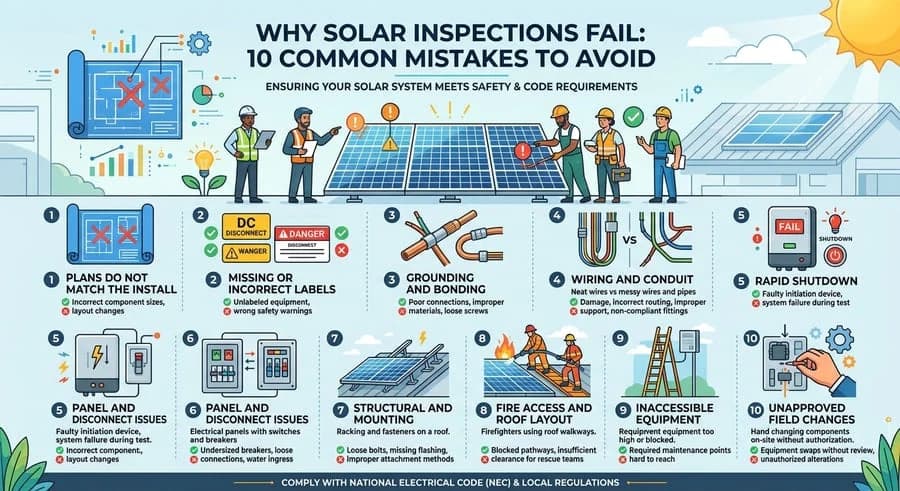
Why Solar Inspections Fail: 10 Common Mistakes to Avoid
Discover the 9 critical reasons solar inspections fail and how to avoid costly m...
Solar Grounding And Bonding: How To Pass Inspection Every Time
Learn how to pass solar grounding and bonding inspections every time. Avoid comm...
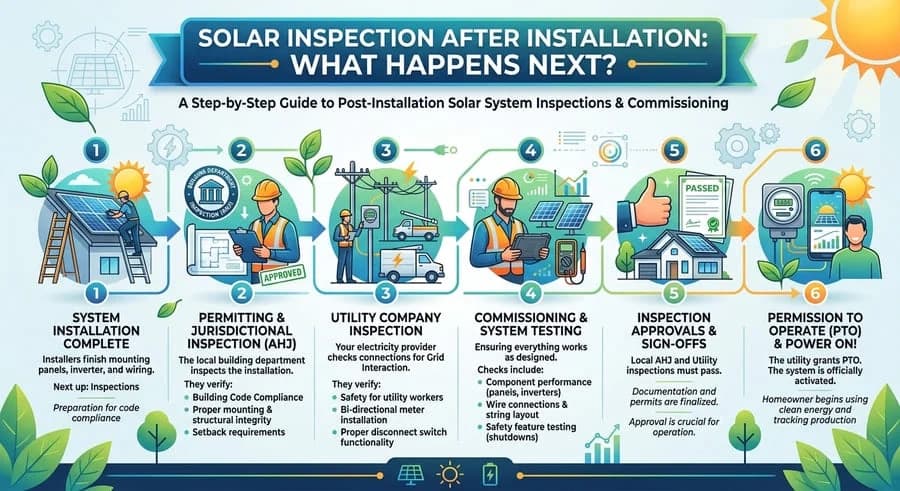
Solar Inspection After Installation: What Happens Next?
Learn how to pass your solar inspection by following essential tips for obtainin...