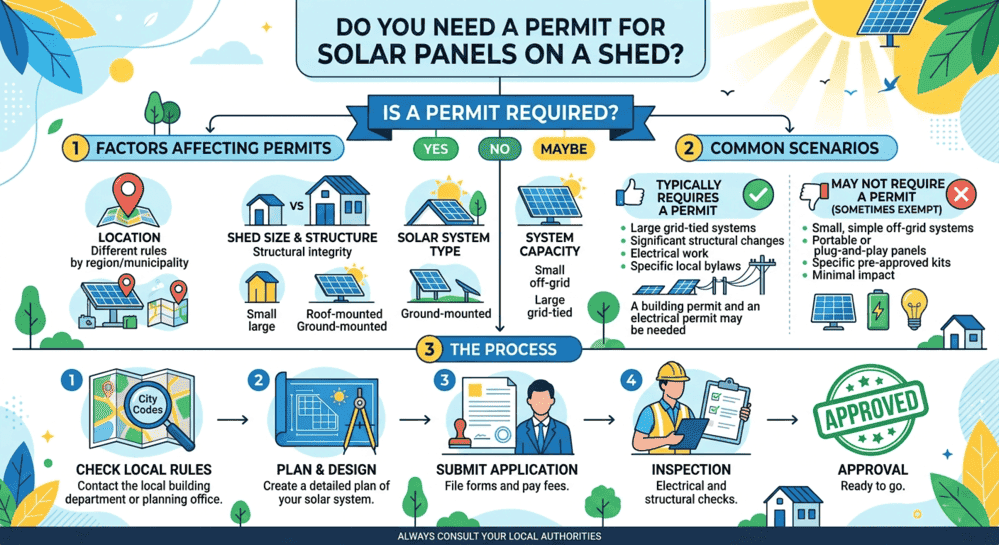
Yes, in most cases you need a permit for solar panels installed on a shed. Grid-tied systems, permanently mounted arrays, and any system connected to your home’s electrical panel require both a building permit and an electrical permit from your local Authority Having Jurisdiction (AHJ). Small off-grid solar setups that power only lights, a battery bank, or small devices may qualify for an exemption in some jurisdictions, but there is no universal exemption. Permit requirements vary by city and county, and the only reliable way to confirm is to contact your local building department or check the AHJ’s published checklist before purchasing any equipment.
This guide covers every scenario in which a shed solar permit is or is not required, what documentation you will need, how much it costs, what causes rejections, and how to get first-pass approval. If you want a professional plan set prepared for your project, Solar Permit Solutions covers all 50 states, including accessory structure and shed installations.
When Do You Need a Permit for Solar Panels on a Shed?
The permit trigger for a shed solar system is determined by three factors: how the system connects to the grid or your home’s electrical panel, how the panels are mounted, and whether the local AHJ has adopted an exemption for small off-grid loads. The National Electrical Code (NEC) through Articles 690 and 705 establishes the baseline electrical requirements; the International Fire Code (IFC) adds structural and access path requirements. The table below summarizes the most common scenarios.
| Situation | Permit Required? | Why |
| Grid-tied solar (exports to utility) | Yes | Requires interconnection agreement; NEC Articles 690 and 705 apply |
| Connected to home’s main electrical panel | Yes | NEC 705.12 load-side rules; 120% busbar rule applies |
| Battery storage added to PV system | Usually yes. | NEC Article 706 and NFPA 855 add documentation and labeling scope |
| Permanent roof-mount on shed | Usually yes. | Structural review required; building permit triggered in most jurisdictions |
| Off-grid system under 1 kW (lights/fans only) | Sometimes no. | Some AHJs exempt low-wattage off-grid loads; confirm locally |
| Portable solar kit or plug-in power station | Often No | Not permanently installed; no circuit modification |
Grid-Tied Solar Systems
Any shed solar system that connects to the utility grid requires a utility interconnection agreement in addition to local AHJ permits. Grid-tied systems are evaluated under NEC Article 705, which governs distributed energy resource connections, and NEC Article 690, which governs the PV system design itself. For a complete walkthrough of interconnection documentation, see our supply-side vs. load-side interconnection guide.
Solar Panels Connected to Your Home’s Electrical Panel
Wiring a shed solar system back to your home’s main service panel introduces a second power source onto the building’s electrical system. Under NEC 705.12, the combined rating of the main breaker and solar breaker cannot exceed 120% of the panel busbar rating. This calculation must be documented in the permit plan set and is one of the most commonly flagged items in AHJ plan review. If your busbar cannot accommodate the interconnection under the 120% rule, a supply-side connection or a meter-main upgrade may be required.
Solar Systems With Battery Storage
Adding a battery energy storage system to a shed solar installation introduces permit requirements beyond a standard PV-only plan set. NEC Article 706 governs ESS installations, and NFPA 855 adds fire safety, ventilation, and spacing requirements. Our NEC 690/706 compliance checklist for battery storage covers every document the AHJ will request.
Permanent Roof-Mounted Solar Installations
Once panels are bolted to the shed roof with racking hardware, the installation is classified as permanent construction in virtually every jurisdiction, triggering both a building permit for the structural modification and an electrical permit for the wiring. The key structural question is whether the shed’s framing can carry the additional dead load plus wind and snow loads calculated per ASCE 7-22. Most prefabricated storage sheds were not designed for this.
Commercial or Large Residential Solar Sheds
Sheds used for commercial purposes are subject to commercial building code requirements. See our guide to commercial solar plan sets for what NEC and IBC requirements apply at that scale. Review timelines for commercial shed solar projects are correspondingly longer than residential.
When You Might Not Need a Permit
There is no nationally uniform exemption for small off-grid solar systems, but several conditions make a permit unnecessary in practice. All of the following must typically be true simultaneously for an exemption to apply.
Small Off-Grid Solar Systems
Some AHJs exempt off-grid systems below a wattage or voltage threshold when the system does not connect to any building wiring and does not store energy in a fixed battery bank. Solar Permit Solutions offers a dedicated off-grid solar system design service for these projects. Even when a full permit is not required, having engineered drawings protects you during any future inspection or property sale.
Portable Solar Panels and Power Stations
Truly portable equipment, panels that fold up and are brought indoors, or plug-in power stations not permanently wired into a structure, generally do not require permits because they do not constitute permanent construction and do not involve circuit modifications. The NEC applies to permanent wiring installed as part of a structure; portable equipment used as a plug-in appliance is outside its scope.
Temporary or Non-Permanent Sheds
Temporary structures such as canopies, fabric-covered frames, or sheds placed on skids without a permanent foundation may fall outside the building code’s jurisdiction in some rural or unincorporated areas. However, a solar system connected to any fixed wiring still requires an electrical permit in most jurisdictions, and NEC 690.12 Exception No. 2 (2023 edition) for carports and canopies applies only to the rapid shutdown requirement, not to the permit requirement itself.
Low-Voltage Solar Installations
Solar installations that operate entirely below 50 volts DC, uncommon for anything beyond a tiny single-panel system, may fall under low-voltage electrical code provisions rather than NEC Article 690. In practice, most solar panels produce 30 to 50V open-circuit, and a two-panel string approaches or exceeds 50V, bringing the full NEC Article 690 into play.
What Permits Are Required for a Solar Shed?
Most shed solar installations require more than one permit. The number and type depend on system configuration and local AHJ requirements. For a full national overview, see our solar panel permit requirements guide.
Building Permit
A building permit is required whenever you make a permanent structural modification to a shed. The building permit process involves plan review of your site plan, array layout, and structural calculations, plus a post-installation inspection confirming the physical work matches the approved drawings. Building permit fees for residential solar typically range from $50 to $500 depending on jurisdiction.
Electrical Permit
An electrical permit covers the wiring, conduit, disconnects, inverters, and all NEC Article 690 compliance documentation. The plan set must include an electrical single-line diagram (SLD) tracing the circuit path from the PV modules through string wiring, the inverter, AC and DC disconnects, and the point of interconnection. NEC calculations for conductor sizing, overcurrent protection, and the 120% busbar rule must be shown.
Structural Permit and PE Stamp
A licensed professional engineer must evaluate whether the shed framing can support the added dead load plus wind and snow loads per ASCE 7-22. Our state-by-state PE stamp requirements guide covers which states mandate PE stamps for accessory structure installations, kW thresholds, and typical cost ranges. The PE must be licensed in the state where the project is located; an out-of-state stamp is not valid.
Utility Interconnection Approval
Grid-tied shed solar systems require a utility interconnection application in addition to local AHJ permits. Most residential systems qualify for Level 1 expedited review (inverter-based, 25 kW or less, UL 1741-listed). See the DSIRE database to confirm interconnection rules for your specific utility and state.
Zoning Approval
In some jurisdictions, solar panels on an accessory structure require a zoning approval or conditional use permit, particularly in historic districts and HOA-governed communities. For a related scenario, see our solar carport cost and permitting guide which covers many of the same zoning considerations for detached structures.
Required documentation for the permit application typically includes:
- Site plan showing the shed location, property boundaries, and setback dimensions
- Electrical single-line diagram (SLD) with all components labeled
- Structural calculations with PE stamp from an engineer licensed in the project state
- Equipment specification sheets for panels, inverter, racking, disconnects, and wire
- NEC compliance notes referencing the AHJ’s adopted code edition; see our NEC 2023 Article 690 updates guide
- Label schedule with exact NEC-required wording per our solar PV labeling requirements guide
Does the Shed Itself Need a Permit First?
This is one of the most overlooked questions in shed solar permitting, and getting it wrong delays the solar permit application before it even starts.
Permit Requirements for the Shed Structure
In most jurisdictions, detached sheds above a certain square footage threshold require a building permit of their own, separate from and preceding any solar permit. The solar permit application will often require the reviewer to confirm that the underlying structure is legal and code-compliant.
Size Thresholds That Trigger Shed Permits
Common permit thresholds for detached accessory structures range from 100 to 200 square feet, though they vary by jurisdiction. Many AHJs require permits for any shed with electrical wiring regardless of square footage. Some use a combined test: sheds under a certain size and value are exempt from structural review but still require an electrical permit if wiring is present. Confirm your local threshold with the building department (AHJ) before designing the solar system.
What Happens if the Shed Was Built Without a Permit?
An unpermitted shed creates a compounding problem. The AHJ may require the shed to be brought into compliance before approving the solar system, retroactive structural review, code upgrades to the shed’s framing, and additional permit fees. In some jurisdictions, a solar permit application that references an unpermitted accessory structure will be denied outright. Check your county assessor’s and building department’s records for the shed’s permit history before proceeding with solar design
Solar Permit Solutions
Skip the Permit Headaches
We design plan sets that pass inspection the first time. Code-compliant, PE-stamped, accepted by AHJs nationwide.
Can Your Shed Support Solar Panels Structurally?
Structural inadequacy is the most common engineering issue discovered during shed solar plan review, and it can require significant reinforcement work before a permit will be issued.
Typical Weight of Solar Panels
A standard 400W residential solar panel weighs approximately 40 to 50 pounds and covers roughly 21 to 23 square feet of roof area. A 4-panel array weighs approximately 160 to 200 pounds, not counting racking hardware. Most residential racking systems add another 1 to 3 pounds per square foot of array area, bringing the total dead load to approximately 3 to 5 psf, which may exceed the load capacity of a prefabricated shed designed only for light storage use.
Wind Load Requirements
Wind uplift is often the controlling load condition for roof-mounted solar arrays on sheds. The wind design speed for your location, determined by ASCE 7-22 and the jurisdiction’s adopted building code, establishes the minimum uplift resistance your racking attachment must provide. Coastal areas, hurricane zones, and high-wind regions require engineered attachment hardware and closer anchor spacing.
Snow Load Considerations
In regions with significant annual snowfall, the northern United States, Rocky Mountain states, and New England, snow load is an additional dead load combined with the panel weight in the structural analysis. The design ground snow load for your location is specified in ASCE 7-22 and may range from 5 psf in mild climates to 60 psf or more in heavy snow regions. Sheds with low-pitch roofs or weak framing are most likely to require reinforcement under combined snow and panel loading.
Why Engineering Stamps Are Often Required
Most states require PE-stamped structural calculations for all grid-tied solar installations regardless of system size. The PE evaluates the shed’s existing roof framing, rafter or truss size, spacing, material, and span against the combined dead load and wind and snow loads. See our solar PE stamp requirements by state for the specific threshold and cost data for your state. If the structural review reveals that the shed cannot support the array, the PE may specify reinforcement options such as sistered rafters, additional posts, or a ground-mount relocation.
Solar Shed Permit Costs in 2026
Total permit costs for a shed solar installation depend on jurisdiction, system size, and whether the project requires a separate structural engineering review. According to NREL’s solar market research, permitting and inspection costs represent a meaningful share of residential solar soft costs, which is why professional plan preparation that achieves first-pass approval has real dollar value.
| Cost Item | Typical Range | Notes |
| AHJ building permit fee | $50 – $500 | Flat fee or percentage of project value; varies by jurisdiction |
| AHJ electrical permit fee | $50 – $300 | Separate from building permit in most jurisdictions |
| Plan set design (professional service) | $200 – $500 | Residential; includes SLD, site plan, NEC calculations |
| PE stamp (structural + electrical) | $200 – $600 | Must be licensed in the project state; see PE stamp guide |
| Engineering reinforcement work | $0 – $2,500+ | Only required if shed framing needs upgrades |
| AHJ inspection fees | $50 – $200 | May be included in permit fee or billed separately |
| Utility interconnection fee (Level 1) | $0 – $100 | Many utilities waive fees for residential Level 1 systems |
For a typical residential shed solar system of 2 to 4 panels (800 W to 1.6 kW), total permitting costs including plan set design, PE stamp, and AHJ fees generally fall between $400 and $1,400. Systems requiring structural reinforcement or commercial classification will cost more. Our residential solar permit service includes PE-stamped plans for all 50 states with a typical 1 to 2 business day turnaround. See our pricing page for current plan set rates.
How to Get a Permit for Solar Panels on a Shed: Step by Step
The permitting process for a shed solar installation follows the same sequence as a residential rooftop installation, with the addition of a shed permit verification step at the start. For a detailed walkthrough of the full solar permit design process, see our dedicated guide.
- Verify local permit requirements. Contact your city or county building department and ask specifically about permits for solar panels on an accessory structure. Request the published checklist if one exists. Confirm which NEC edition the AHJ enforces. Do not assume a single phone call prevents plan set revisions.
- Verify the shed’s permit status. Request records from your building department for any existing permits. If the shed was built without a permit and your AHJ requires legalization before solar approval, address the shed permit first.
- Evaluate shed structural capacity. Hire a licensed PE to assess whether the shed roof can support the array under your jurisdiction’s ASCE 7-22 wind, snow, and dead load criteria. If reinforcement is required, complete it before finalizing the solar design.
- Prepare the solar permit plan set. The plan set must include a site plan, array layout drawing, electrical single-line diagram, PE-stamped structural calculations, NEC calculations, equipment spec sheets, and a complete label schedule with exact NEC-required wording.
- Submit to the AHJ and utility simultaneously. Many jurisdictions accept digital submissions. Jurisdictions using SolarAPP+ can issue same-day approvals for qualifying systems. Standard manual review takes 1 to 4 weeks for residential projects.
- Respond to any plan check comments. If the AHJ reviewer issues redlines, revise and resubmit. For common rejection triggers, see our permit rejection avoidance guide. Professional plan set services typically handle revisions within 12 to 24 hours at no additional cost.
- Complete installation and schedule final inspection. Install exactly as shown in the approved plan set. Any deviation requires a permit revision before work continues. Once the inspection passes, grid-tied systems proceed with the utility’s Permission to Operate (PTO) process.
Common Reasons Solar Shed Permits Get Rejected
Rejections on shed solar permits closely track national patterns, with several shed-specific triggers. For a comprehensive national breakdown, see our solar permit requirements and rejection avoidance guide. Each rejection cycle adds 1 to 4 weeks to the project timeline.
Missing Structural Calculations
Structural calculations must be provided by a licensed PE and must use the correct ASCE 7-22 design criteria for the project location, the right wind speed, exposure category, and ground snow load. Generic notes that do not reference site-specific load conditions or were prepared for a different jurisdiction will be flagged.
Incorrect or Missing Site Plans
AHJ reviewers routinely cross-reference submitted site plans against satellite imagery and county GIS records. If the shed’s location, dimensions, or the array’s setback from property lines does not match the aerial data, the plan is returned. This is especially common when site plans are prepared from estimated measurements rather than actual survey data.
Incomplete Electrical Single-Line Diagram
The single-line diagram must trace the complete circuit from PV modules to the point of interconnection, with every component labeled by manufacturer, model number, and electrical ratings. Missing disconnects, unlabeled conductors, or failure to document rapid shutdown compliance under NEC 690.12 are each independently sufficient to generate a correction.
Unpermitted Existing Shed
Some AHJs require the shed structure to be permitted and code-compliant before approving solar. If the shed has no permit on record, the reviewer may reject the solar application and require legalization first. This is not universal but common enough that permit history should be verified before investing in plan set preparation.
Wind and Snow Load Deficiencies
Structural calculations that use incorrect design wind speeds or omit snow load in regions where ground snow load exceeds 20 psf are flagged immediately. Using a generic template for structural calculations rather than pulling site-specific data from ASCE 7-22 is the most common source of this error.
Wrong NEC Edition Referenced
Submitting plans that cite NEC 2020 to a jurisdiction that has adopted NEC 2023, or vice versa, triggers an automatic revision request. Always verify the AHJ’s adopted code edition before starting design. See our NEC 2023 Article 690 updates guide for the changes that affect labeling, rapid shutdown, and DC voltage labels in the current cycle.
State-by-State Solar Shed Permit Requirements
Shed solar permit requirements follow the same state-level framework as rooftop solar. The NEC edition, PE stamp requirements, and AHJ portal vary by state. Use the DSIRE database to look up your specific state’s current adoption status and solar access laws.
California
California enforces NEC 2023 alongside Title 24 energy code requirements. All solar installations, including those on accessory structures, must comply with NEC Article 690. California Civil Code Section 714 limits HOA authority to prohibit solar on accessory structures. Many California jurisdictions participate in SolarAPP+ for expedited residential permit review. For a full state guide, see our California solar permit overview and the detailed requirements specific to California AHJs.
Florida
Florida requires PE stamps on virtually all solar installations with no kW-based exemptions, driven by hurricane zone structural requirements. Florida enforces NEC 2023 statewide. Coastal properties in Wind Speed Zones II through V require wind load calculations specific to those zones. Under Florida HB 683 (effective July 1, 2025), local governments have 5 business days to approve residential solar permit applications, which applies to accessory structure installations.
Texas
Texas solar permitting varies significantly by municipality. Major cities require PE-stamped plan sets for grid-tied systems; many smaller jurisdictions have different requirements. The Texas Department of Licensing and Regulation (TDLR) licenses residential solar retailers. Always contact the specific city or county building department to confirm requirements before preparing plans. See our guide to PE stamp requirements for Texas, California, and Florida for state-specific thresholds.
Arizona
Arizona is one of the highest-solar-density states in the country. Pima County (Tucson) and Phoenix are among the most active SolarAPP+ jurisdictions in the United States, with same-day permit approvals available for qualifying residential and accessory structure installations. Structural requirements are less restrictive than snow-load states, but wind exposure calculations are important in high-desert and rural areas.
New York
New York requires PE stamps for most installations, with snow load and wind exposure calculations that vary significantly between New York City and upstate regions. Ground snow loads in upstate New York can exceed 60 psf, which creates significant structural review requirements for shed installations with weaker framing. The NFPA 70 (NEC) edition enforced by each New York AHJ varies; confirm with the local building department before finalizing plan set code references.
Conclusion: Do You Need a Permit for Solar Panels on a Shed?
In the vast majority of cases, yes. Grid-tied shed solar systems, permanently mounted arrays, systems with battery storage, and any installation that connects to your home’s electrical panel require permits. Small off-grid systems that do not connect to any fixed wiring and only power lightweight loads may qualify for exemptions in some jurisdictions, but there is no national standard. The only way to confirm is to contact your local AHJ directly.
The three questions that determine your permit path: Is the system grid-tied? Is it permanently mounted? Does it connect to the home’s electrical system? If the answer to any of these is yes, you need a permit.
Permit costs for a residential shed solar system typically fall between $400 and $1,400 total for plan set design, PE stamp, and AHJ fees. According to NREL solar market research, permitting and inspection costs represent a meaningful share of residential solar soft costs, making first-pass approval one of the highest-leverage outcomes in the permitting process. The contractors and homeowners who consistently achieve first-pass approval share one habit: they verify the AHJ’s specific requirements before starting plan preparation, not after the application is submitted.
Solar Permit Solutions produces PE-stamped, AHJ-ready plan sets for residential and commercial solar projects across all 50 states, including accessory structure and shed installations. Contact our team to discuss your project, or create a free account to get started.
Frequently Asked Questions
Skip the Permit Headaches
We design plan sets that pass inspection the first time. Code-compliant, PE-stamped, accepted by AHJs nationwide.
Frequently Asked Questions
It depends on your jurisdiction and system configuration. A small off-grid system powering only lights or a battery charger may be exempt in some areas. A system with an inverter, battery bank, or subpanel will almost always require an electrical permit even without a grid connection. Solar Permit Solutions offers a specialized off-grid solar system design service for these projects.
In most jurisdictions, homeowners can pull their own permits and perform their own solar installations, though a licensed electrician is required for electrical work in some states. However, the installation must have a PE-stamped plan set if your state requires PE stamps and must pass a final AHJ inspection. DIY plan sets have higher rejection rates (estimated 50 to 70%) compared to professionally prepared plan sets (85 to 95%+). See our residential solar permit service if you need professional documentation.
Yes, but doing so triggers additional permit and interconnection requirements. Any wiring connection to your home's electrical panel is subject to NEC 705.12 load-side interconnection rules, including the 120% busbar rule. See our supply-side vs. load-side interconnection guide for documentation requirements and when a supply-side connection is the better option.
The limiting factors are the shed roof's structural capacity under ASCE 7-22 and the available roof area after applying fire setback dimensions per the IFC. A licensed PE's structural analysis establishes the maximum load the shed framing can support. On the electrical side, the inverter's maximum input limits the number of panels regardless of roof size.
Prefabricated sheds can support solar panels, but most were not engineered for the added dead load of a solar array plus wind and snow. Obtain the manufacturer's structural specifications for your specific shed model before commissioning a structural review. Many shed manufacturers publish load data online; confirm your model's specs before the PE prepares calculations.
Most states have solar property tax exemptions that exclude the value of solar energy systems from property tax assessments. Use the DSIRE database to look up the scope of your state's exemption, including whether it applies to accessory structures as well as primary residences.
Yes, but adding battery storage to a previously permitted PV-only system typically requires a new or amended permit. The original plan set does not cover the NEC Article 706 documentation, NFPA 855 fire safety requirements, and labeling that a battery system introduces. See our NEC 690/706 compliance checklist for battery storage for the full document list the AHJ will require.
California Civil Code Section 714 and similar statutes in some other states limit HOA authority to prohibit solar on accessory structures. HOAs may impose reasonable restrictions on size, placement, and aesthetics. Check the DSIRE database for your state's solar access law and your specific HOA declaration before proceeding.
Many AHJs require the shed structure to be code-compliant and permitted before approving a solar application. Check your building department's records and confirm their policy. For context on how unpermitted structures affect permit applications nationally, see our solar panel permit requirements and rejection avoidance guide.
In most states, yes. PE-stamped structural and electrical plans are required for all grid-tied solar installations. See our complete PE stamp requirements guide by state for the specific threshold and cost data for your state. The PE must be licensed in the state where the project is located.

SPS Editorial Team
Solar Permit Solutions
Solar Permit Solutions provides professional solar permit design services for residential, commercial, and off-grid installations across all 50 states. Our team ensures permit-ready plan sets delivered fast.
Related Articles
Solar Permit Requirements In Florida: Complete Step-By-Step Guide
Solar Permit Solutions breaks down Florida’s permit requirements by county...
How to Mount Solar Panels on a Roof: Mounting Systems, Rails, and DIY Tips
Learn how to mount solar panels yourself with this complete guide. Covers compon...
AC vs DC Coupled Solar Batteries: Which Should You Choose?
AC vs DC coupled solar batteries compared: efficiency, costs ($8K-$18K), and ins...