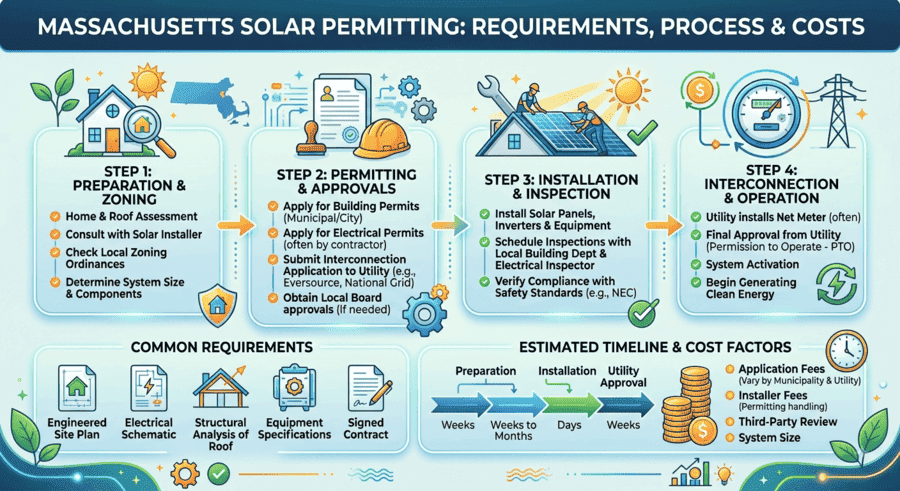
Massachusetts solar permitting is not a single statewide process. A project moves through two parallel tracks at once: local construction permitting, handled by the municipality’s building department or Authority Having Jurisdiction (AHJ), and utility interconnection, handled separately by the serving electric company. Requirements can vary by municipality, project type, system size, and whether the installation includes battery storage, but the underlying state codes, the net metering rules, and the SMART incentive program are set at the state level and apply everywhere in the Commonwealth.
Quick answer: In Massachusetts, a solar permit (building and/or electrical) allows a project to be legally constructed. Utility interconnection approval, granted separately by Eversource, National Grid, Unitil, or a municipal light plant, is what allows the system to operate in parallel with the electric grid. Most residential and commercial solar projects need both, and neither one substitutes for the other.
This guide walks through who issues Massachusetts solar permits, what documents a plan set needs, when a PE stamp applies, how battery storage changes the permit package, how interconnection works with each regulated utility, and what typically causes a Massachusetts solar permit to get rejected on first submission. Skipping this process altogether carries real consequences; see our guide on what happens if you install solar panels without a permit for what AHJs and utilities can require if a system is installed without proper approval.
Massachusetts Solar Permitting at a Glance
Before diving into details, here is the full approval stack a typical Massachusetts solar project moves through:
| Approval | Who reviews it? | What it covers |
|---|---|---|
| Building permit | Local building department / AHJ | Structural attachment and construction requirements |
| Electrical permit | Local inspector of wires | PV electrical system, conductors, disconnects, labeling |
| Zoning review | Municipality, when applicable | Setbacks, height, land use, historic districts |
| Fire / ESS review | Fire department or AHJ, when applicable | Battery storage and fire-safety requirements |
| Utility interconnection | Eversource, National Grid, Unitil, or a municipal light plant | Grid connection, metering, export limits |
| Inspection | Local AHJ | Verifies the installed system matches approved plans |
| PTO / authorization to operate | Utility | Final permission for the system to energize and export |
Do You Need a Permit for Solar Panels in Massachusetts?
Yes. Virtually every grid-tied solar installation in Massachusetts, and most off-grid and standalone systems, require a permit from the local AHJ. What changes from project to project is which permits apply and what documentation each one requires.
Residential rooftop solar
Residential rooftop systems almost always need a building permit for the racking attachment and structural load, plus an electrical permit for the PV wiring and interconnection equipment. Our residential solar design team prepares AHJ-ready plan sets covering both scopes so contractors are not submitting incomplete packages.
Ground-mounted solar
Ground-mount arrays are reviewed as a structure in their own right, with foundation design, setbacks, and sometimes zoning or site-plan review layered on top of the standard electrical permit. See our ground-mount solar permit plans service page for the foundation types and structural documentation Massachusetts AHJs typically expect.
Commercial solar
Commercial rooftop and ground-mount systems generally require both permits plus a more detailed structural and electrical review, and PE stamps are common on the design package. Our commercial solar design service covers three-phase electrical design and multi-inverter architecture for these projects.
Solar with battery storage
Adding an energy storage system (ESS) does not eliminate any of the standard PV permitting requirements, and it adds its own documentation: battery location plans, clearances, ventilation, disconnects, and UL 9540 listing information. The battery and ESS permitting section below covers this in detail.
Solar additions and system expansions
Expanding an existing array, adding a battery to a PV-only system, or upgrading service equipment typically requires a new or amended permit. The exact package depends on what already exists on file with the AHJ, so confirming the original permit history before submitting is worth the extra step.
Who Issues Solar Permits in Massachusetts?
Massachusetts does not have one statewide office that issues every solar permit. Permitting is administered locally by each municipality’s own building department, electrical inspector, and, where applicable, fire department and zoning board.
The Commonwealth is made up of 351 incorporated cities and towns, and permitting is administered at that municipal level rather than through a single state permitting portal. In practice, a Massachusetts solar permit package is typically reviewed by some combination of the following local officials:
- Building department / Inspector of Buildings / Building Commissioner
- Inspectional Services Department (in cities with a combined department, such as Boston)
- Inspector of Wires or electrical authority
- Fire department, for systems that include battery storage or where local fire code review applies
- Zoning or planning authority, for setback, height, or land-use questions
- Historic district commission, for properties in a local historic district
Why Massachusetts solar permitting varies by town
The state building code (780 CMR) and the state electrical code (527 CMR 12.00) apply statewide, so the underlying technical standard is consistent. What varies town to town is administrative: application portals and forms, submittal requirements, zoning bylaws, whether a pre-submission meeting is expected, fire department review procedures for battery storage, and how quickly a given department turns around a review. Confirming these local specifics before submitting, rather than assuming a plan set that worked in one Massachusetts town will be accepted as-is in another, is one of the most reliable ways to avoid a first-round rejection.
Solar Permit Solutions
Skip the Permit Headaches
We design plan sets that pass inspection the first time. Code-compliant, PE-stamped, accepted by AHJs nationwide.
Massachusetts Solar Permit Requirements
Every Massachusetts solar permit application is built around a plan set: the engineered drawings and supporting documents that show the AHJ exactly what is being installed and how it complies with code. Our solar permit design and plan set guide breaks down what each sheet is for; the list below covers what a typical Massachusetts submittal includes.
Typical Massachusetts solar permit documents
- Project information and permit application form
- Site plan showing the property, array location, and setbacks
- Roof plan with module layout and access pathways
- PV array and equipment layout
- Structural attachment details and structural calculations
- Electrical single-line diagram (and three-line diagram where required)
- Equipment specification sheets: modules, inverters, racking
- Rapid shutdown documentation and equipment identification
- Conductor sizing and overcurrent protection (OCPD) calculations
- Disconnect locations and grounding/bonding details
- Label and placard schedule
- Main electrical service information
- Utility and interconnection information
- Battery / ESS documentation, when applicable
- PE-stamped structural and/or electrical documents, when the AHJ or project scope requires it
Massachusetts Solar Plan Set Requirements
Site plan
Shows property boundaries, the array location relative to the structure, setbacks, other structures, access routes, and the location of the utility service and main disconnect.
Roof plan
Documents module layout, roof dimensions, attachment point locations, required fire-access pathways and setbacks, and any roof obstructions such as vents, chimneys, or skylights.
Electrical single-line diagram
Traces the circuit from the modules through the inverter, disconnects, service equipment, breakers, conductors, grounding, and the point of interconnection. Disconnect placement and sizing is a common source of AHJ comments; our PV disconnect switch guide covers NEC sizing and placement rules in detail.
Structural drawings and calculations
Cover roof framing capacity, attachment method, and wind, snow, and (for ground mounts) foundation design. Massachusetts’ 10th Edition building code incorporates updated ASCE 7-16 wind-uplift guidance specific to roof-mounted solar arrays, along with revised seismic design values in parts of the state, so structural calculations should reference the currently effective edition rather than an older one carried over from a prior project.
What Codes Apply to Solar Permitting in Massachusetts?
Articles 690, 705, and 706 of the National Electrical Code (NFPA 70) govern PV system design, interconnection, and energy storage, respectively, and are incorporated into Massachusetts’ electrical code by reference:
| Code / regulation | Why it matters |
|---|---|
| Massachusetts State Building Code, 780 CMR (10th Edition) | Structural and construction requirements for the racking, roof, or ground-mount attachment |
| Massachusetts Electrical Code, 527 CMR 12.00 | PV electrical installation; currently the 2026 NEC with state amendments |
| NEC Article 690 | Solar PV system requirements: sizing, rapid shutdown, grounding, labeling |
| NEC Article 705 | Interconnection of distributed resources, including the load-side connection rules |
| NEC Article 706 | Energy storage system (battery) requirements |
| Massachusetts energy code (base, stretch, or specialized) | Applies at the municipal level; can affect new-construction and major-alteration projects |
| Local zoning bylaws | Setbacks, height limits, historic-district and land-use requirements |
Massachusetts is currently on the 10th Edition of the state building code, 780 CMR, based on the 2021 International Building and Residential Codes with state amendments. On the electrical side, the Board of Fire Prevention Regulations promulgated a new edition of 527 CMR 12.00 based on the 2026 National Electrical Code (NFPA 70), effective April 24, 2026. This is important for plan sets: the applicable electrical code edition vests on the date the electrical permit application is filed, not the date the building permit was applied for, so a project that spans that transition can end up designed to a different NEC edition than the building permit assumed. Our NEC 2023 Article 690 updates guide is a useful baseline for the Article 690 changes carried forward into the 2026 cycle, but Massachusetts plan sets prepared today should reference the current, 2026-based 527 CMR 12.00 rather than the 2023 NEC used in many other states.
Massachusetts also maintains Base, Stretch, and Specialized energy code pathways, administered by the Department of Energy Resources, that municipalities can opt into. These primarily affect building envelope and electrification requirements rather than the PV system itself, but they can influence structural and electrical documentation on new construction and larger alteration projects.
Does a Massachusetts Solar Project Need a PE Stamp?
Not every Massachusetts solar project automatically requires the same PE-stamp scope. Requirements depend on the project type, system size, and how the specific AHJ handles review; there is no single statewide threshold that applies to every town.
When structural engineering may be requested
- Unusual roof construction or framing
- Complex or non-standard attachment methods
- High snow-load areas, including higher-elevation sites in western Massachusetts
- Unusual roof geometry
- Ground-mount systems and their foundations
- Solar carports and canopies
- Non-standard racking products without pre-engineered load tables
- Structural modifications to the existing building
What a structural PE review typically evaluates
A structural PE review generally confirms that the roof or foundation can carry the added dead load, wind uplift, and (where applicable) snow load from the array, and that the attachment method transfers those loads into the structure appropriately.
Why AHJ-specific requirements matter
Some Massachusetts AHJs request a PE stamp on every submittal; others only require it above a certain system size or for non-standard installations. Because this varies by town and by project scope, confirming the specific AHJ’s threshold before finalizing a design is more reliable than assuming a blanket rule. Our state-by-state PE stamp requirements guide covers how these thresholds tend to be structured across different jurisdictions.
Massachusetts Solar Electrical Permit Requirements
The electrical permit covers everything downstream of the modules: wiring, conductors, overcurrent protection, disconnects, grounding and bonding, rapid shutdown, labeling, and the point of interconnection. In Massachusetts, this work must be performed under a licensed electrician and reviewed by the local inspector of wires under 527 CMR 12.00.
- Licensed electrician of record for the installation
- Service and panel capacity confirmed for the added PV load
- Breaker and conductor sizing, including the busbar rule for load-side interconnections
- Disconnect locations, sized and placed per NEC Article 690
- Grounding and bonding details
- Rapid shutdown equipment identification and documentation
- Complete label and placard schedule
- Point-of-interconnection documentation matching the utility application
Two areas generate a disproportionate share of Massachusetts electrical-permit comments: rapid shutdown labeling and disconnect sizing. Our solar PV labeling requirements guide and our NEC 690.56(C) rapid shutdown label guide cover the exact wording, placement, and format inspectors are checking for.
Massachusetts Solar Battery & ESS Permitting Requirements
Does adding a battery change the permit requirements?
Yes. Battery storage brings NEC Article 706 into the plan set alongside Article 690, and it typically brings the fire department into the review in addition to the building and electrical departments. AHJ review processes for ESS are still maturing in many Massachusetts towns, which can mean more detailed correction requests than a PV-only submittal. Our NEC 690 and 706 compliance checklist lists the twelve documents a solar-plus-storage plan set typically needs.
What documents are needed for battery storage?
- Battery location plan showing clearances from combustibles and egress pathways
- Wiring schematics for AC-coupled, DC-coupled, or hybrid configurations
- Ventilation and clearance documentation, especially for indoor installations
- Dedicated ESS disconnect locations
- Battery nameplate data and UL listing information
- Emergency shutdown and signage details for first responders
UL 9540 vs. UL 9540A
UL 9540 is the system-level safety listing for the battery energy storage system as a whole. UL 9540A is a separate large-scale fire test method that evaluates thermal runaway propagation and is referenced by NFPA 855, the installation standard most Massachusetts fire departments use when reviewing ESS submittals. AHJs generally want to see the UL 9540 listing documented in the plan set and may ask for UL 9540A results on larger or unusual installations.
ESS location, disconnect, and fire department review
Indoor battery installations generally face closer scrutiny than outdoor or garage-mounted units because of ventilation and egress considerations. Expect the fire department to weigh in on spacing, signage, and emergency shutdown access, particularly for lithium-ion systems above the residential capacity thresholds referenced in NFPA 855.
Massachusetts Solar Interconnection Requirements
Permitting and interconnection are separate processes with separate reviewers. A completed, inspected, and closed-out local permit does not by itself authorize a system to operate; the utility still has to approve interconnection and issue permission to operate (PTO).
Which utilities handle solar interconnection in Massachusetts?
| Utility | What installers and homeowners should know |
|---|---|
| Eversource | Regulated electric company; handles its own interconnection application and review process |
| National Grid | Regulated electric company; handles its own interconnection application and review process |
| Unitil | Smallest of the three regulated utilities; also runs its own interconnection process |
| Municipal light plants (MLPs) | Not regulated by the DPU for net metering; each MLP sets its own interconnection process |
To net meter in Massachusetts, a customer must be served by one of the three regulated electric companies, Eversource, National Grid, or Unitil, and the generating facility must be interconnected by that electric company and meet its technical requirements. Solar, wind, and anaerobic digestion facilities can net meter up to 2 megawatts for a private facility or 10 megawatts for a public facility. Customers of a municipal light plant are not eligible for the state’s net metering program and instead need to contact their MLP directly about its own interconnection and billing process.
Net metering and SMART: how they relate to permitting
Net metering and the Solar Massachusetts Renewable Target (SMART) program are administered separately, and a project can participate in both. As of 2026, Massachusetts is running SMART 3.0, a redesigned version of the program that moved from fixed, declining-block incentive rates to rates the Department of Energy Resources adjusts annually. The SMART 3.0 tariff and regulatory framework (225 CMR 28.00) were finalized through the Department of Public Utilities in 2026. None of this changes what the local AHJ requires for a building or electrical permit, but it does affect the utility-side paperwork installers submit alongside the interconnection application, and it is worth confirming current program status before quoting incentive timelines to a client.
Interconnection for commercial and larger systems
Commercial and larger systems generally go through a more detailed interconnection review, sometimes including a feasibility study before a formal application. Our commercial solar interconnection guide and our broader utility interconnection requirements guide cover the application steps, equipment certification requirements, and common causes of interconnection delay that apply across utilities, including in Massachusetts.
Massachusetts Solar Permitting Process: Step by Step
Because municipal permitting and utility interconnection run on separate, parallel tracks, the fastest Massachusetts projects treat them as two workstreams that start close together rather than one after the other.
- Identify the project location: municipality, AHJ, serving utility, zoning jurisdiction, and historic-district status.
- Collect project information: roof or site conditions, existing service size, and equipment selection.
- Confirm AHJ-specific requirements: application forms, portal, and any local submittal checklist.
- Prepare the solar design: array layout, equipment specifications, and single-line diagram.
- Prepare structural documentation, including a PE stamp where the AHJ or project type requires it.
- Prepare electrical drawings: conductor sizing, disconnects, grounding, and the label schedule.
- Submit the building permit application.
- Submit the electrical permit application.
- Submit the utility interconnection application in parallel with municipal review.
- Respond to corrections from the AHJ, the utility, or both.
- Install the system once permits are issued.
- Pass building and electrical inspections.
- Submit utility closeout documentation, including as-built information where requested.
- Receive permission to operate (PTO) from the utility.
How Long Does Massachusetts Solar Permitting Take?
There is no single Massachusetts solar permitting timeline. Review speed depends on the municipality, the completeness of the submittal, and whether battery storage or fire department review is involved.
Overall project timing is really the sum of several separate steps, each of which can vary:
- Design and plan set preparation
- Municipal building and electrical permit review
- Correction and resubmittal cycles, if any
- Installation and scheduling of building and electrical inspections
- Utility interconnection review
- Permission to operate (PTO)
What causes permitting delays?
- Incomplete plan sets missing required sheets or calculations
- Outdated code references, especially electrical designs citing an older NEC edition than the AHJ currently enforces
- Missing or mismatched PE stamps
- Battery/ESS documentation added late instead of being part of the original submittal
- Zoning or historic-district review that was not identified up front
- Interconnection applications submitted after, rather than alongside, the building permit
Common Reasons Massachusetts Solar Permits Get Rejected
- Incorrect or outdated code edition referenced in the plan set
- Wrong AHJ or submittal format for the specific municipality
- Incomplete site plan, missing setbacks or property lines
- Missing or insufficient structural calculations
- Incorrect roof framing information
- Electrical calculations that do not match the equipment shown
- Single-line diagram that does not match the equipment schedule
- Equipment specification sheets inconsistent with the drawings
- Missing rapid shutdown documentation or equipment identification
- Missing or incomplete labels and placards
- Incorrect main service information
- Missing PE stamp where the AHJ requires one
- Incomplete battery/ESS documentation
- Missing UL listing information for PV or ESS equipment
- Permit drawings that do not match the utility interconnection application
- Historic-district or zoning review overlooked before submittal
- Fire department or ESS-specific requirements not addressed
If a project does come back with corrections, working through them systematically matters more than speed. Our guide to responding to solar permit corrections walks through building a response matrix so nothing gets missed on resubmittal.
Massachusetts Solar Permit Checklist
Before submitting
☐ Confirm municipality and AHJ
☐ Confirm serving utility (Eversource, National Grid, Unitil, or MLP)
☐ Confirm the currently effective building and electrical code editions
☐ Verify site information and setbacks
☐ Verify roof or ground-mount site conditions
☐ Verify main electrical service capacity
☐ Verify equipment specifications against the drawings.
☐ Complete site plan
☐ Complete roof or foundation plan
☐ Complete electrical single-line diagram
☐ Complete structural calculations
☐ Confirm whether a PE stamp is required for this AHJ and project type.
☐ Confirm whether battery/ESS documentation applies.
☐ Confirm the label schedule is complete.
☐ Confirm the utility interconnection application matches the permit drawings.
☐ Cross-check every document against every other document before submitting.
Massachusetts Solar Permit Cost
Massachusetts solar permit fees are set locally rather than by the state, so a single statewide number would not be accurate. Fees generally depend on the municipality, the project’s declared valuation, whether it is residential or commercial, and whether zoning or fire review applies on top of the standard building and electrical permits.
Permit fees, engineering/design fees, and utility interconnection fees are three separate line items. Confirm each one separately with the AHJ, the design provider, and the utility rather than assuming one number covers the whole project.
Massachusetts Solar Permitting for Different Project Types
- Residential rooftop solar — building and electrical permit, structural review appropriate to the roof and attachment method
- Residential solar plus battery — adds NEC Article 706 documentation and, often, fire department review
- Ground-mounted solar — foundation design, setbacks, and sometimes zoning or site-plan review
- Commercial rooftop solar — more detailed structural and electrical review, PE stamps common
- Commercial ground mount — combines commercial-scale electrical design with ground-mount foundation and civil considerations
- Solar carports and canopies — reviewed as a structure, with fire-access and clearance requirements layered on top of standard PV documentation
Official Massachusetts & Industry Sources
This guide is built on primary sources rather than secondhand summaries. The regulations, standards, and program pages referenced throughout include:
- Massachusetts 780 CMR, State Building Code (10th Edition) — Division of Occupational Licensure
- Massachusetts 527 CMR 12.00, Massachusetts Electrical Code — Board of Fire Prevention Regulations
- Massachusetts 2025 Building Energy Codes (Base, Stretch, Specialized) — Department of Energy Resources
- Massachusetts Net Metering Eligibility — Department of Public Utilities, Electric Power Division
- Massachusetts Municipally Owned Electric Companies list — Mass.gov
- SMART Programmatic Review and 225 CMR 28.00 — Department of Energy Resources
- SMART 3.0 program overview — Massachusetts Clean Energy Center (MassCEC)
- Massachusetts Cities and Towns list — Secretary of the Commonwealth
- NFPA 70, National Electrical Code — National Fire Protection Association
- UL 9540, Energy Storage Systems and Equipment — UL Solutions
Ready to get a Massachusetts solar project permit-ready? Submit your project for a PE-stamped, AHJ-ready plan set, and our team will build the design around the specific municipality, utility, and project type.
Frequently Asked Questions
Skip the Permit Headaches
We design plan sets that pass inspection the first time. Code-compliant, PE-stamped, accepted by AHJs nationwide.
Frequently Asked Questions
Yes. Nearly every grid-tied residential, commercial, and ground-mounted solar project in Massachusetts requires a building and/or electrical permit from the local AHJ, in addition to utility interconnection approval.
Permit fees are set by each municipality and vary based on project valuation, system type, and whether additional review (zoning, fire, historic district) applies. There is no single statewide fee.
Timelines vary by municipality and by how complete the initial submittal is. There is no single statewide timeline; design preparation, AHJ review, corrections, inspections, and utility interconnection each add their own time.
Permits are issued locally by each municipality's building department, electrical inspector, and, when applicable, fire department and zoning authority, rather than by a single state office.
Most Massachusetts solar projects need both: a building permit for the structural attachment and an electrical permit for the PV wiring and interconnection equipment.
Not automatically for every project. PE-stamp requirements depend on the AHJ and the project's structural complexity, so confirming the specific municipality's threshold is more reliable than assuming a blanket rule.
Ground-mounted systems are reviewed as freestanding structures, which typically adds foundation design and can add zoning or site-plan review beyond what a rooftop system needs.
Yes. Battery storage brings NEC Article 706 and NFPA 855 into the plan set, typically adds fire department review, and requires documentation such as UL 9540 listing information and clearance details.
Utility interconnection approval is a separate process from the municipal permit, and both are generally required before a system can legally operate and export power to the grid.
A solar permit authorizes construction of the system under building and electrical code. Interconnection approval, granted by the utility, authorizes the system to operate in parallel with the electric grid.
The system can be installed and then inspected by the local AHJ. Once inspections pass and utility closeout documentation is submitted, the utility issues permission to operate (PTO).
Eversource, National Grid, and Unitil are the three regulated electric companies that handle interconnection and net metering. Customers of a municipal light plant go through that MLP's own process instead.

SPS Editorial Team
Solar Permit Solutions
Solar Permit Solutions provides professional solar permit design services for residential, commercial, and off-grid installations across all 50 states. Our team ensures permit-ready plan sets delivered fast.
Related Articles
DIY Solar Panel Installation: Permits, Plans & Engineering Guide
Yes, you can install solar panels yourself in most U.S. jurisdictions. DIY solar...
Off-Grid Solar System Requirements: Sizing, Permits & NEC Code Guide
Off-grid solar permit requirements by state: building codes, NEC compliance, bat...
Solar Battery Permit: What Most Installers Get Wrong
Quick Answer: Adding battery storage to a solar system almost always requires ne...