
The most critical question to ask a solar installer is “What is the cash price, and what will I pay in total if I finance it?” The gap between those two numbers reveals hidden dealer fees, which the CFPB found can add 30% or more to a solar loan. Next, confirm who installs the system, who prepares and stamps the permit plans, and who honors your warranties if the company closes.
A solar system runs for 25 to 30 years, so the installer you pick is a long-term partner. This guide gives you 35 questions in seven categories. Each one shows what a good answer sounds like and what should make you walk away. It reflects the rule changes that took effect in 2026.
Quick answer: the 10 questions that matter most
- What is the cash price, the price per watt, and the total financed cost with every fee?
- Does the loan include a dealer, platform, or program fee? How much is it in dollars?
- Will your own employees install my system, and who is the NABCEP-certified lead?
- What is your contractor license number, and can I see your insurance certificates?
- How did you estimate my annual kWh production, and what happens if the system underproduces?
- Which exact panel, inverter, and battery models are in this quote? Can you swap them without my written approval?
- Who prepares my permit plan set, and will a licensed Professional Engineer (PE) stamp it where my city requires it?
- The 30% homeowner tax credit ended on December 31, 2025. Which incentives actually apply to me now?
- For a lease or PPA: what is the yearly escalator, and what happens if I sell my home?
- What is due at signing, at install, and at permission to operate (PTO), and how do I cancel?
A good installer answers all 10 in writing. If they dodge questions 1, 2, or 3, keep shopping.
What changed for solar buyers in 2026?
Most checklists online were written when every buyer got a 30% federal tax credit. That changed on January 1, 2026, so several old questions now lead to wrong answers.
| Change | What to ask because of it |
|---|---|
| The Section 25D homeowner tax credit ended for systems installed after December 31, 2025, with no phase-down (EnergySage). | “Show me the price with no federal credit.” Any 2026 cash or loan quote that subtracts 30% is wrong. |
| Leases and PPAs can still use the commercial Section 48E credit. Projects that began construction after July 4, 2026 must be in service by December 31, 2027 (SEIA). | “Does my lease rate depend on meeting that deadline?” |
| Installers quoting leases and PPAs on EnergySage rose from about 14% to 41% between January and June 2026 (pv magazine). | Expect a lease or PPA pitch. Use the contract questions below. |
| The median quote rose 3.2% to $2.57 per watt in the first half of 2026, about $30,700 for a 12 kW system (Mercom). | “What is my price per watt?” Quotes well above $3/W need a clear reason. |
Want a baseline before the sales calls start? Run your address through our solar calculator to estimate system size and savings.
The 35 questions to ask a solar installer
Bring this list to every sales call and ask for the key answers in writing. A confident installer welcomes these questions.
1. The company and the crew
| # | Question | Good answer | Red flag |
|---|---|---|---|
| 1 | How long have you been installing, and how many systems have you installed in my county? | A specific number and local jobs you can see. | Vague answers or a very new company. |
| 2 | What is your contractor or electrical license number? Can you send insurance certificates? | A license number on the spot, plus liability and workers’ comp certificates. | “We’re covered,” with no documents. |
| 3 | Who is the NABCEP-certified professional on my project? | A named person you can look up in the NABCEP directory. | “The company is certified,” with no name. |
| 4 | Will your own employees install my system, or subcontractors? | Own crews, or named subcontractors the installer supervises and warranties. | The sales firm and the install firm are different companies. |
| 5 | Can I call three customers from the last 12 months who use my utility? | Real names and numbers. | Only website testimonials. |
2. Price, financing, and the contract
Most overpayment happens here, even when the monthly payment looks low.
| # | Question | Good answer | Red flag |
|---|---|---|---|
| 6 | What is the cash price and the price per watt? | Both in writing. The 2026 median is $2.57/W. | Only a monthly payment. |
| 7 | Does the loan include a dealer, platform, or program fee? | The fee in dollars, or confirmation there is none. | Financed price far above cash price, with no explanation. |
| 8 | What is the APR, the term, and the total I will pay? | All three in writing, including any payment jump. | A payment that rises after 18 months unless you pay a lump sum. |
| 9 | What is due at signing, at installation, and at PTO? | Most of the payment is tied to milestones, with the last at PTO. | Full payment before the system is turned on. |
| 10 | How long do I have to cancel, and how? | A written window. The FTC’s Cooling-Off Rule gives 3 business days for many in-home sales of $25 or more. | “Sign today to lock in this price.” |
| 11 | For a lease or PPA, what is the yearly escalator, and what will I pay in year 20? | 0% to about 2.9%, with a year-by-year table. | An escalator above 3% hidden in the fine print. |
| 12 | What happens if I sell my home before the contract ends? | A clear transfer process, buyout figures, and whether a UCC lien is filed. | “The buyer just takes it over.” |
3. Incentives in 2026
With the homeowner credit gone, local programs and your utility’s export rules decide how fast solar pays off.
| # | Question | Good answer | Red flag |
|---|---|---|---|
| 13 | Which state, utility, or local incentives apply, and are they in this price? | Named programs you can confirm on DSIRE. | A 30% federal credit applied to a 2026 purchase. |
| 14 | Who receives each rebate: me or you? | A written split. | Rebates assigned to the installer with no lower price. |
| 15 | For a lease or PPA: is this project eligible for the 48E credit, and what if it misses the 2027 deadline? | A clear answer and a fixed contract rate. | A rate that can rise if the company loses its credit. |
| 16 | What does my utility pay for power I send to the grid? | The current net metering or export rate, used in the savings model. | Savings that assume 1:1 net metering your utility no longer offers. |
4. System design and production
Your savings estimate is only as good as the design behind it.
| # | Question | Good answer | Red flag |
|---|---|---|---|
| 17 | How did you size my system? | From 12 months of your actual bills. You can check it against our solar calculator. | Sized from a satellite photo with no bill review. |
| 18 | How did you estimate annual kWh production, including shade? | A named tool (such as NREL PVWatts) and a site shade analysis are the same data a permit plan set is built on. | A round number with no method. |
| 19 | What share of my usage will this offset, and what utility price increase did you assume? | An offset percentage and about 2% to 4% a year in rate increases. | 5% or more a year, which inflates savings. |
| 20 | Do you guarantee production? What if the system underperforms? | A written guarantee with a payout or a fix. | “The panels are guaranteed” (that is the manufacturer’s warranty, not production). |
| 21 | Did you plan for an EV, a heat pump, or a battery later? | The design leaves room to add panels or storage. | No questions about future loads. |
5. Equipment and warranties
| # | Question | Good answer | Red flag |
|---|---|---|---|
| 22 | Which exact panel, inverter, and battery models are in this quote? | Brand and model numbers in the quote and contract. Compare panel formats in our 60-cell vs 72-cell guide. | “Tier 1 panels,” with no model named. |
| 23 | Why did you choose this equipment for my home? | Reasons tied to your roof, shade, and budget. | “It’s what we always use.” |
| 24 | Can you swap equipment without my written approval? | No. Any swap needs your signature and equal or better specs. | The contract allows “equivalent” swaps at the installer’s choice. |
| 25 | What are the panel product and performance warranties? | About 25 years each, with degradation of 0.5% a year or less. | A 10-year product warranty and no degradation figure. |
| 26 | What is the inverter warranty, and who files claims? | 10 to 25 years by type, and the installer handles claims and labor. | You deal with the manufacturer and pay labor. |
6. Permits, roof, and installation
Permits are where many projects stall and where shortcuts cost the homeowner later.
| # | Question | Good answer | Red flag |
|---|---|---|---|
| 27 | Who prepares my permit plan set, and is it PE-stamped where required? | A code-compliant plan set with a site plan, electrical diagrams, and structural calculations, stamped by a licensed PE when the city asks. | “We’ll sort out permits later,” or no permit at all. |
| 28 | Who handles permits, inspections, and utility interconnection, and are the fees included? | The installer handles every step at no extra charge. See our residential permitting service. | Permit or interconnection fees added after signing. |
| 29 | Is my roof in good enough shape to outlast the panels? | An honest roof check. If it is near the end of its life, plan to replace the roof and add solar together. | No roof inspection before the quote. |
| 30 | What warranty covers leaks from mounting holes, and for how long? | A written roof-penetration warranty of 10 years or more. | “Leaks are the roofer’s problem.” |
| 31 | What is the timeline from signing to PTO, and what if you miss it? | A realistic range, often weeks to a few months, based on local permit times. | No timeline in writing. |
| 32 | Will I need an electrical panel upgrade, and is it in the price? | A clear yes or no, priced in the quote. | A surprise change order mid-project. |
7. After the installation
| # | Question | Good answer | Red flag |
|---|---|---|---|
| 33 | How will I monitor the system, and is there a fee? | A free app, with the installer watching for alerts. | A monthly monitoring fee. |
| 34 | Who do I call for service, and how fast do you respond? | A named service line and a written response time. Know the common panel defects to report. | “Call the manufacturer.” |
| 35 | What happens to my warranties if your company closes? | Manufacturer-backed or third-party-backed warranties that still apply. | No answer. |
Solar Permit Solutions
Solar Contractor? We Design Your Plans.
Outsource your permit plan sets to our team. PE-stamped, code-compliant, fast turnaround so you can focus on installation.
9 red flags to walk away from
The biggest regrets come from a sales process that hid the true cost. Walk away if you see any of these:
- No cash price. The rep only talks monthly payments. The CFPB advises getting the cash price and comparing it to a bank or credit union loan.
- “Your bill will be zero.” The CFPB lists exaggerated savings claims as a top risk in solar sales.
- A 30% tax credit in a 2026 purchase quote. For systems you own, that credit ended on December 31, 2025.
- Same-day pressure. “This price expires tonight” is a tactic, not a deadline.
- A sales company that doesn’t install. The job goes to a subcontractor you never vetted.
- Evasive math. If they won’t explain a fee or figure, move on.
- Monitoring fees. Most reputable installers include monitoring free.
- Skipping permits. An unpermitted system can’t get PTO and may cause insurance and resale problems. See what happens if you install solar without a permit.
- Full payment before PTO. You lose your leverage if the system fails inspection.
How to compare solar quotes side by side
Get at least three quotes and compare them on price per watt: the cash price divided by the system size in watts. An 8 kW system at $2.57/W costs 8,000 × $2.57 = $20,560 before incentives.
| Line item | Installer A | Installer B | Installer C |
|---|---|---|---|
| System size (kW DC) | |||
| Year-1 production (kWh) | |||
| Cash price ($) | |||
| Price per watt ($/W) | |||
| Financed total over term ($) | |||
| Dealer or platform fee ($) | |||
| Panel and inverter models | |||
| Workmanship warranty (years) | |||
| Roof-penetration warranty (years) | |||
| Permits and PE stamp included (yes/no) | |||
| Own crew or subcontractor | |||
| Timeline to PTO (weeks) |
Then run two checks. Divide the cash price by year-1 production to get cost per expected kWh; a cheaper quote that produces less can be worse value. And compare the cash price with the financed total; that gap is what the loan really costs.
Pre-signing checklist
- I have three written quotes in the same format.
- Each shows cash price, price per watt, and financed total.
- Any dealer fee is disclosed in dollars.
- No 30% federal credit is applied to a 2026 purchase.
- I verified the license and saw insurance certificates.
- I know who installs the system and who the NABCEP lead is.
- Exact equipment models are named in the contract.
- The permit plan set, inspections, and interconnection are included.
- All warranties are in writing.
- My final payment is tied to PTO.
- I know my cancellation window.
Next step: get permit-ready plans
If you are a DIY installer, or your contractor doesn’t prepare plan sets in-house, Solar Permit Solutions can help. We produce permit-ready, PE-stamped solar plans for all 50 states, typically in 2 to 5 business days, with unlimited revisions until your building department approves. Submit your project or see how it works.
Sources
- CFPB: Solar financing issue spotlight
- CFPB: Solar financing consumer advisory
- EnergySage: Federal solar tax credit in 2026
- SEIA: One Big Beautiful Bill fact sheet
- Mercom: US residential solar prices rise 3%
- pv magazine: Third-party ownership gains ground
- NRG Clean Power: Solar installation costs 2026
- EnergySage: Questions to ask when choosing a solar installer
- FTC: Cooling-Off Rule
Frequently asked questions
Solar Contractor? We Design Your Plans.
Outsource your permit plan sets to our team. PE-stamped, code-compliant, fast turnaround so you can focus on installation.
Frequently Asked Questions
Ask for the cash price and the total financed cost in writing. The difference reveals dealer fees, which the CFPB found can raise a loan's cost by 30% or more above the cash price.
Not for systems you buy with cash or a loan. The Section 25D credit ended for systems installed after December 31, 2025. Leases and PPAs can still benefit indirectly, because the system owner may claim the commercial 48E credit and pass on a lower rate.
The median quote was $2.57 per watt in the first half of 2026, and average low and high quotes ran about $2.38 and $2.94 per watt before incentives. Price varies with state, roof, and equipment.
Buying usually gives the best long-term value if you pay cash or get a low-fee loan. Leases and PPAs gained market share after the homeowner credit ended, because the system owner can still claim the commercial credit. Compare the 25-year cost, the escalator, and the home-sale terms.
Most full-service installers do, but confirm it in the contract. The permit needs a plan set with a site plan, electrical diagrams, and often structural calculations. Our solar permitting guide explains each step.
A valid state contractor or electrical license, liability and workers' comp insurance, and at least one NABCEP-certified professional on your job.
Often, if you act fast. The FTC's Cooling-Off Rule gives 3 business days for many in-home sales of $25 or more, and some states allow longer for solar. Check your contract.
The physical install usually takes one to three days. Signing to PTO often takes several weeks to a few months, driven by permits, inspections, and your utility.

SPS Editorial Team
Solar Permit Solutions
Solar Permit Solutions provides professional solar permit design services for residential, commercial, and off-grid installations across all 50 states. Our team ensures permit-ready plan sets delivered fast.
Related Articles

Can You Cancel a Solar Panel Contract After Installation? (2026 Legal Guide by State)
Yes, you can cancel a solar contract after installation. Learn about early termi...
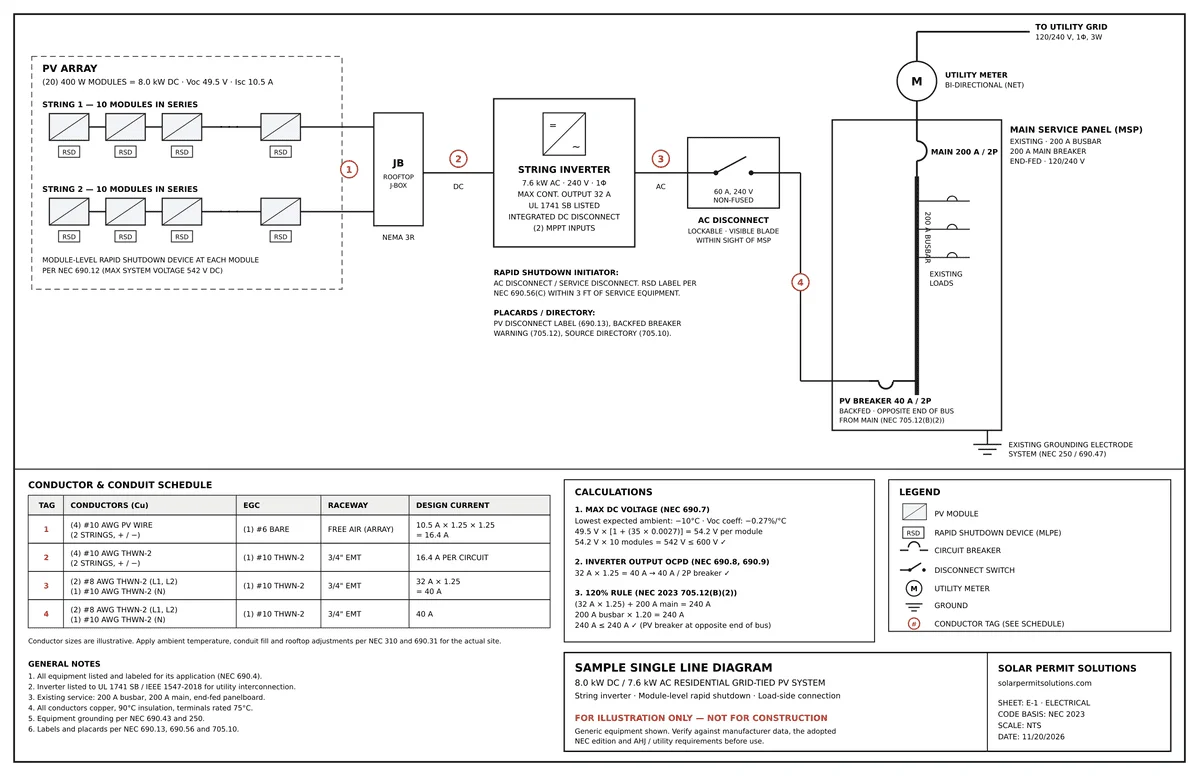
Solar Single Line Diagram (SLD): What It Must Show to Pass Permit Review
Learn what a solar single line diagram is, why it’s required for permits, ...
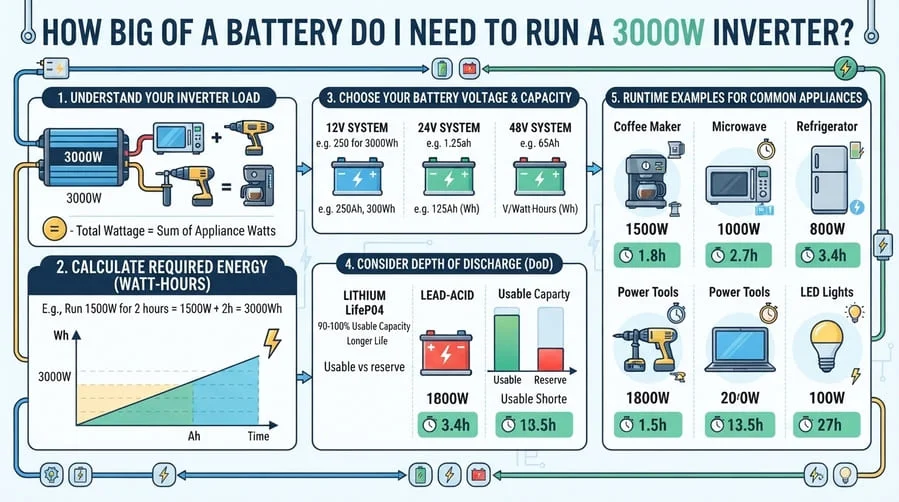
How Big of a Battery Do I Need to Run a 3000W Inverter?
A 3000W inverter needs about 3.3 kWh of usable battery for every hour it runs at...