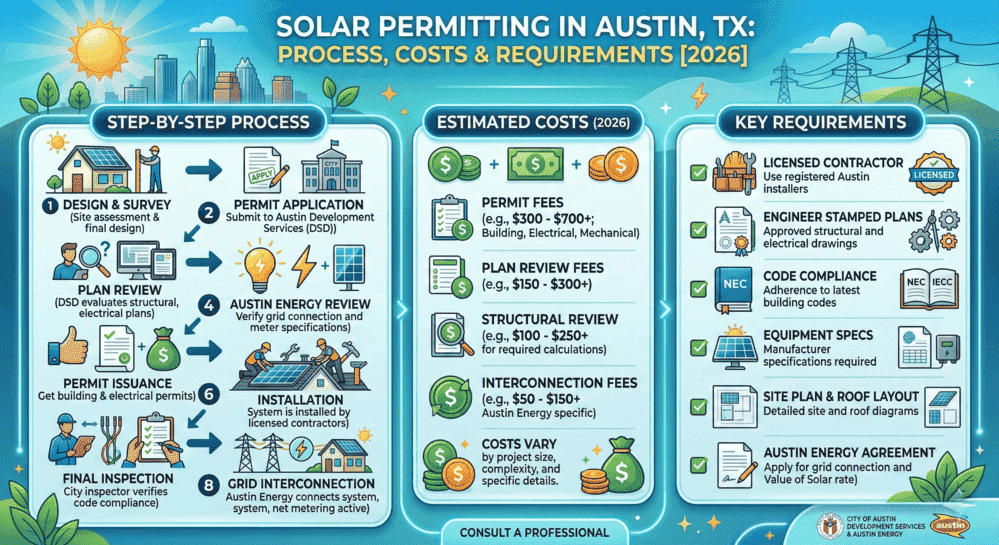
Solar permits in Austin center on an Auxiliary Power Electrical Permit for any solar or battery system connected to the Austin Energy grid. Commercial projects inside city limits, solar shingles, and ground mounts inside city limits add a plan review and a building permit. Solar Permit Solutions prepares coordinated, permit-ready plan sets for homeowners, contractors, and developers across the Austin Energy service area.
Whether you are installing rooftop solar, adding battery storage, designing a commercial PV system, or answering permit corrections, we prepare the project documentation for the permitting authority and utility requirements that apply. For wider Texas context, see our guide to solar permits across Texas.
Austin Solar Permit Quick Reference
The right permit path depends on the property’s jurisdiction, the project type, and the equipment. This table summarizes the pathways in Austin Energy’s May 2026 Solar Permitting Manual.
| Project Type | Permit Path | Additional Review |
|---|---|---|
| Residential rooftop solar | Residential Auxiliary Power Electrical Permit through Austin Build + Connect | Interconnection Agreement approved before permit activation |
| Residential solar + battery | Residential Auxiliary Power Electrical Permit: solar and batteries can be included together. | Austin Energy Distributed Generation Plan Review for ESS |
| Residential ground-mounted or solar shingles inside city limits | Residential Plan Review with a Building Permit and Engineer-Stamped Plans | Auxiliary Power permits fall under the Building Permit |
| Residential ground-mounted or solar shingles, ETJ, or outside city limits | Residential Auxiliary Power Electrical Permit; no City of Austin building permit | Other electrical permits if the scope includes service work |
| Commercial solar or ESS inside city limits | Commercial Plan Review with a Building Permit | Austin Energy Distributed Generation Plan Review |
| Commercial solar, ETJ, or outside city limits | Standalone Commercial Auxiliary Power Electrical Permit | Structural components such as ground mounts can change the path. |
| Any project 25 kW-ac or larger, Downtown Network, or spinning generator | Same permit as above | Distributed Generation Planning Application or Transformer Capacity Review |
Not sure which row fits your property? Send us the address and scope using the quote link at the end of this page, and we will confirm the pathway before design starts.
Our Austin Solar Permit Services
We provide solar permit plan design, electrical documentation, structural documentation, engineering support, battery and ESS plans, and permit correction assistance. Our services include:
- Residential and commercial solar permit plans
- Solar site plans and array layouts
- Electrical single-line diagrams and equipment schedules
- Structural documentation and load calculations
- PE and SE engineering support when required
- Battery and ESS permit plans
- Permit correction revisions and AHJ permitting support
Austin Solar Permit Plans for Homeowners and Contractors
A solar installation in Austin involves more than designing the panel layout. The permit package may need to coordinate the solar array, electrical system, service equipment, structural information, battery storage, equipment specifications, and utility requirements. Our goal is one coordinated plan set that matches the proposed installation and is ready for submission.
Residential Solar Permit Plans
Our residential solar design service covers rooftop and ground-mounted homes. Residential plans may include:
- Roof layout, array layout, and site plan
- Electrical single-line diagram and equipment schedule
- Module and inverter information
- Rapid shutdown information
- Conductor and overcurrent protection information
- Structural documentation and load calculations when applicable
- Battery and ESS documentation
- Engineering stamps when required
Commercial Solar Permit Design
For larger and more complex properties, our commercial solar design service prepares PV layouts, electrical one-line diagrams, equipment schedules, electrical calculations, structural documentation, battery and ESS documentation, and permit correction responses. Requirements vary with system size, property, equipment, jurisdiction, and scope of work.
Solar + Battery Permit Plans
If your project includes battery storage, the battery system should be built into the electrical and permitting documentation from the start. Depending on the project, plans address battery location, equipment specifications, electrical connections, disconnects, overcurrent protection, clearances, structural considerations, required labels, and applicable calculations.
Solar Permit Solutions
Skip the Permit Headaches
We design plan sets that pass inspection the first time. Code-compliant, PE-stamped, accepted by AHJs nationwide.
Austin Solar Permitting: What You Need to Know
Austin solar permitting involves both local permitting requirements and Austin Energy requirements. Austin Energy’s current Solar Permitting Manual states that solar distributed generation systems, energy storage systems, and interconnected spinning generators require an Auxiliary Power Electrical Permit.
The exact process still depends on where the property is located and what is being built. Austin Energy identifies separate pathways for commercial solar or ESS inside city limits, residential solar shingles, and residential ground-mounted systems. That makes the property’s jurisdiction and utility service territory the first thing to confirm.
For a step-by-step walkthrough of fees, documents, and the rebate process, read our complete Austin solar permit guide.
City of Austin vs. Austin Energy
One of the most important distinctions on an Austin project is the difference between the local permitting authority and the electric utility. Each handles different steps, and a project usually needs both.
City of Austin
Austin Development Services handles the applicable building and electrical permits and plan review. Depending on the project, that can include electrical permits, building permits, residential or commercial plan review, structural review, inspections, and other city requirements. Most permits are applied for through the Austin Build + Connect portal, and the city publishes a full list of permit types with instructions for each.
Austin Energy
Austin Energy handles the utility side of connecting distributed generation to its system. Its solar inspections page states that solar and battery installations in its service area must pass a final solar inspection before they can be turned on.
What about properties outside Austin city limits?
Austin Energy’s service territory extends beyond the City of Austin. A property can receive electricity from Austin Energy while another municipality handles some or all building permit requirements. This matters most in the Extra-Territorial Jurisdiction (ETJ) and surrounding cities. The city’s jurisdiction web map helps confirm where a property sits, and our explainer on what an AHJ is in solar shows how jurisdiction drives requirements.
How the Austin Solar Permit Process Works
The exact sequence depends on the project, but most Austin solar projects follow this general path.
- Collect project information. Gather the property address, utility information, main service equipment, roof or ground-mount details, solar and battery equipment, site and structural information, and project scope.
- Design the plan set. A permit-ready plan set coordinates the site, electrical, structural, and equipment information for the proposed installation.
- Determine the permitting path. Property jurisdiction, Austin Energy territory, residential or commercial use, rooftop or ground mount, solar shingles, battery or ESS, service changes, and project size all affect the path.
- Submit the permit application. Austin Energy’s manual identifies Austin Build + Connect as the portal used for most Auxiliary Power Electrical Permits and notes that city vendor registration is required before submitting.
- Plan review. The applicable authority reviews the submittal. Comments can involve electrical design, structural information, equipment, site information, battery requirements, and code compliance.
- Corrections, if issued. The plan set is revised and resubmitted. See the corrections section below.
- Permit approval. After the required reviews, the permit auto-bills fees and moves to Pending. Once the assigned electrical contractor pays, it becomes active.
- Installation. The contractor installs the system according to the approved plans. A pre-construction meeting is required for commercial projects and optional for residential projects.
- Inspection. The solar company requests the inspection through Austin Build + Connect. All related permits, such as a panel upgrade, must be in final status before the final solar inspection is scheduled.
- Permission to Operate. After the inspection and solar meter review, the permit moves to Final, and the customer has Permission to Operate.
Austin Energy Solar Review Requirements
Not every project follows the same Austin Energy review path. The May 2026 manual ties additional reviews to project characteristics.
A Distributed Generation Planning Application, or Transformer Capacity review, applies when:
- Proposed distributed generation output (solar plus ESS) is 25 kW-ac or greater
- The project will interconnect to the Downtown Network
- The project involves an interconnected spinning generator
Austin Energy’s Distributed Generation Plan Review applies when:
- The project includes an energy storage system, or
- The proposed project is on commercial property
For all residential projects, and for commercial projects at or above 500 kW-ac, an Interconnection Agreement is required and must be approved by Austin Energy staff before the permit can be activated. If a contractor fails the Distributed Generation Plan Review more than two times, the manual states a re-review fee applies to the third review, so getting the first submittal right saves money as well as time. Our overview of utility interconnection requirements explains what utilities typically enforce, and the technical baseline for inverter-based interconnection is IEEE 1547.
Austin Solar Permit Requirements
A typical permit-ready package includes several coordinated documents. Austin Energy’s manual lists the Distributed Generation Planning Application, a wire diagram or design packet, and the Interconnection Agreement as mandatory uploads where they apply. The equipment ratings in the permit form should match the application, the wire diagram, and the equipment spec sheets.
Site Plan
Depending on the project, the site plan shows the property, existing structures, solar array, inverter, battery, main service equipment, electrical equipment locations, and applicable access and clearance information.
Solar Array Layout
The array plan identifies module quantity and locations, roof planes, array dimensions, ground-mount locations, equipment locations, and applicable setbacks and clearances.
Electrical Single-Line Diagram
The diagram shows how the PV modules, inverters or microinverters, combiner equipment, disconnects, overcurrent protection, service equipment, battery systems, conductors, grounding and bonding, and rapid shutdown equipment relate to each other. Electrical design follows the edition of the National Electrical Code that the permitting authority enforces.
Equipment Schedule
The schedule lists the modules, inverters, batteries, racking, disconnects, rapid shutdown equipment, and service equipment proposed for the installation. Module-level devices such as power optimizers belong on the schedule and the diagram, and unusual loads such as a solar-direct hybrid AC/DC mini split need their own electrical documentation. Keeping the schedule consistent with what is actually installed helps avoid unnecessary corrections.
Structural Documentation
Roof-mounted systems may require documentation of the existing structure and the proposed attachments, including roof framing information, attachment and fastener details, racking information, structural calculations, and engineer stamps when required. Stamp thresholds vary, so see our guide to PE stamp requirements by state for background.
Austin Solar Permit Services for Ground-Mounted Systems
Ground-mounted systems follow different rules from standard rooftop installations. Inside Austin city limits, the manual states that residential ground-mounted systems require City of Austin Residential Plan Review with a Building Permit, engineer-stamped plan sets, and a City inspection, with the Auxiliary Power permit falling under the Building Permit.
Within the ETJ or outside city limits, the same systems require a Residential Auxiliary Power Electrical Permit and no City of Austin building permit. Additional electrical permits may still apply if the scope includes service work beyond the distributed generation system.
Ground mounts may also need foundation information, racking details, structural calculations, a site plan, equipment layout, setbacks, and engineer-stamped documentation. Confirm the property’s jurisdiction before finalizing the permitting strategy.
Austin Solar + Battery Permitting
Adding energy storage introduces additional review. Austin Energy states that its Distributed Generation Plan Review applies to projects that include an Energy Storage System. A battery project may need more information on equipment, location, electrical connections, disconnects, overcurrent protection, ratings, clearances, structural support, labeling, and calculations.
Battery fire and installation safety is also governed by standards such as NFPA 855, which the plan set may need to address depending on the installation. SPS incorporates the battery into the overall plan set so solar and storage are documented together. If you are adding a battery to an existing system, read our solar battery permit guide first, because a PV-only permit rarely covers the new circuits and disconnects.
Austin Solar Permit Corrections
Receiving corrections does not mean the project cannot move forward. The design team reviews each comment, decides which plan or calculation needs to change, and submits revised documentation. SPS can assist with revisions involving electrical diagrams, site plans, equipment schedules, structural documentation, calculations, notes, equipment changes, and battery documentation.
The goal is a clear response to each comment while keeping the revised plan set consistent with the proposed installation. For a general workflow, see our guide on how to respond to solar permit corrections.
Preparing for the Austin Energy Inspection
Austin Energy states that solar companies request inspections through Austin Build + Connect and that a final inspection must be passed before the system is turned on. Requests are only available for permits in Active status. The manual notes that the portal may display a same-day date after you request an inspection, but the inspection is not scheduled until Austin Energy confirms it by email, usually within 3 business days.
Installed equipment, labels, and conduit should match the approved plans exactly. Our article on why solar inspections fail covers the most common field mistakes, from labeling to grounding to roof penetrations, and is worth reviewing before you schedule.
How Much Does Solar Permitting Cost in Austin?
Solar permitting costs vary by project. The total can depend on project type, system size, residential or commercial classification, battery or ESS, structural review, plan review, inspections, additional permits, utility requirements, and project-specific reviews. Austin publishes separate fees for solar permitting, solar inspections, ESS inspections, and other reviews. Because City and utility fees change, check the current official fee schedule before submitting.
Permit fees are separate from the cost of solar design, engineering, installation, and permitting services. For installed system pricing, see our 5kW solar system cost breakdown. That article was written in 2025, so read its after-credit figures with care: the federal Section 25D residential credit expired for expenditures after December 31, 2025. For SPS pricing, request a project-specific quote.
How Long Does Austin Solar Permitting Take?
No single timeline applies to every Austin project. The overall schedule is affected by the completeness of the first application, project complexity, plan review workload, corrections, structural and engineering requirements, Austin Energy reviews, inspection scheduling, equipment changes, service modifications, and battery requirements.
A coordinated plan set submitted once, with matching equipment data across every document, reduces avoidable delays. National research from NREL shows how widely permitting and interconnection timelines vary: its permitting, inspection, and interconnection timelines research notes that review processes across thousands of jurisdictions and utilities can add weeks or months to an installation. Programs that simplify permitting, such as those described in the SolSmart national permitting guide, exist to shorten that wait.
Why Work With Solar Permit Solutions?
Solar permitting requires coordination between the solar design, electrical system, structural information, equipment documentation, permitting authority, and utility. Solar Permit Solutions focuses on preparing solar permit documentation and supporting the permitting process.
- Residential solar plans: permit-ready documentation for rooftop solar projects.
- Commercial solar design: permit plans for larger and more complex projects.
- Electrical documentation: single-line diagrams, equipment schedules, calculations, and related documents.
- Structural documentation: structural review and engineering support when required.
- Battery and ESS plans: documentation for solar-plus-storage projects.
- Permit corrections: plan revisions in response to AHJ comments.
- Engineering support: PE and SE support when the project requires it.
Solar Permit Services for Austin Homeowners
If you are a homeowner preparing to install solar in Austin, SPS can prepare the technical documents the permitting process requires. We can work from property information, roof photos, electrical panel photos, equipment selections, the solar layout, battery information, structural information, and installation details.
Our plans are prepared from the information provided for the proposed installation. If equipment or installation details change after the plans are complete, the plans may need to be revised.
Solar Permit Services for Austin Solar Contractors
If you are a contractor working in the Austin Energy service area, SPS can act as your solar design and permitting support partner, so your team spends less time on permit documentation and more time on installations and customers. We support residential plan sets, commercial plans, electrical one-lines, site plans, structural documentation, PE and SE engineering support, battery plans, permit corrections, and multiple-project volume.
Working on projects elsewhere in Texas? We also provide solar design and permitting in Houston.
Get Austin Solar Permit Plans
Planning a solar project in Austin, Texas? Send us your project information and we will review the scope and tell you what documentation is needed. Request an Austin solar permit quote to get started.
Project requirements can vary by jurisdiction, system size, equipment, and scope of work. Permitting requirements, fees, and utility procedures can also change, so always verify current requirements with the applicable authority before submitting a project.
Frequently Asked Questions About Austin Solar Permits
Skip the Permit Headaches
We design plan sets that pass inspection the first time. Code-compliant, PE-stamped, accepted by AHJs nationwide.
Frequently Asked Questions
Yes. Austin Energy's current Solar Permitting Manual states that all solar distributed generation systems, energy storage systems, and interconnected spinning generators in Austin Energy territory require an Auxiliary Power Electrical Permit. Some project types add Plan Review and a Building Permit.
Most projects need an Auxiliary Power Electrical Permit, applied for through Austin Build + Connect. Commercial solar or battery projects inside Austin city limits require Commercial Plan Review with a Building Permit. Residential ground-mounted systems and solar shingles inside city limits require Residential Plan Review with a Building Permit and engineer-stamped plans.
The Distributed Generation Planning Application (DGPA) describes the proposed solar and storage equipment and ratings. Austin Energy's manual lists it as a required upload for every Auxiliary Power Electrical Permit, along with a wire diagram or design packet.
Yes. Austin Energy states that every solar energy system in its service area must pass a final solar inspection before it can be turned on. The solar company requests the inspection through Austin Build + Connect.
For all residential distributed generation projects, and for commercial projects at or above 500 kW-ac, the manual states an Interconnection Agreement is required and must be reviewed and approved by Austin Energy staff before permit activation.
It can. Austin Energy's Distributed Generation Plan Review applies when a proposed project includes an Energy Storage System. Solar and batteries can be included together in one residential Auxiliary Power Electrical Permit.
Yes. Inside Austin city limits, residential ground-mounted systems and solar shingles require Residential Plan Review with a Building Permit and engineer-stamped plan sets. Within the ETJ or outside city limits, they require a Residential Auxiliary Power Electrical Permit and no City of Austin building permit, although other electrical permits may apply if the scope includes service work.
No. Austin Energy serves customers outside the city limits, but the permitting authority can differ by jurisdiction. Check the property's jurisdiction before starting, especially in the Extra-Territorial Jurisdiction (ETJ) and surrounding municipalities.
After you request an inspection in Austin Build + Connect, the manual says the contractor usually receives a scheduling email with the date and time within 3 business days. The portal may show the same day, but the inspection is not yet scheduled at that point.
Yes. SPS prepares permit-ready solar plan sets and related engineering and permitting documentation for residential and commercial projects, including battery and ESS projects.
Yes. Depending on the service purchased, SPS can revise applicable plan documents in response to permitting comments and resubmission requirements.
Yes. SPS can incorporate battery and energy storage equipment into the solar permit plan set so the PV and storage documentation stay consistent.

SPS Editorial Team
Solar Permit Solutions
Solar Permit Solutions provides professional solar permit design services for residential, commercial, and off-grid installations across all 50 states. Our team ensures permit-ready plan sets delivered fast.
Related Articles
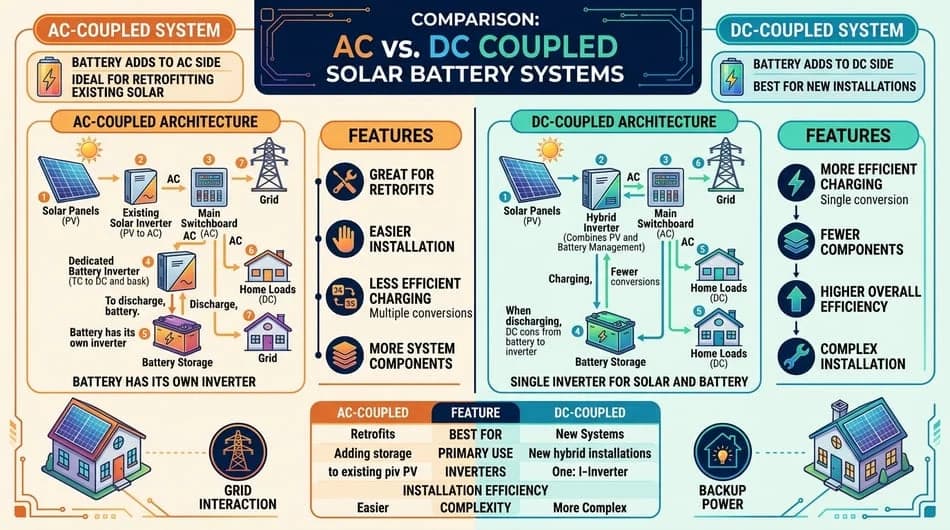
AC vs DC Coupled Solar Batteries: Which Should You Choose?
AC vs DC coupled solar batteries compared: efficiency, costs ($8K-$18K), and ins...
How Many Solar Panels Do I Need to Run Off the Grid?
Most off-grid homes need about 8 to 16 solar panels rated at 400 watts, dependin...
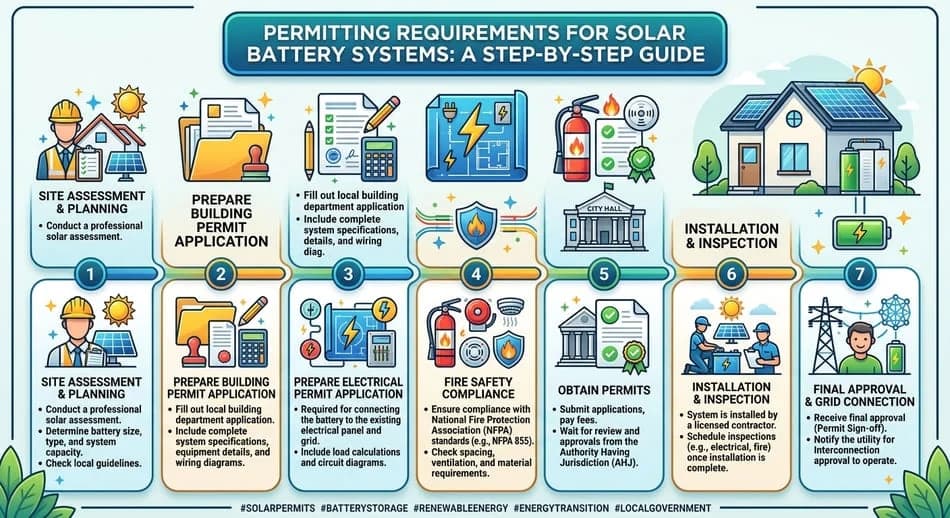
Solar Battery Permit Requirements: What You Need to Know
A solar battery usually needs local approval and a utility review before it can ...